Month: March 2015
25. BOARDS OF CANADA – IN A BEAUTIFUL PLACE OUT IN THE COUNTRY [EP] (2000)
Somewhere, about a 30 minute or so drive south of Glasgow’s city centre, there is a sizeable windfarm. In some ways it is a desolate place – built on the exposed landscape of the Fenwick moors, but on a clear day, if one can brave the wind, it is a beautiful place. It is one of the locations I visualise when I listen to Boards of Canada’s spellbinding EP ‘In A Beautiful Place Out In The Country’, released in 2000.
We all know the story – the Sandison brothers, Michael Sandison and Marcus Eoin, emigrated with their family from their native Scotland to Canada for a very short period (1979-1980) when the boys were around 8 or 9 years old. BoC was formed in 1986, named after the National Film Board of Canada, producers of several television documentary films the boys had watched while living in North America. Since then, the band has had several line-ups, the only permanent and remaining members being the two brothers. They are one of the most critically acclaimed artists of the new millennium: their shy and reclusive character and dogged determination to allow their music to speak for itself without any self-promotion, has won them legions of admirers.
The music is characterised by a profound sense of displacement and dislocation. One might imagine this compulsion to document their childhood experiences would make for an indulgent trawl through their collective memories, but instead it fashions an experience which, with an almost Machiavellian plunder of the subconscious, subjugates the listener, who is beholden to probe into his own sense of nostalgia as the music plays. The idea that their music could actually brainwash people is an attractive one to Marcus and Eoin. “I do actually believe that there are powers in music that are almost supernatural. I think you actually manipulate people with music, and that is definitely what we are trying to do.” (Boards of Canada, 2001)
Listening today, there I am, 1975, sat in the lotus position amongst my friends in the school’s social area, observing as the janitor/technician wheels out this huge mass of electronic boxes and mess of cables (which look like discarded props from Tarkovsky’s ‘Solaris’) before, through the miracle of video recording technology, we settle down to watch an educational feature of highly dubious quality. For me, this image is a recurrent one when I listen to Boards of Canada. The analogy is somewhat apt. In the Soviet science-fiction film, the protagonist – Kris Kelvin – is sent to investigate the strange goings on aboard a space station orbiting the (fictional) planet Solaris. What he finds is that the planet’s ocean possesses the capacity to send ‘visitors’, apparitions or ‘islands of memory’ from the past, compelling the recipient to examine his own conscience, ultimately leading to psychological devastation. Let’s call it The Boards of Canada Effect’.
So what is the process they use? Well, on the surface the music of Boards of Canada is a kind of intense and brooding electronic introspection. With its utilisation of analogue synths and blending of distorted samples and sounds siphoned from vintage tape machines, it seems at times almost joyless: there is little that sounds rapturous or euphoric. But what lends it weight, is the tremendous patience and restraint in the composition – there is no premature reaching for ecstatic highs. Rather, there is an almost nerveless concentration on the development of each sound, where the most minor change of key or chord is liable to disorientate the senses. The listener is thus rewarded with a far more enduring experience, one which stands up to and bears repeated listens.
From the diaprojektor driven beats of the opener ‘Kid For Today’ to the indescribably beautiful closer ‘Zoetrope’ this is a faultless collection. On the latter, a patient minimalist keyboard begins its teetering search for a hook, which (thankfully) never arrives, the track almost dissolving within its own beauty before fading out. It sounds like the breathless farewell speech of an antique musical instrument which gave joy to many, but whose life is now gracefully ebbing away.
In between we have two tracks which remind us that while the boys rural sensibilities are a vital ingredient in the mix, so also is their discomforting capacity for blending their ‘electro-agrarianism’ (as Pitchfork labelled it) with sounds and themes suggesting something more foreboding. ‘Amo Bishop Roden’, the widow of David Koresh, of Branch Davidian / Waco infamy, lends her name to the title of one of the four tracks; this one features a repetitive almost static drone punctuated by beats which change tempo at regular intervals, while a plaintive keyboard surreptitiously fades in and out of the mix.
The title track features a recurrent BoC motif – the laughter of children, particularly disconcerting in the context of the song’s theme, but its unobtrusive beat is enlivened and beatified by one of the most hypnotic and unsettling keyboard parts you could wish to hear. The seductive but sinister atmosphere is accentuated by a vocoder-processed voice, slowed down, which repeats with chilling effect: ‘Come out and live in a religious community in a beautiful place out in the country’. I believe the voice belongs to Amo Bishop Roden. While eerily disturbing, it is a truly stunning piece of music.
‘In A Beautiful Place Out In The Country’ deserves to take its place in the all-time pantheon of greatest ever EPs, alongside ‘Chronic Town’ ‘Slates’ and ‘Datapanik in The Year Zero’. These may be musically tenuous reference points, but some even unlikelier comparisons could be made. In their approach to recording – where every note is sweated over until distilled to perfection, and each sound subjected to the utmost scrutiny before its inclusion on a record – BoC employ a similar aesthetic to their fellow compatriots The Blue Nile (at least in Buchanan’s early days). Finally, I was watching the Dexys documentary ‘Nowhere is Home’ on BBC4 last week, and was intrigued by Kevin Rowland declaring he had no interest in forming friendships with fans, but that he was determined to treat them with ‘total respect’ through a commitment to high quality recordings and the delivery of impassioned concert performances. That very admirable ethos mirrors that of BoC, which is based on the following principle:
“We always assume that the listener is the most intelligent person imaginable” (Boards of Canada, 2001)
This is a vision shared by the late great Soviet director, whose austere but visually stunning film-making invited its audience to co-create its own film from each individual’s subjective viewing experience. It may often not be true that the viewer – or listener – is the most intelligent person imaginable, but he can be sure of one thing: the quality of the music of Boards of Canada is guaranteed by such integrity and this unquestionably purist approach to making records. (JJ)
24. PEARLS BEFORE SWINE – BALAKLAVA (1968)
“In peace sons bury their fathers,
In war fathers bury their sons,
Love is silent at the edge of the universe,
Waiting to come in'” (‘Translucent Carriages’)
Balaklava was the second album by Pearls Before Swine, and their second to be released on New York’s legendary ESP, the label responsible for The Heliocentric Worlds of Sun Ra and other uncompromising free jazz recordings of the mid-1960s, as well as oddball counter-cultural rock albums by the likes of The Fugs and The Godz, to whose music I was introduced through a resounding commendation in the original Perfect Collection.
The very first time I heard the music of Pearls Before Swine I knew it was what I had been waiting for my whole life. I had a complete set of albums by The Velvet Underground, Love, The Byrds, Buffalo Springfield, Tim Buckley et al. But something was missing. I never knew what that something was until I encountered Balaklava.
Pearls Before Swine were different. Once fittingly described as “a madman saint leading the asylum band during the rainy season”, Tom Rapp, the band’s leader, songwriter and only permanent member, enjoyed little popular success despite a catalogue of wonderful psych-folk albums in the late 1960s and early 1970s. Perhaps his quivering voice and heavily pronounced lisp – charmingly honest to some – provided an obstacle to commercial credibility. Or his lyrics, so rich in strange Biblical and Blakean imagery, may have alienated others. Whatever the case, success eluded the band during their career. Recognition came late – too late for pop stardom – but a quietly flourishing audience of fans including a number of musicians, resulted in a tribute album, and concert invitations began to flood in during the late 1990s, by which time Rapp was working as a Civil Rights lawyer in Florida.
Their debut offering, One Nation Underground, was initially recorded as a demo and sent to ESP, who promptly signed the band and rush released the album. On first hearing, it’s Dylanesque protest folk – along with song titles like ‘Drop Out’ and tunes as immediate as ‘Uncle John’ – may seem to have captured the zeitgeist well, but the album sleeve featuring the macabre painting The Garden Of Earthly Delights by Hieronymus Bosch, hinted at something more portentous. At this stage the band had not yet ‘turned on’ – indeed Rapp identifies the strongest intoxicant favoured by the fledgling Swine to have been Winston cigarettes! Although it was the only Swine album to sell fairly well (around 200,000) the band claim to have received very little royalties and this may have accentuated a darker worldview which while not quite dystopian, stood in stark contrast to the vacuous euphoria of the ‘flower power’ generation.
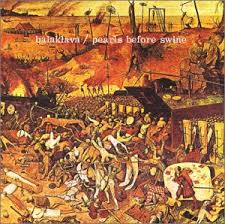
Balaklava which appeared a year later, received Rolling Stone magazine’s dreaded [], it’s lowest possible rating. But in the 1960s Rolling Stone frequently got it badly wrong. Once again the album featured some apocalyptic artwork, this time Pieter Bruegel’s The Triumph of Death, and presented a uniquely harrowing vision of the horrors of war, delineated by Rapp’s (Winston inspired!) hallucinatory and surrealistic poetry.
The album is bookended by two historical recordings: the first, by Trumpeter Landfrey, who sounded the bugle at the beginning of the ‘Charge of the Light Brigade’ at the Battle of Balaklava during the Crimean War; after the second, a barely audible recording of the voice of Florence Nightingale, we hear a tape loop of the whole album rewind to the beginning, surely a commentary on the perennially rapacious nature of the human species, forever embroiled in military conflict, captured at the precise moment when the ugly truth about America’s involvement Vietnam was gradually emerging.
‘Transluscent Carriages’ the most explicitly anti-war song, is shrouded in mystery, Rapp’s ghostly utterances over a plaintive acoustic guitar line, tastefully embellished by atmospheric clavinette. The lyrics to the opening verse are indicative of the album’s sombre mood:
“The translucent carriages
Drawing morning in
Dawn inside their pockets
Like a whisper on the wind.”
‘Images of April’ has a simple swooning bass line but replete with birdsong, flutes, echoed voice, and introducing the intriguing ‘swinehorn’ of Lane Lederer, is the archetype for the album’s peculiar sound.
Even better is ‘I Saw The World’. Warren Smith’s string arrangements provide a panoramic sweep somehow reminiscent of the theme tune to the classic 1960s French children’s TV series The Adventures of Robinson Crusoe (or is that just the augmentation of the sound of sea spray?), while the ghostly atmosphere evoked by the distinctive percussive arrangements sound like they come from the depths of The Black Ark. A strange marriage indeed, but listen and you may hear what I hear…
‘Lepers and Roses’, Rapp’s take on the Orpheus myth, is equally gorgeous . The lyrics may be inscrutable:
“In fields where Susan sings/The leopard brings/Yesterday/In upon a string/And all your dead rainbows/Begin to stain/The lace on your raincoat/So leave the blind/Roses behind/You’
..but the music is drunk on its own beauty. A dreamer’s dream…the songs on the album are less conventional narrative or story and more mood pieces. Rapp once clarified his approach to songwriting in an interview with Goldmine:
“My sense of writing a song was that you started with a mood or a feeling and you just chipped away everything that wasn’t that feeling and in the end you’d have something that had crystallized it somehow’
Despite this concentration on mood and atmosphere, the album has its flaws. Although there is a delicately judged cover of Leonard Cohen’s ‘Suzanne’, there is at least one mis-step along the way, the plodding sub-Donovan (sub-sub-Dylan) folk of ‘There Was A Man’. But, the old gramophone production of ‘Guardian Angels, is exquisite. Here Rapp once again resurrects the voice of the ancient prophets:
‘All of the pain in the world is outside your bed/In the shapes of phantom men tapping your window with rhythms of dread/And all of the silver rosaries hung on the door/Will not drive them away they are going to stay.’
Rapp and a new set of Pearls went onto release four albums for Reprise, two of which at least (These Things Too and The Use of Ashes) are the equal of Balaklava. His influence is slight and could be detected in the likes of Bill Fay (another much under-appreciated songwriter) but it has been left to long-time devotees such as Damon & Naomi (of Galaxie 500 fame) and Flying Saucer Attack to rekindle a flame which never so much burnt out as was ever adequately ignited in the first place. But, still that flame flickers for the chosen few – those seduced by the sounds and visions of an authentic lost prophet.(JJ)
22. THE FALL – DRAGNET (1979) / (A) THE FALL – SLATES (1981)
DRAGNET
It might seem odd to talk about a departure in the Fall’s sound but if there ever was such a moment, it came with Dragnet. Yvonne Pawlett had gone through the exit, on possibly the last occasion before the hinges needed fixed, dragging behind her the endearingly spooky organ that had been as central to their early sound as Tony Book had been to Manchester City a decade earlier.
Enter Craig Scanlon and Paul Hanley, neither of whom could ever be described as lieutenants to Mark E Smith- could anyone?- but who, as dramatically outlined in Hanley’s memoir The Big Midweek, stayed for the best part of two decades as the fist-close witnesses, and unceasingly compelling soundtrackers of, Smith’s, well, ownership of a band that previously borne a vague resemblance to a democracy.
It still (a word that always recurs in Fall reviews) stands as one of their most gripping statements, though I’m quite aware Smith is unlikely to take kindly to such a view about a record made as long ago as 1979. A Figure Walks is as terrifying as you’d expect a song about stalking to be and, along with Muzorewi’s Daughter, shows that tom-tom thunder is possibly the most thrilling sound yet discovered by scientists. They had never yet been so downright tuneful as they are on Your Heart Out and Flat Of Angles, despite reliably unsettling lyrics (“Then they take your heart out/ With a sharp knife, it wasn’t fake”) nor as plain brutal as on Spectre Vs Rector, which served notice that this band were probably not in music to make money and certainly weren’t in it to make friends. Before The Moon Falls sounds like the title of a lovely Al Bowlly-crooned ballad from somewhere around 1932. It isn’t. It’s classic Fall.
And what’s classic Fall? It would be more than slightly churlish to say that if you have to ask, you’ll never understand, so one listen to this song – and this album – should give you pretty shrewd idea. (PG)
SLATES
If I were allowed but one Fall record in my collection I would probably choose Slates. This primordial slab of Salford sludge finds MES at his most cryptically acerbic and blisteringly bewildering and the band making a glorious amphetamine-fuelled racket.
Slates was released in an unusual 10″ format, two years into Thatcher’s premiership at the height of the Brixton Riots of April 1981. It clocks in at a little over 22 minutes. In fact, it’s safer to say that it’s an EP rather than an LP, but with 6 tracks it’s just unclear enough to ignite a discussion on the matter.
The first half kicks off with Middle Mass. Musically, a Velvets-y organ drone breaking into a jaunty Beefheartian guitar break, it is ostensibly a yarn about the drinking habits of football fans during the close season; while others have divined a tirade about Marc Riley (‘The boy is like a tape loop’). More likely the kicking is aimed at Mark’s favourite target the middle classes themselves. Just quite what Mark is getting at with his repeated declaration that ‘The Wermacht never got in here’ is anyone’s guess.
‘An Older Lover etc’ is probably about… well, his older lover (11 years older) at the time, Kay Carroll. Here his cerebral ponderings are rawly laid bare. It’s accompanied by one of those spookily amateurish guitar rumbles, like the Magic Band tuning up, and is punctuated by Mark’s indignant yelps…’Dr. Annabel Lies’ – she being the mythical agony aunt for Mark’s self therapy session
I must have listened to Prole Art Threat around 100 times but I’m none the wiser – one can surmise it has something to do with the surveillance or suppression of working class culture in Thatcher’s new Britain. Or is it? For a more extensive and insightful analysis I refer you to Taylor Parkes’ superb piece in the Quietus (http://thequietus.com/articles/03925-the-fall-and-mark-e-smith-as-a-narrative-lyric-writer) Musically, a magnificent Fall moment – driven by one of those ferocious cyclical riffs, rising, falling, FALL-ing – like only The Fall can – Hanley and Scanlon brutalising their collective ten strings, the groove intermittently suspended by the guitar squealing in protest at its ill treatment. The band were rarely if ever, tighter than on this track – every note sounds both harsh and wild and yet is delivered with military precision.
Mark sounds buoyant on Fit & Working Again, back observing the world around him after an unexplained layoff? For me it’s the slightest musical and lyrical achievement here, Mark chopping away on a solitary piano key over a skiffle-like rockabilly rhythm. But that only makes the final twosome sound even more spectacular.
A million words have been spent attempting to decode and deconstruct The Fall’s ‘definitive rant’ – who or what exactly are the Slags, Slates etc’ of the title? Accountants in suits, the pub bore, plagiarists, ‘dead publisher’s sons, material hardship pawns, The Beat, Wah! Heat – male slags…?’ I’ve even read some analysts identify the slates as vinyl records, particularly 7 inch reggae singles? To be honest one can only ‘have a bleedin’ guess.’ I am sure MES must get a kick out of reading ‘academic male slags’ trying to piece together his cryptic declamations. And their vain attempts no doubt conveniently provide him with useful material for his next rant. So forget the mystery of the subject matter and celebrate instead the vigorous kick in the gonads provided by the huge two chord guitar riff that – combined with Steve Hanley’s bowel bursting bass intro, never seems to relent. It makes for one of the greatest ever Fall tracks, enhanced further by Mark’s immortal interjection to the boys: ‘don’t start improvising for God’s sake’ – demonstrating both a natural flair for tyranny and a sensitive ear for musical purity. Bloody marvellous!
‘Leave The Capitol’ provides a fitting climax. It’s wiry and punchy and bouncily infectious in equal measure, as Mark’s invective spills over in this Arthur Machen inspired tirade at old ‘Lahndan Tahn, (‘this f-ing dump’) where he exhorts himself to ‘Exit this Roman Shell!!’ Holed up in his hotel room where the ‘maids smile in unison’ and where ‘the beds are too clean’ and the water ‘poisonous’ – you can just see him there can’t you? Pining desperately to return north to his fags’n’beer an’ a bit of proper culture…God Bless him!
Selecting one album from The Fall’s extensive repertoire is not a simple task. And the one I’ve picked is not even an album. But with prodigious economy, Slates – more than any other – is a one stop distillation of the Fall sound. Reasonable people may argue with this choice, but perhaps it would be most fitting to let the children of the Wermacht offer the final word on the matter. See below: (JJ)
21. ECHO & AND THE BUNNYMEN – HEAVEN UP HERE (1981)
20. MATT JOHNSON – BURNING BLUE SOUL (1981)
So much for British psychedelia: Syd’s Pink Floyd the only enduring body of work from a time when the top of the UK charts was ring-fenced by Englebert Humperdinck, the whole hippy dream lampooned mercilessly by the Small Faces and the best we could do aside from letting the mad genius play, was – apparently – Status Quo. Ok, there was The Beatles – who did it well, sometimes very well – and, ahem…’Their Satanic Majesties’. The odd hidden gem such as The Eyes’ ‘You’re Too Much’ or ‘I Must Be Mad’ by The Craig if you looked a little harder, but as for great albums…nothing much doing. Some might point to The Yardbirds or The Creation and of course there was the plain weirdness and wizardry of The Incredible String Band but arguably nothing besides that to take you to the aural outer limits.
The prevailing perception is that psychedelic music was an historical (largely US) phenomenon which materialised around 1965, peaked two years later on the West Coast, and gradually burnt out thereafter as the decade drew to its unhappy close. The long-playing record was its principal currency. But this perspective is a narrow one. When I first heard those Grateful Dead albums, the promise of their garish dayglo sleeves (so intriguing to a teenager with a 1960s fixation) was quickly nullified by the content within. So this is psychedelic? It seemed to me that the copious use of hallucinogenics led only to overinflated egos and particularly unadventurous sets of extended blues jams. This was clearly not the mind-expanding experience I had so enthusiastically sought. And I, in my youthful innocence, was looking for something which might distort my perception of reality just enough to take me to another world for 45 minutes or so…I persisted with my search and soon found an unlikely source.
The The’s debut album ‘Burning Blue Soul’ was released in 1981. For contractual reasons it was credited to its creator, Matt Johnson. He was 19 years old. Even now, few would classify it as a ‘psychedelic’ album. But let me go one step further. I contend that not only is BBS a great ‘psychedelic’ album but it is possibly the greatest ever British psychedelic long player. It is however a particular species of psychedelia, peculiar to a post-punk UK landscape, one brought about by a failing industrial economy, and an emerging nihilistic moral vacuum.
So what makes this record psychedelic? Perhaps let’s begin with a definition:
Psychedelic (adj): of or noting a mental state characterized by a profound sense of intensified sensory perception, sometimes accompanied by severe perceptual distortion and hallucinations and by extreme feelings of either euphoria or despair. (www.dictionary.com)
Nothing here about ’free love’ and getting it together (maan!) Matt Johnson was not the cheeriest of chaps in 1981. While he often claims that this, his debut album is full of wry humour, it frequently reads like a teenage suicide note.
‘I have no future for I’ve had no past
I’m just sittin’ here pullin’ arrows out of my heart.’
‘…See me dwindle, watch me dwell
In my cut out corner, in my plastic world.’ (‘Icing Up’)
‘Saturday night and I was lying in my bed
The window was open and raindrops were bouncing off my head
When it hit me like a thunderbolt
I don’t know nothing and I’m scared
That I never will.’ (‘Another Boy Drowning’)
100,000 people today were burned
I ‘felt a pang of concern
What are we waitin’ for
A message of hope from the pope?
I think he got shot as well.’ (‘Song Without An Ending’)
Johnson’s dogmatic pessimism – such a contrast to the ridiculously utopian optimism of the 1960s – seemed so beguiling to me when I first discovered this album as a 19-year old in the late 1980s. I was helplessly drawn to this strange otherworldly concoction as I stared gloomily at the bedroom ceiling. Today for some, its self-obsession and sixth form existential angst appear naiive and suggest the author was still a little wet behind the ears. But it is the music that really counts here, and for that we can forgive Johnson his lugubrious self-indulgence. Matt was concerned that people would find his lyrics too direct and worked tirelessly to bury the vocals deep in the mix, and this only serves to intensify the disorientation of the listener.
There are all kinds of things going on here: some have criticised the album’s ‘crude tape-splicing’, rather than appreciate it’s brilliant range of guitar and keyboard treatments. Consider for instance the inauspicious and relatively uneventful opener ‘Red Cinders in The Sand’ where a subterranean tribal drum pattern emerges from a piercing sonar tone before breaking briefly into a middle-eastern raga-type dirge. Then we have what sounds like large metal sheets being thrown unceremoniously onto a truck. A pulverising industrial beat emerges accompanied by shards of feedback and a droning tuba (?). It’s an unnerving sound reminiscent of Throbbing Gristle and pre-empting the kind of territory that would be explored by the likes of Test Dept. in the mid-1980s.Or listen to the feverishly voltaic spittle of guitars over a portentously motoric bass riff on ‘Out Of Control’, which could have served as a fitting soundtrack for the classic lost 1970s BBC TV series ‘The Changes’.
‘Song Without an Ending’ is truly astounding. A bass-driven hurdle over nervy jagged guitar lines with the kind of riff the likes of Hot Chip would sell their souls for. Listen to the swell of the surf-style reverb break in to the relentless groove at 1:14, followed swiftly by a paranoiac backwards guitar accompanied by an expansive keyboard part which, synthesised with the galloping clutter of beats manages somehow to make the song feel simultaneously claustrophobic and panoramic. Quite an achievement.
It’s not hard to detect the sleight of hand of Wire duo Gilbert and Lewis on a few of the album’s more abstract moments. They are at work on one of the oddest of all, ‘The River Flows East In Spring’ where the spiderlike guitar picking of the intro is abruptly assaulted by what sounds like a stampeding fanatical Maoist (?) chant.
And to top it all there is the aforementioned ‘Another Boy Drowning’ where Johnson’s palpable despair sits incongruously with perhaps the most gorgeous melody of his career. It’s written like it was his last day on earth – and perhaps he feared it might have been.
Recently, listening to one of my favourite albums from recent years, the justly celebrated Loud City Song by Julia Holter, I was struck by the profusion of ideas on the record. It’s what set it apart from the competition in 2013. A line from one of her songs seemed to encapsulate this: ‘There’s just no room for all our thoughts’ she purrs on This Is A True Heart. Well, although Loud City Song is a more cohesive and assured record than Burning Blue Soul, by comparison with the sheer volume of ideas on Johnson’s debut, it sounds positively anaemic. There is such a proliferation of mindbending moments on Burning Blue Soul that it’s hard to draw comparisons with other ‘out there’ records. It could be a spiritual cousin of ‘Metal Box’ and rivals the likes of ‘Starsailor’ for sheer inventiveness and ‘Sister Lovers’ as a capsule of psychological meltdown. But while flawed and in some ways a sprawling mess, Johnson dazzles us on BBS with his musical dexterity and with a kaleidoscopic palate, which unleashes a deluge of visionary dreamscapes. If psychedelic has anything to do with loss of ego (the ‘I’), then Burning Blue Soul is a spectacular failure. It’s narcissistic traits leave no room for doubt on that front. But if we go by the definition above – while there may be only sporadically euphoric moments, the songs on his debut album take us on those profound and intense hallucinatory journeys from which our fragile minds will never fully recover…(JJ)
19. THE CONGOS – HEART OF THE CONGOS (1977)
Even by the highly spiritual standards of ’70s reggae, Heart of the Congos is a record drenched in soul. Like most roots reggae, it tells of incalculable pain – the inhuman slavery which dragged ancestors from their homes, the alienation and displacement of the here and now and the brutalising poverty of the ‘sufferahs’, to say nothing of the prejudice faced by those who found themselves in the ‘wrong’ place.Yet it’s also saturated with hope and redemption, drawn from the deepest and most heartfelt convictions. There are those who are only able to rationalise faith (or, if you will, belief system) by caricaturing it but to do so underestimates its complexity and potency – for those who feel it most sincerely, it means everything.And the sincerity heard on Heart of the Congos is as profound as it gets. Each of its 10 songs is woven from three elements: lyrics recasting the Bible in a Rastafarian setting, bringing comfort, intercession and grave warning in equal measure; the dizzying harmonies, with Cedric Myton’s stratospheric tenor anchored by Roy Johnson’s steadfast tenor, and Lee ‘Scratch’ Perry’s magisterial production, which paints the haze of a Jamaican summer where spiritual tranquility is being pursued but threat and privation are never far away. Aptly, this particular trinity forms an indivisible whole.Fisherman, the opener and best-known song, depicts the toil of those whom the “hungry-belly pickney…millions of them” rely upon for survival, to a rhythm which, like most of the album, is brisk but not needlessly hurried. Congoman, meanwhile, sounds like it has the entire population of Kingston on percussion – polyrhythmic doesn’t even begin to cover it – as they yearn for a return to Africa, a theme developed on the following Open Up The Gate, which may well have the most entrancing intro reggae has ever produced.The scriptural message is as stern as the melodies are solemn on Can’t Come In (“You’ve got to be clean…the door is locked on you”) and on Sodom and Gomorrow (sic), but they’re not averse to punning – you’ll hear the ‘j’ pronounced with relish in “hallelujah” and the invocation “Jah-Jah- judgement come.” I have to admit that I find a couple of the songs tough to listen to because the emotion is so overwhelming – you’dexpect nothing less from a song called Children Crying, while the fear they feel for the pious and the sanctimonious on The Wrong Thing is palpable.If all this seems too weighty, the downright beauty of the songs triumphs every time, nowhere more so than on the closing Solid Foundation. The harmonies swoop from the highest to the lowest in the space of a few breaths, while the music is the dubbiest and most languid of the whole album – listen to the few seconds at 3:08 where the drums drop out to let Scratch make the sun rise; power has never sounded so gentle.Heart of the Congos has lived through several cycles. It was patchily available in the UK through the now lost art of import but John Peel was offering access to it by 1978. Three years later, the Beat licensed it to be issued on their Go-Feet label, shamelessly billing it a ‘gold spinner’ for what was even then the bargain price of £2.99 – it was at this time that I got to know it, for free, thanks to my ever-bountiful local library. Although Fisherman – the only song I’d heard previously – suspiciously seemed a minute or so shorter than the version Peel had been playing, I fell hard and fast for the whole thing and it became the unlikely soundtrack to spring in a Glasgow suburb.In the late ’90s, it received a similarly sensitive reissue on Mick Hucknall’s Blood and Fire imprint, all of which makes it both baffling and irritating that the Congos’ Spotify profile asserts the album was subjected for years to “crappy reissues.”But this is irrelevant – you could issue Heart of the Congos in chip wrapper festooned with whelks and the strangeness, compassion and outright glory of its music would be undimmed (PG).
18. SONIC YOUTH – SISTER (1987)
When a bands career exceeds 20 years and sixteen plus albums it is difficult to know where to start. To any newcomer to the world of Sonic Youth I would point them in the direction of their fifth album Sister. This is an album often unfairly overlooked in favour of its big brother (Ha!) Daydream Nation or their more heavily promoted major label records released throughout the nineties.
Sister was released in 1987, arriving in the middle of a perfect three album run (between EVOL and Daydream Nation) that rivals Bob Dylan’s similar run of albums in 1965-66 for inspiration to a rock underground. Recorded at Sears Sound in the middle of Times Square, it fits in perfectly to a line of New York rock that stretches from The Velvet Underground through Patti Smith and the Voidoids. But theres more to it than that. As a band they capture something of the American Night better than any band since the Doors. There is also a real classic psych/garage rock feel to a lot this record – imagine the frantic Feathered Fish through a New York/No Wave Filter, or a post punk take on Voices Green and Purple.
Sister finds The Sonic Youth (as they are called on the sleeve) moving away from their earlier sound into more arranged songs and sounding all the better for it. The twin guitars of Ranaldo and Moore still coil and snake around each other like Verlaine and Lloyd or Quine and Julian. A lot of Sister reminds me of those early Eno/Island Television demos when Richard Hell was still in the band, when the songs were not quite formed, the guitars still feeling their way into the songs and stripped of the raunch and polish that Andy Johns brought to Marquee Moon. The songs still ebb and flow often breaking down halfway through. That they hold together so well I think is down to Steve Shelley, now fully integrated into the band.
Opener Schizophrenia comes on like the Cramps covering I Worship The Sun, or is it Felt covering Can’t Find My Mind. Either way, two minutes in the song collapses in on itself the way only Sonic Youth seem to be able to do as Kim takes over vocals from Thurston and the song shifts somewhere else- “The future is static, it’s all in your mind”. It is really quite beautiful.
(I Got A) Catholic Block has such a killer riff. In the summer of 1988 I used to wake up every morning to the live version of this song on the Rhythm and Noise compilation cassette given away with Underground magazine. It was like waking up to someone throwing a firework in your bed.
Beauty lies in the eye distills Patti Smiths first three albums into two minutes twelve seconds, and yet sounds nothing like her. Take the atmosphere and mood of We Three, add the turbulent guitars of Birdland and transmit it from the furthest reaches of Radio Ethiopia and you might get close to the beauty of this song.
Stereo Sanctity opens with Thurston and engineer Bill Titus trading “Seven”’s (and Seven and Seven is?) before taking us on a white knuckle ride through Phillip K. Dicks psyche. Side one closes with Pipeline/Kill Time – “Stretch me to the point where I stop” such a classic opening line to a rock and roll song.
Side two opens with Tuff Gnarl like folk rock gone wrong, Thurston cutting up fanzine reviews to form the lyrics. Kims Pacific Coast Highway is up next, sounding like the worst hitch hiking experience ever. Again after one minute the song shifts mood to somewhere prettier before grinding back. A cover of Crimes “Hot Wire My Heart” makes perfect sense here. It took me about another fifteen years before I managed to hear the original and its influence on the Sonic Youth sound was not hard to spot.
Cotton Crown starts like the band trying to ape the Steve Miller Bands “Song For Our Ancestors”, relocating it from the San Francisco Bay to the the Hudson river, before becoming one of Sonic Youths more sensuous songs. Of course it doesn’t stay that way for long. I can never figure out if this is a love song to a person (“Angels are dreaming of you”) or a city (“New York City is forever kitty”) or something else entirely. The album closes with punker White Cross, another catholic guilt song.
Flashback to Sunday 7 June 1987. Sonic Youth are onstage at Rooftops in Glasgow, setting up their own gear. they look impossibly cool. Lee Ranado seems to have about half a dozen electric twelve string guitars behind him in cardboard boxes. This is my first time seeing them (I’d missed the Splash One gig the previous year). They kick off with Schizophrenia and end with Expressway To Your Skull. In between they blew my mind. When I picture them in my head this is what I see and Sister is what I hear. Remember them this way. (TT)