96. TEENAGE FANCLUB – A CATHOLIC EDUCATION (1990) / (A) SONGS FROM NORTHERN BRITAIN (1997)

Teenage Fanclub are a Scottish institution. Many of us have grown up with them. TNPC speaks to Gerry Love and selects two albums often unfairly overlooked from an impressive career.

  
A Catholic Education (1990)

The inclusion of Teenage Fanclub in The New Perfect Collection was always an easy decision. Not so easy was narrowing it down to a single choice. Bandwagonesque and Grand Prix tend to get the plaudits, even making some of those Best Albums charts which were a reason for starting this blog. That still left me with 5 albums which were all candidates for inclusion (even Thirteen which Norman Blake recently rated as his least favourite but which includes personal highlights ‘Norman 3’, ‘Gene Clark’ and ‘120 Mins’, classics all). 

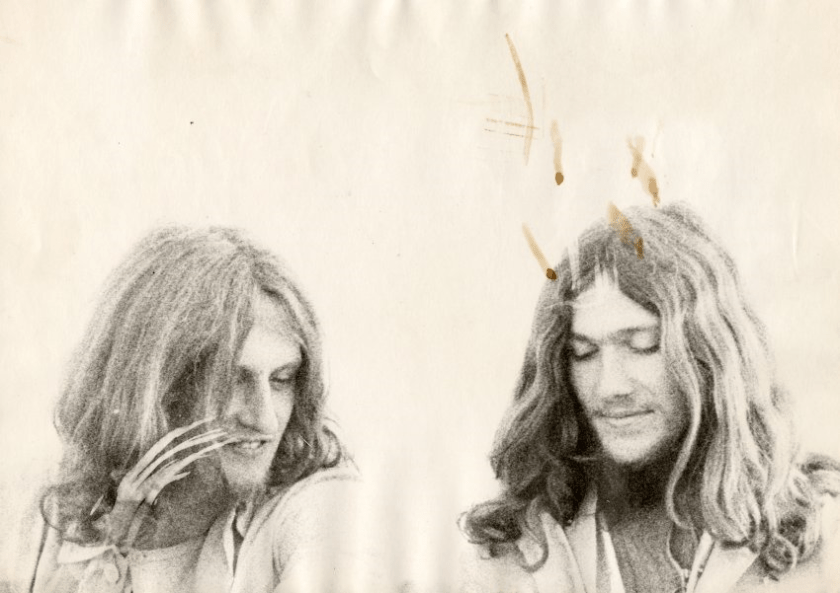
But the inclusion of A Catholic Education may not be as obvious a choice. In a lot of ways it is the least Teenage Fanclub sounding album. Its true it is sonically different to the TFC we now know. This is TFC before they were fully formed, recorded before they had played live. A noisier, more raucous confection, less obviously in thrall to Beach Boys/Beatles/Big Star/Byrds/Orange Juice. The sound here is closer to a loose Crazy Horse meets the Stones filtering through the myriad of changes affecting American post punk and hardcore. The early hazy melodicism of R.EM., the fuzzy power of Husker Du, the ear bleeding folk rock of Dinosaur Jr. Most of all I thought of them as a stoned (more Stoned?) Replacements, a similarly Alex Chilton-obsessed band with a reputation for riotous early gigs. 
Formed from the ashes of The Boy Hairdressers, a group was assembled to record an album written by Norman Blake and Raymond McGinley before they had ever played live. Initial recordings made in Glasgow were supplanted by a re-recording of four songs at Peter Hooks studio in Rochdale in the second half of 1989. This is the Fannies before they discovered those daydreaming harmonies, before those jangling chiming guitars. The guitars, for reasons that now seem lost to time are down-tuned two semi-tones, giving them a thicker sludgier sound, a sound they would move away from even as it became more popular in the early nineties. It has a style of guitar playing that had all but gone by the time they recorded Thirteen.
Some will dismiss it as an album overshadowed by one killer song, filled out with instrumentals and two versions of the title track. While true that the heart melting surge of ‘Everything Flows’ is possibly the standout track on the album, and is the only track from the LP still performed live, it fits the flow (ahem) of the album perfectly. Starting each side with an instrumental I always thought was a supremely confident move, ‘Heavy Metal II’ in particular sounding like Crazy Horse jamming on the Pastels’ ‘Ditch The Fool’ and I wouldn’t trade a second of either. The inclusion of both versions of ‘A Catholic Education’ was down to indecision over the best version (version 2 adds a chord and ups the tempo), and manages to sum up a youthful nihilism in about 10 words, played with a suitably ‘Rip This Joint’ looseness. Skill.

For me, however, its the rest of the songs that are the heart of the album. Early live favourite ‘Too Involved’ is a withering attack (“You’re just nothing”) on a slacker. ‘Don’t Need A Drum’ pitches itself somewhere between a shuffle and a boogie, with a lead guitar higher than the vocal. The vocals on the album are generally deep in the mix, unusually for a band with such good singers. their records would rarely be this unbalanced again. Side one closes with ‘Critical Mass’, a bittersweet love song in true Fannies style (“You’re in my heart, but its the feeling that all fell apart”)
‘Eternal Light’ is such sunny sing-a-long tune I wish I knew what the lyrics were so I could join in, and is graced by one of Raymond’s finest guitar solos. At various times ‘Every Picture I Paint’ has been my favourite song on the album, a love song to rival TV Personalities finest. Another of the reasons that A Catholic Education feels different to almost every other TFC album is the lack of Gerry Love songs, and perhaps this is the strongest reason for not including it. Indeed the only writing credit he received is on the scathingly funny album closer ‘Everybody’s Fool’. A friend once called this (not entirely tongue in cheek) our generations ‘You’re So Vain’. Whether or not it is about a specific person or not, I’m sure most people will have come across someone like this at one time or another. It dishes out some brilliant Glaswegian sarcasm, before building to a delightfully dismissive sweary chorus. They always seem to know when best to deploy the F-bomb (‘Verisimilitude’, ‘Some People Try To Fuck With You’)

I admit that some of my affection for this album is tied up in nostalgia for the period it was released. I saw them at (I think) their second gig supporting Primal Scream at the Glasgow Tech. They seemed to crop up regularly on support slots around that time and they were always a joy to behold. But that does not take away from this record. They would release better collections of songs in the future, their new album has all the makings of a masterpiece. But whenever I haven’t listed to them in a while, A Catholic Education is always the first one that I reach for, and it invariably leads me to working my way through the entire catalogue. It has been 10 albums and 26 years since A Catholic Education was released. Listening to it now, the distance from there to Here doesn’t seem so far. (TT)

Gerry Speaks…

The guitars are all down tuned a whole tone (I think) for this album. Was that a nod to The Velvet Underground/Sonic Youth, or was it the result of experimentation that worked for these songs? 
“Looking back, I don’t actually know why the guitars were tuned down two semitones. I asked Norman and Raymond the other day and they can’t remember exactly why. Our only guess is that there might have been a change of key in a couple of the songs, if the original key was proving a more difficult range to sing, and tuning down would allow the chords to be played in the original shapes; having the same open strings ring out in the same way instead of placing a capo higher up the neck or trying to find a jazzier way of playing it and losing the open strings. Tuning down definitely made for a more resonant sludgy sound, especially on open strings, and maybe they just decided to record everything that way instead of tuning up then tuning down. There was probably no real reason why the bass should have been tuned down too but I had just joined the group and I just did what they did, I wasn’t going to rock the boat.”
I read that the band were not happy with the initial recordings made in Glasgow and it was re-recorded in Rochdale. Does the album include recordings from both sessions?
“The first session was recorded in Pet Sounds, Maryhill, with Francis Macdonald on drums. In the following months, Brendan O’Hare joined the group and the decision was made to re-record four of the songs which we thought could be improved, maybe the tempos were slightly wrong or maybe we decided to try a different feel. We recorded the four songs and then mixed the entire album at Suite 16 in Rochdale – but i could be wrong, it’s all a bit blurry, maybe mixes from Maryhill made the final cut, but I think it was all Suite 16. The album contains the four songs recorded with Brendan and seven songs from the Maryhill session, with Francis. The song ‘A Catholic Education’ appears twice as we couldn’t decide which one was best.”
Was anything recorded at the time not used?
“No, everything was used. The whole point of the session was to record an album that Norman and Raymond had written. We hadn’t played live at this point, we weren’t really a band as such, we were a means to an end. We didn’t even have a name when we first turned up in Maryhill. The first album was the absolute beginning of the band; apart from a few rehearsals, there was nothing before that.”
You, Norman and Raymond are all credited with writing ‘Everybody’s Fool’. Was it written with someone specific in mind? (someone recently called this our generation’s ‘You’re So Vain’).
“I have to say I don’t know if the song was about anyone in particular but we all knew characters who tried too hard to be cool, who would try to put you in your place, and I always regarded the song as a counter to that type of character. As far as I remember, this was the only lyric that Norman didn’t have finished. He may have had a few lines here and there and I remember us sitting about suggesting possible rhymes to finish off the verses, but It’s all a bit hazy. It was predominantly Norman’s song, myself and Raymond might have come up with a line each and so we shouldn’t really have had any significant songwriting credit.”
Had you played in any bands prior to TFC?
I played bass guitar in a live incarnation of Joe McAlinden’s Groovy Little Numbers. I’d messed about with pals before that but nothing had ever come of it. The Groovy Little Numbers was the first time I had ever played bass and the first time I had ever played live on a stage. I knew Joe and Catherine from school, and I knew a couple of the other guys in the band, including Francis Macdonald. They were a nice bunch of people, with a few patter merchants – it was a good laugh.”
—————————-
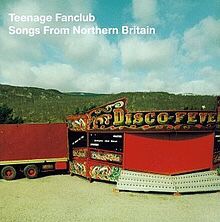
  (A) Songs From Northern Britain (1997)

If they have stayed true to that cautionary maxim not to become too big for their boots, then Teenage Fanclub have done so virtually unselfconsciously. In itself, commercial success was never something they strove to achieve. If it came along, then sure it would be welcomed; if not, then too bad. It would be futile, dishonest, to chase after it. It is that very groundedness as human beings – the stubbornly democratic creative principle within, the unassuming personalities outwith – which is a turn off for some. This is rock’n’roll after all. Where’s the glam, the swagger, the smashed up hotel rooms, the foul mouthed tirades? 
It’s a rhetorical question of course. Cliched rock’n’roll behaviour was never really their thing. Instead, they excel at making brilliant records. Their collective artistic output during the ’90s compares favourably with any other band I can think of. Usually however, it is Bandwagonesque and Grand Prix which battle it out for the accolade of best album, but our second Fannies’ pick is Songs From Northern Britain, coincidentally the band’s highest charting release (#3, August 1997).

“Here is a sunrise/ain’t that enough?/True as a clear sky/ain’t that enough?”

Sometimes chastised as the blander, ‘mature’ album, a pale regression following the dazzling cocksureness of Grand Prix, it was a record that saw a conscious shift in approach. Gerry Love explains: “I think we decided, after making the Have Lost It EP, that we may as well do our own thing from then on, please ourselves and just follow our own instincts…we had done noisier stuff but we didn’t want to get stuck there, we were into all sorts of music and I guess we wanted to express ourselves in a slightly different manner.”
And the results were fresher than a fridge full of fruit smoothies. Blake, recently married and a new father, was in fine optimistic fettle on ‘I Don’t Want Control Of You’ an ethical, nay equitable, adult love song with majestic group harmonising, and is at his yearning poetic best on ‘Planets’ a romantic ode to seeking out nature’s solitude, which as well as conjuring images of chilly autumnal evenings in the West Highlands, is also one of three songs to experiment with the Mini Moog the band had acquired relatively inexpensively in Boston six years earlier. “I guess we used it because we had it there in the studio, but also the musical territory of that album provided a perfect context” recalls Love. “[It] sat really well amongst the strings in the song ‘Planets’, it was Norman’s idea to arrange it that way…it provided a good counter-texture to the more scratchy rhythmic elements.” The string accompaniment was added at Abbey Road.

Raymond sounds equally ‘loved up’ hitting peak form on what I understand to have been the last song recorded for the album, ‘Can’t Feel My Soul’. A stinging lead intensified by some seriously twisted whammy-bar pummelling recalls the axe sound on those early fuzzmungous Buffalo Springfield records. Meanwhile the ghost of ‘Eight Miles High’ wanders the corridors of his equally splendid ‘Your Love Is The Place Where I Come From’.  
Gerry’s Zuma-flavoured desert foraging on ‘Mount Everest’ sounds bruising, possibly even rather solemn, whereas his ‘Take The Long Way Round’ and in particular ‘Ain’t That Enough’ are unashamedly ebullient slices of pure pop, as indebted to The Archies or The Monkees as to Big Star and The Byrds.
I have always found the lyrics to the closer, Gerry’s ‘Speed Of Light’, to be a little cryptic. If they communicate positivity, still I’ve struggled to deconstruct them. Perhaps it’s pointless to try – I suppose we construct our own meanings from our favourite songs – but under minimal duress, their intrepid author was happy to explain (spoiler alert*): “Firstly I need to describe the context: I was in a marijuana phase at the time, we were on the verge of a new century and I guess I was trying to write some type of futuristic pop song. It’s not a short story or a cohesive narrative in the traditional sense, it’s more like a slide show of related images…Lyrically, I would classify it as an advice song. I’m from a big family and I have a lot of younger brothers and sisters, and at that time a couple of them were still teenagers. It wasn’t intended as an instruction manual for them, or for anyone for that matter, it was only intended as a vehicle for the melody, under the guise of bubblegum philosophy. It’s certainly no big hitter, nothing there that I’m particularly proud of. I was just looking for a lyrical possibility, a means to an end, and this was it, this was the breakthrough. In the first verse, “ Drive an easy road, if you’re looking for direction”, “Take an easy load, all you need is information” – pretty straightforward, be smart and value knowledge over materialism. “Only you and me add up” – together we’re stronger. “The speed of light and stars have planned it” – it’s simply a law of the universe, how it is and how it will always be. Second verse “Need a changing face when the wind around is blowing” – A clunky way of saying if the wind changes direction your face will stay like that, which was the type of advice I received when I was a teenager, which I would guess translates as roll with the punches and don’t get too hung up. “Waste in space, if you’re looking for persuasion, everything you need can grow” – back up in outer space, I can see space junk and fruitless searches for meaningful life and I’m saying forget that – all we need is right here on earth. And there you have it, ‘Speed of Light’, a lyrical deconstruction twenty years later!”
Rather than being a watered down version of what came before, here we see our four friends finally finding their places in a world of adult responsibility. Through their lens, this grown up graduation was not as unwelcome as it is for many. Liberated from the burden of having to make any kind of statement, musically or politically, they simply let their own optimism and enthusiasm spill over naturally into what I would regard as their finest set of songs. It’s more them than Bandwagonesque (indisputably marvellous but sooooo Big Star) and the songs, performances and production (if not the volume) are ratched up a notch or two from Grand Prix. It’s unfairly maligned and is deserving of greater acclaim. I often think of it as their Notorious Byrd Bros, their Loaded. With characteristic understatement Love recalls the album fondly. “I think we achieved good results everywhere, everything sounded really nice, we were working with good equipment and good people.” TFC have the knack of making everything sound effortlessly joyful and uncomplicated. Northern Britain is proud of you. (JJ)

(*Gerry’s emphasis)

94. GLORIA – SHADOWS OF KNIGHT (1966)

90. MARY MARGARET O’HARA – MISS AMERICA (1988)


The Agony & The Ecstasy

It is an album whose incubation is shrouded in mystery. Throughout its shifting moods and styles, one savours that voice: one moment floating upon starsailing crescendos, the next a crumbling interior avalanche, buckling breathlessly beneath a stream of consciousness deluge of jagged emotion. If the vocal performances sound raw and spontaneous, the instrumental arrangements by contrast, suggest a creative process of painstaking precision: clearly envisioned, perfectly measured.

Recorded in 1983-84, but not released until 1988, one might imagine Miss America to have drained Toronto’s Mary Margaret O’Hara both emotionally and physically. Certainly, the album had a complicated evolution. After being signed by Virgin, O’Hara was given creative carte blanche, but from the very beginning the problems mounted up. Andy Partridge of XTC had been tasked with its production, but it soon became clear that the pair could not work together. Partridge, unable to fit in with her modus operandi, reputedly lasted one day. Enter the formidable figure of Joe Boyd, producer of more classic folk roots albums than it is possible to count. Almost all of the songs you hear on the album date from the sessions he oversaw at Rockfield Studios in South Wales in 1984, but remarkably, by the time the album finally saw the light of day, Boyd was uncredited on the sleeve. He has spoken very candidly about this elsewhere (http://www.joeboyd.co.uk/rentree-letter)

Eventually, the production credits would go to Michael Brook, who had already worked with Eno, David Sylvian and the late Pakistani superstar, Nusrat Fateh Ali Khan, a devotional singer of such strength and singularity who could attain similarly feverish trancelike states. However, a more obvious touchstone would be Van Morrison’s Astral Weeks. In their mutual search for spiritual ecstasy, the parallels between O’Hara and Morrison are obvious. Compare “the loves to love the love’s to love the love that loves…” of Morrison’s ‘Madame George’ to O’Hara’s “Joy is aim-eh, joy is the aim-eh, joy…” from ‘Year In Song’, the oldest tune here, written on the cusp of the 1980s. Or again with virtually all of the incomparable ‘Body’s In Trouble’, where an inscrutably awkward carnal tangle is enlightened by the most sublime fadeout. Just as well perhaps, as O’Hara sounds like she’s being recorded having a psychological breakdown live in the studio. Graeme Thomson wrote that Miss America contains “an aura of exorcism. She has talked about inner and outer voices and believes in unseen powers” and a mystical web weaves itself through the album’s rich tapestry.

From the aching Patsy Cline inspired C&W of ‘Dear Darling’, through the angelic (go on, listen, it is not a lazy adjective) lounge jazz of ‘Keeping You In Mind’, to the gulping funk hiccup of ‘Not Be Alright’, it is clear we are hearing something quite extraordinary.“When your heart is sick with wonder/at a long and lonely way/walk in brightness/cause its anew day”, she purrs effortlessly as if she were a hundred years old on the masterfully crafted gladsome swing of ‘Anew Day’, which must have had the likes of Nanci Griffith weeping with envy. The most perfectly executed performance of all is on ‘Help Me Lift You Up’ where that voice surreptitiously reaches acrophobic heights over a languid rhythm redolent of Tim Buckley’s godlike ‘Morning Glory’. And with only double bass for accompaniment, she closes out with the most fragile finale imaginable – virtually singing herself to sleep on ‘You Will Be Loved Again’

Morrissey adored it, prompting him to requisition her services for ‘November Spawned A Monster’, but 28 years on from its release, O’Hara remains something of a recluse, defiantly at odds with… well… with the way things ought to be. “Just because I have an idea, I don’t have to make something of it” she quipped some time later with characteristic contrariety. Frustratingly, she has barely exercised her tonsils since, contributing only sporadically to others’ music, whilst producing virtually nothing of her own: a Christmas EP in 1991 and the soundtrack to the film Apartment Hunting a decade later (although tantalisingly, one new song emerged earlier this year). And so, she remains a puzzling enigma. The songs presented to Virgin for her second album we very well may never hear. The label apparently found them too obtuse. Like those critics at the time who labelled her ditsy and kooky or those who heard only a coffee table companion, the public failed to appreciate O’Hara’s unconventional, blessed genius, or recognise a soul possessed by strange angels. (JJ)


89. SIMPLY SAUCER – CYBORGS REVISITED (1989*)

   
 I’m due to hear from frontman Edgar Breau next week, so you might think it unusual not to delay TNPCs inclusion of Simply Saucer’s Cyborgs Revisited until after we speak. The thing is, I’ve constructed my own myth around this album, I’ve rewritten rock history in my head, and I’m reluctant to let it go, for surely if rock’n’roll is about anything, it’s about gratuitous escapism – so I’m going to hang on to this movie script for a little while longer…

“What a fantastic movie I’m in / what a fantastic scene I’m in…”

[Scene: Backstage, Velvet Underground performance, Max’s, August 22nd, 1970]

Any similarity to characters real or fictional is…blah blah blah…

DY: What’s the matter with you Lou – that was some hokey shit tonight?

LR: Cuz the whole thing’s fucked you asshole. Your stupid Cyborg obsession – it’s getting us nowhere. What the fuck is a Cyborg anyhow?

DY: Remember when you used to be rock’n’roll? Long time ago. You’re not even a footnote now. There’s stuff out there which is unbelievable Lou – wash out your ears, how can you not hear it? Look at the Ig guy – he’s insane. It’s just pure rock’n’roll… 

LR: Let him go and do his shit. Who’s gonna remember that? They called it right. Stooges!! Just a noise goin’ fucking nowhere Doug…Forty people out there tonight...Brigid snapping awaywho’s gonna want tapes of us playing this shithole?…

[SM (barely audible):hey…someone tell Jonathan to beat it…Jonathan get outta here man, go home…its late…]

DY: Are you outta your mind? It’s not like we’re reaching out Lou – nobody came then, nobody’s comin’ now, nothin’s changed; let’s face it. But til now, at least we’ve been able to hold our heads up man. You know, I’m beginning to think Cale got it right. He got out cuz he knew this lame loser shit was on the way

LR: Hey, I got rid of that asshole… that’s precisely the kinda bullshit I might expect to hear from him!…I mean…avant garde, avant garde?! – thinks he’s John fucking Cage. One letter outta place in the name he thinks he’s a fucking genius. That one letter makes all the difference! He was never gonna be a star and neither are you Dougie boy. I’m a star, just like Andy says, and not for fifteen minutes either…just try to stop me honey.

DY: I didn’t join the band to become a star Lou. You want your face on a magazine cover, that’s your business – I want more. I want people to talk about my music 50 years from now.

LR: Your music!? What are you, some kinda comedian? What’ve you ever done? You’re just hanging on my coat-tails you asshole – just along for the ride! Playing supper clubs for twenty people ain’t gonna pay the bills. Well, what you gonna do after tomorrow, you’ll be on your own…cos it’s over…? 

DY: Asshole! 

LR: No, you’re the asshole…

Of course, as we all know, Lou walked out the very next evening, before Yule dragged Velvets’ devotee Jonathan Richman with him and they, together with a noisy young Rimbaudesque poet called Richard Meyers, went on to blitzkrieg the vacuous coked up pomposity of early 70s rawk, with all its ludes and bad hair and mind numbingly bland guitar solos, via their paradigm-shifting interstellar punk rock…

Or perhaps not… this is only a movie after all. 

…In actual fact, Yule made Squeeze the ‘fifth’ VU album, which nobody recognises as an authentic release – it wasn’t of course, as it featured none of the original members. By 1974 he had done nothing else but add guitar to Reed’s Sally Can’t Dance. He would resurface again with the feckless country rock of American Flyer just as punk was exploding. It turned out Doug Yule was never going to do anything authentically punk. But it was not outwith the realm of possibility that he could have been the prescient saviour of rock’n’roll. After all, he joined the Velvets right after White Light White Heat. The last ‘song’ they recorded before he walked in the door was ‘Sister Ray’. If that didn’t put him off, then it was still a hell of a long way to slide before he got to writing ‘Dopey Joe’… so my guess is he must have possessed a tiny kernel of the punk gene, but he buried it. Somewhere deep. Unless of course, he was, as Lou says, just along for the ride…

So, instead it was left to some scraggy music & sci-fi obsessed teenagers from Ontario to pick up the mantle…their lives would be saved by rock’n’roll and they aimed to save it from annihilation along the way. 

“I like the way that you treat me like dirt…”

Hamilton lies close to the Canadian/US border. The two US cities in closest proximity are Detroit and Cleveland – and if you’re looking for clues as to the origin of Simply Saucer’s sound, you need look no further. While the primary influence was undoubtedly The Velvets, Simply Saucer’s true kindred spirits were Iggy, MC5, Mirrors, Rocket From The Tombs and The Electric Eels, alongside a hearty dose of Krautrock and a psychedelic spattering of Syd’s Pink Floyd and Hawkwind.

The band – Edgar Breau (guitar, vocals), Kevin Christoff (bass, vocals) John LaPlante – aka Ping Romany (electronics) and Neil De Merchant (drums) would hardly become household names; formed in 1973, they only ever released one single (in 1978) before quietly disbanding. It would take another ten years before an album collection finally emerged. Culled from only two sessions – one recorded in Bob and Daniel Lanois’ mother’s home in 1974, the other recorded live in Hamilton a year later – Cyborgs Revisited was the first full length document of their incredible music, and as such is one of the great lost albums of the 70s.

A virulent distillation of acid-fried space rock and brutal urban punk, it comes over as a deranged masterpiece. ‘Instant Pleasure’ possesses the shambolic jerk of the Neon Boys’ ‘Love Comes In Spurts’ although predates it. As Breau pleads “Let me sleep inside of your cage / I want to feel your sexual rage”, Christoff’s impossibly spasmodic bass convulses around Romany’s anarchic theremin noodlings. ‘Electro Rock’s garage riff could be something off MC5s High Time. Delivered in Breau’s slovenly sneer it is laid to waste by a collision of screeching guitar, pummelling bass and some bizarre electro-magnetic loops. ‘Nazi Apocalypse’ degenerates magnificently into a big Ron Asheton wah-wah scorched earth guitar storm and the instrumental ‘Mole Machine’ is like a psychic summons to outer space by a college of math rock guitar freaks beckoning with all their might (and incomprehensible formulae) the descent of the mothership…it succumbs gladly to their invocation.

On ‘Bullet Proof Nothing’ Breau does indeed does sound like Yule having a crack at ‘Sweet Jane’ with The Modern Lovers providing the back up. (“Treat me like dirt, drive me insane / treat me like dirt now, tear out my brain… I’m just bullet proof nothing to you / Point blank target for your waves of abuse.”) Despite the nihilistic sentiment, it’s the most accessible thing on here, and would have fitted comfortably onto Loaded or even Transformer and even ennobled both of them. At any rate it truly is one of the great lost tracks of the 70s.

But it is no exaggeration to say that the live tracks (which comprise Side Two of the album) – recorded on a roof on Jackson Square on June 28th 1975 are just staggering – a revelation. The live version of ‘Here Come The Cyborgs’ is an astonishing sonic assault with more killer guitar riffs than James Williamson could accumulate on the entire Kill City LP. And that’s saying something. It briefly melts down into a blues jam and then knocks satellites out of the sky before the discordant thrash at the tail – a precursor to The Fall’s ‘Hip Priest’. Meanwhile, ‘Dance The Mutation’ is like a Jumpin’ Jack Flash Jagger cranking it out over an unstoppable tidal wave of nuclear moog radiation from Romany which evidently hungers to swallow up everything in its path. And as for ‘Illegal Bodies’ well, it captures on tape one of the most viscerally exhilarating guitar performances ever recorded. Think for one moment of ‘Run Run Run’ – it’s a smack song right? Well, ‘Illegal Bodies’ has that guitar, but Breau propels the song forward with such amphetamine fuelled momentum that, cut loose from its moorings, it spills its guts out all over the place…a sprawling mess of sheer punk adrenalin.
Now imagine if Breau, Romany and co had been afforded proper exposure at the time. Surely rock history would have been rewritten and perhaps punk would never have happened at all. There would have been no need. Julian Cope wrote a genius review of it on his Head Heritage site around 15 years ago – it’s here (https://www.headheritage.co.uk/unsung/albumofthemonth/simply-saucer-cybords-revisited) and no-one has came close to it since, so there may be a chance you’ve tracked it down before now, but if it’s something you haven’t heard yet, then I envy you your first listen. This is the stuff you’ve been looking for. (JJ)

88. NEU! – NEU! ’75 (1975)

img_5634-1
If music is often a portrait of the life of the artist, then it may sometimes bear the wounds and scars of the complex nature of human relationships; even at times, of the differences musicians experience working together. If that can lead to albums being abandoned mid-recording, it can also occasionally result in the creation of transcendent pieces of art. Think of ‘The Beatles’ or Spacemen 3’s ‘Recurring'(featured in TNPC #51). But rarely has any album borne witness to this possibility more transparently than ‘Neu! ’75’.
In late 1974, when he entered the studio to record Neu!’s third album, Michael Rother was 23 years old. It is no exaggeration to say that by that stage in his short career, he and Klaus Dinger had already rewritten the future of popular music. They might not have known it, and Rother may even feel faintly embarrassed by the suggestion, but it is virtually impossible to talk about the music Neu! produced in the early 1970s without introducing to the discussion references to the profusion of artists and musicians who have borne their influence directly or indirectly. From contemporaries such as Hawkwind, Eno and of course Bowie, through PiL and Joy Division, to 80s synth bands such as Ultravox (who worked with Neu!’s producer Conny Plank) and The Human League, through to the post-rock landscapes of Stereolab, Tortoise, Mogwai and The Sea & Cake, they can boast legions of admirers.
At its root this was music without a past, and as a consequence, it constructed the future. But buried in its grooves, ‘Neu! ’75’  bore the DNA of the divergent paths Rother and Dinger had taken in the intervening three years since they had last collaborated (on ‘Neu! 2’). Rother had fully immersed himself in his latest project Harmonia (with Cluster’s Dieter Moebius and Hans-Joachim Roedelius). It was a project from which Dinger possibly felt excluded. If ultimately Harmonia was a failure on a commercial level, nevertheless it was artistically a tremendously rewarding one for Rother, and something with which he was aesthetically very satisfied. The time with Moebius and Roedelius had not been wasted, nurturing in a period of creative growth, during which his musical horizons expanded immeasurably.
By contrast, during the same period in question, Dinger had travelled to London in order to seek more media exposure for Neu!. With the exception of some additional air play from John Peel, his efforts were largely fruitless. Likewise, his own project, the fledgling Dingerland record label, had collapsed leaving him bankrupt. At the same time his girlfriend Anita (the ‘love of his life’) left him. Disillusioned and filled with rage, Dinger re-entered the studio with Rother to complete together their third LP for Brain, the dreaded contractual obligation album.
It is a schizophrenic creation. Unlike say Bowie’s ‘Low’, where the two sides of the album simply differ stylistically, here we have the two protagonists moving in completely opposite directions, so much so that they compromised on composing one side of music each. Despite this, Rother and Dinger were possessors of sufficient fingerspitzengefühl, alongside a virtually telepathic understanding, enabling them to contribute selflessly to the other’s compositions. For example, Rother plays guitar on Dinger’s ‘Hero’ and Dinger plays keys on ‘Leb Wohl’ perhaps the two songs which capture best their sonic polarisation. Neu! as an entity, could probably not have lasted any longer than it did at the time. The differences, musical and personal were too great to bridge. Dinger was aided in his efforts by Thomas Dinger and Hans Lampe who played drums on his side of the album allowing him to focus on guitar. That the album was as brilliant as it was is truly remarkable given the circumstances.
The Music:

‘Isi’ / Rother – Michael, enthused by his experiments with Harmonia, procures a crisper and more joyous sound – this possesses a lightness of touch – the simple  recurring piano motif – and features a trebly keyboard line which points forward to the electro pop of Depeche Mode and OMD. Musically, clearly a descendant ‘Hallogallo’, but simultaneously dancing into the future.

‘Seeland’/ Rother: there’s a greater emphasis on synths and keys on the album; at times Michael’s guitar creeps back into the shadows. Here however, his brooding, patient playing creates a solemn ghostly sound. Listen to this and then play ‘The Overload’ from ‘Remain In Light’ – Eno was clearly smitten. There’s a (subconscious) Eastern influence too. The track has been criticised for ‘not going anywhere’ but the patient, hypnotic groove is mesmerising as is the inventiveness of the atmospheric wash of guitars.

‘Leb’ Wohl’ / Rother: Rother and Dinger shared a mutual love of natural sounds, but if  Dinger was more likely to cultivate an aggressive confrontational noise, some may say proto-punk, then Michael was by the same token proto-ambient. Here the music anticipates the experiments of Eno, Harold Budd and David Toop  with a chilled out concoction of ocean sounds and minimalist piano (possibly by Dinger), the whole thing breathing and groaning  like the great Aum of existence. And with a title such as Leb’ Wohl’ (‘Farewell’) who knows if it was possibly Rother’s goodbye hymn to Klaus.

‘Hero’ / Dinger: Klaus, raging at providence unleashes a tirade against Anita, the press, the record company and Lord knows who else. “Your only friend is music until your dying day/Your only friend is music/And you’re just another hero riding through the night/Riding through the city, trying to lose your fight…Fuck the press/Fuck your progress, fuck the press/Fuck the company, fuck the company/Your only friend is money.” If it had been released in 1977, it would have made more sense. And more money perhaps. Some say it was the inspiration for Bowie’s ‘Heroes’ but listen to ‘Red Sails’ off Lodger for an even closer comparison. Oh, and listen to Johnny Rotten too, I’m sure his ears must have been seduced by Dinger’s histrionics.
‘E-Musik’ / Dinger: Klaus utilises all that destructive energy, channelling it into the creation of an ‘Autobahn’/ ‘Sister Ray’ hybrid for the 1970s (and possibly the 80s/90s for good measure). The ‘E’ in question does not stand for ecstasy, but for Ernste (so this reads ‘serious music’) – perhaps symptomatic of Klaus’ frustrations at Neu!’s relatively modest critical and commercial standing at the time? [Trainspotter alert: Deerhunter sampled the little keyboard riff at 5:42 for ‘He Would Have Laughed’]. But what really stands out here is the brilliant use of phasing in the percussion – a new and significant development in the Neu! Sound, and the way the rhythm dies off into nothingness at the end, blown away by the wind; providing temporary respite before…
‘After Eight’ / Dinger: Almost their most conventional rock’n’roll moment with Dinger’s guitar revv-ing it up like Manzanera kicking off on ‘In Every Dream Home A Heartache’. Not perhaps entirely representative of Neu!’s sound but a psychotic discharge which provides an aural snapshot of Dinger’s state of mind at the time. (JJ)

Special Feature: TNPC interviews MICHAEL ROTHER

INTERVIEW WITH MICHAEL ROTHER
Rother on Dinger, Kraftwerk, Harmonia and the Bowie Project that never was. (With thanks to Tim Sommer for helping guide some of the Qs)

TNPC: Your influence on modern music has undoubtedly been far-reaching. Did you and Klaus ever envisage that you would have such a pioneering role in the development of rock music?

MR: The truth is that I never really bothered with thinking about the future or thinking about what influence the music could have. I worked from day-to-day. Now, looking back, maybe I thought about these things, but on the other hand I knew it could have distracted me from what I wanted to do. It was really the joy of experimentation – the ambition was really to create music that was our own. Klaus was certainly as ambitious as I was. We never spoke about it really; we just went into the studio and did it.

neu2

TNPC: I am particularly interested in how you would assess your influence upon Kraftwerk, the most celebrated German band of all. It seems clear that after you and Klaus were invited to join them in 1971, they never sounded the same after that collaboration…

MR: I joined Kraftwerk in  1971, February or March. Klaus and I formed Neuafter we were in Kraftwerk. I didn’t know the band Kraftwerk. I was working in a mental hospital but by chance ended up in the Kraftwerk studio with another guitar player who had been invited, and I joined with Ralf Hutter – it was a revelation for me to notice that I wasn’t alone in this approach to ‘music without roots’, which instead focused on a tradition of central European music in the melody and the harmony. That was very surprising for me. I think Ralf and I over the years probably watched what the other was doing with some respect. I know from talking with my friend Karl Bartos, who was in Kraftwerk for 14 years, that Ralf Hutter and he jammed to my track’ Karussell’ [from ‘Flammende Herzen’, Rother’s first solo studio album] in the Kraftwerk studio, so I think they enjoyed my approach to music. Of course they had amazing success when they released ‘Autobahn’, which was quite a step forward – although I really love the first three Kraftwerk albums and don’t really understand why people don’t see these as realKraftwerk albums. I think the influence must have been equally in both directions, not one way. It is clear that Ralf Hutter, if you look at the melodies he created, and mine, we would always be able to just play along without talking. I was very strict about what was possible and not possible as a melody/note. 

You can’t imagine how difficult it was to find people who were on the same path in the late 1960s, early 1970s. Nearly everyone I knew was still so influenced by only British and American music of the time and still stuck to that system. Florian [Schneider] was also a huge influence on me when I played with him and Klaus Dinger in Kraftwerk, although maybe not musically that much, but I was very impressed by the great flute treatments he did and the amazing permutations he produced when we performed live. It is a fact that is not noticed by the sound recording engineers on The Beat Club performance – my guitar is way too loud; they didn’t understand how important the crazy stuff was to the sound. I would have mixed it in a different way.

There was a great connection with Ralf Hutter on a musical level. Based on working with Conny Plank, it’s clear to see the influence of Neuon UK & US bands of later years. Also, when I met Eno in 1974, he mentioned how much he liked our music and how he and Bowie enthusiastically exchanged their ideas and views about our music back then

TNPC: It’s interesting to hear you talk about the impetus to create music ‘without roots’, although I think I read somewhere of your admiration for the 1960s guitar heroes and so on. Neverthelessthere is an absence of traditional western music (blues etc). Might there have been other more avant-garde influences, such as John Cage, LaMonteYoung, Tony Conrad or The Velvet Underground – or did you not hear these people until much later?

MR: I think this is not really true for me. I was the youngest of that whole group of people. My situation was that I really threw away everything as much as I could. Of course you cannot erase your memory, but I did my best intellectually to avoid picking up any ideas, clichés of music that I’d heard until then. Of course, the guitar heroes, The Beatles, Kinks, Stones, Jeff Beck, Hendrix, Clapton and Cream and so on – I still have much respect for those people, and from time to time, when I hear a song by them I am still blown away, like a few years ago when I was in Dublin and I stumbled along the road and ‘You Really Got Me’ was blasting out, I just got goosebumps again…

My girlfriend at the time already listened to The Velvet Underground. She was more into listening to music. I stopped. In the path I was on it was important to ‘stop listening’ and to try to avoid this. I know the minimalists you talk of were an influence on a lot of the people I worked with, so their influence reached me through other musicians but not directly. I remember once seeing Terry Riley and I remember seeing a German film from the late 1960s – there was a track by The Velvet Underground, ‘Waiting For The Man’ I think was the title, and I remember being moved by the flow of that music, Mo Tucker obviously, that kind of…duh-doh-da-do-do-do-do-do…[imitates rhythm] –  is very close to my heart. But I wouldn’t call it an influence, more a similarity, this idea of forward reaching music that looks out to the horizon, not just the next few yards.

TNPC: In your quest to create something ‘new’ you clearly wilfully avoided listening to too much music, and the Neualbums are certainly exemplars of a new approach to music. Was there a ‘eureka’ moment when you realised one chord was enough?

MR: I don’t think there was this kind of moment. It grew. It started when we played live with Kraftwerk. There was no harmonic change when we played live, it was just on one level and the details happened with the dynamics – starting slowly, relax, building up tension, going through the ceiling at the end, just going wild, and when we recorded the first Neualbum, if you look at tracks like ‘Hallogallo’ which is such a puzzle really – I don’t know how that came together – but it was spontaneous music. Klaus and I had a vision which we had together; this idea of music just running forward and then some of my elec-lines just flying on top – but how that really turned out was the result of very spontaneous decisions and some fortunate things happening, like the wonderful feedback I had on my guitar in the studio which enabled those long long notes, and of course Conny Plank’s amazing skill at catching the most important parts. He was great at that. He had nothing – a reverb plate, a limiter, a tape machine for short delay – that was it, so the whole organisation of the music was of course the result of what we played in the studio, but the way he constructed the final sounds was so impressive.

TNPC: Can I ask you about the first three Neu! albums, in terms of the progression in the music? Sometimes when I listen to ‘Hallogallo’ and ‘Für Immer’ and ‘Isi’ from ’75, you can note the similarity there, but often when I hear ‘Neu! 2’ it almost sounds too adventurous, in the way the tempo of the music changes, speeding up, slowing down – there are lots of ideas floating around. By the time you get to the third album it sounds like you have really hit your stride. There is space for long silences, you can press the noise button at times, there is great variation. Were you and Klaus moving in different directions and really becoming different artists, or had you just reached a point where you were connecting very well?

MR: Well, after ‘Neu! 2’ I started the project Harmonia which took me into completely new fields. I cannot imagine composing or recording tracks like ‘Isi’ and ‘Seeland’ without working first with Moebius and Roedelius [of Cluster] in between. I was able to learn more about music going back and forward with Neu! and Harmonia.

On ‘Neu! 2’ the two sides of the album are quite different. What we wanted to do, well Klaus isn’t around anymore and he may have some other points to stress about this; we certainly didn’t agree on many things. I am actually quite convinced that what we wanted to do was something like ‘Für Immer’. We would have done something like ‘Für Immer’ on both sides, but it took us too long to record all those items. Neu! 2’ was recorded on 16-track as opposed to 8-track on the first album. I got carried away, adding backwards guitars, forwards guitars, backwards pianos, sideways, all those colours which are fun and are hung up are important for the picture – particularly for something like ‘Für Immer’, but at the end we didn’t have the time for all that because we didn’t have enough money. We paid the studio out of our own pockets. And so, we sort of realised we had only one night shift left and we still needed to finish the whole second side! So those experiments were the result of very spontaneous decisions around ‘what can we do to end up with a complete album here?’ Of course the critics hated it. The fans thought we were making fun of them. People did not really accept it. The perception of the second side has changed dramatically over the last 30-40 years. I am not sure if all people want to hear the needle jump and scratch! It certainly turned my stomach around when Klaus kicked the turntable. I thought these experiments, slowed down music, backwards music – I was quite sure that people would stop following us – they were not ready for this at the time. The two tracks ‘Super’ and ‘Neuschnee’, the original tracks, they stand out – that’s what we really wanted to do. We really wanted those on the album, because the record company hadn’t cared about promoting the single. They didn’t. We pressed the single on them. They didn’t want to have one. So that’s the explanation for the second side of ‘Neu! 2’

TNPC: You say that people ‘hated’ the second side of ‘Neu! 2’. More generally, how successful were you in Germany at the time – in terms of sales and so on? The albums were long unavailable in the UK and were the kind of thing you had to pay good money for if you were fortunate enough to find them at record fairs. They were treasure items but success would have been limited here in the UK, at least until the renewal of interest in your music more recently. But in Germany, were you quite successful from the beginning?

MR: Well that always depends on the scale I suppose. There were many many musicians in Germany making pop music and selling hundreds of times the numbers, but in my view the first Neualbum was a real success and we made really nice money. I mean I wasn’t interested in buying stuff. I was happy simply with the freedom some money in the pocket could give me. But the money from Neumade it possible for me to help the project Harmonia, which was a commercial disaster! Compared to Neu!, Harmonia was nothing. People did not enjoy our music. It was terrible at the time, so difficult to survive, not only economically but also emotionally. I mean I loved the music from Harmonia. I didn’t understand and couldn’t make sense of why one was loved and one ignored. Of course, I’m so happy to see in recent years the recognition Harmonia is getting. It’s so sad that Dieter Moebius passed away last year. He was involved in all the decisions until the very end. Only two weeks before he died he thanked me for my work because I was the one who did all the work, because he was too weak by then, and Roedelius was busy with his own projects. But Harmonia was always something that came from my heart. I owe them I don’t know how much. I couldn’t have done Flammende  Herzen and my solo work and also ‘Neu‘75’ without having spent those three years working with Moebius and Roedelius.

TNPC: Often Klaus is portrayed as the angrier of you. He is seen to have had the more punk temperament, and that perhaps musically you are seen to be the one creating landscapes around the metronomic/motorik rhythms he created. At least that is the way people often perceive Neu!, but I was wondering if your musical relationship was more fluid than that. Did your contributions cross over and overlap more than some imagine?

MR: It’s not black and white for sure, much more complex. Klaus once said, maybe ten years ago “Michael and I had a blind understanding in music” – a bit romantic I think but it comes close to the truth. We never had to discuss music, but both admired and respected each other’s contributions. I loved his drumming style, his artistic inspirations. I did not really enjoy his personality to be honest. He could not be my friend. I could not have people like that as friends, but as soon as we made music it was great. He was such an impressive, strong drummer. Obviously I can’t say what Klaus would say now, but I think he felt the same positive way about my contributions, and we met in the middle. He had a heart for melody; maybe not…as…’talented’ [laughs]- but the same is true for me with the rhythms – I also played rhythm guitar – it’s not only Klaus doing the rhythms, it’s also me, but he was in that respect more ‘talented’ than I am.

TNPC: And did he therefore, when punk came along embrace that more fully than you?

MR: Oh yes, Klaus always had a very different way – to do with his personality, his upbringing, with the things that did not go his way. If something goes wrong for me, I’m sad but I try to make sense of it and work around it, but with Klaus, he became furious, angry, would blame other people for things which he was also responsible for. Yeah, Klaus was the punk. I never was a punk. Klaus would often say: “I was never a punk. They copied me!” 

TNPC: I can hear your influence Michael in a lot of the post-punk music. ‘Seeland’ for instance from ‘75’ – you can hear Eno lifting the idea for ‘The Overload’ on ‘Remain In Light’ but more generally that patient, building, brooding sound in Joy Division and other bands. But I also hear an Eastern influence on ‘Seeland’. I wonder if that was to do with your time in Pakistan – did you accommodate those influences as well?

MR: Not purposely, but I can remember being blown away by the music – I have a soft spot in my heart for Indian hypnotic music, like The Ali Brothers –  I have a wonderful CD of recordings of classical Indian raga – actually two Pakistani men and an orchestra. Intellectually, I would think my heart for music must be a mixture of Chopin (from my mother), Bach maybe also, Little Richard and Indian music; then mix in a little Jimi Hendrix and Beatles.

TNPC: There are a lot of organic, natural or found sounds (wind, tidal waves etc). Was that aspect your idea?

MR: Well, maybe it’s a cheap trick – to add drama! Both Klaus and I agreed on that. I love water, the sound of heavy rain, thunderstorms, and of the wind blowing the music away. I don’t want to say and I don’t want to lie about who took what sound or proposed which at a certain point. ‘Hero’ of course was a track that Klaus brought in – I brought in ‘Seeland’ and  ’Isi’ –  and a wonderful example of the amazing energy he could create with his music – and a good example also of the frustrations he felt. We did not talk about this, but I knew that he was very unhappy about the situation – so many things were wrong in his life: the record company, the label that he started going bankrupt; his girlfriend going away. You can hear it in the lyrics. It was the first take, spontaneous. We did the backing tracks together, we recorded the guitars and the drums, and then he went to the microphone and sang the lyrics and belted them away. He tried to improve upon this in the second recording, but that was more organised, but less powerful, so Conny Plank and I were sure about the first take being the right one. It is one of the most impressive expressions I know and one of my favourite Neutracks.

TNPC: Often people say Bowie stole it for ‘Heroes’ of course but I think there is a song on ‘Lodger’ (’Red Sails’) which is more like ‘Hero’ than ‘Heroes’. But obviously Bowie and Eno were borrowing heavily from you during that time…

MR: Well you know that David wanted me to play along on what on what became ‘Heroes’. Somebody prevented that from happening. I did not turn him down.

TNPC: It’s often reported that you declined the invitation, but you can set the record straight…

MR: We were both very enthusiastic and then his manager called and something had gone wrong on his side, not mine.

TNPC: Perhaps you regret this, or do you believe things turn out the way they are supposed to turn out? Even still, might there be a sadness that the opportunity to work with him did not arise?

MR: I don’t know. It was a thrilling time. It was between ‘Flammende Herzen’ and ‘Sterntaler’. My career was taking off. I was having so much success and recognition suddenly. I earned enough money to enable me to buy my own professional recording studio here. I felt like a small child getting a train set. But I was still surprised to get this last phone call from someone from his staff saying ‘You don’t have to come, David doesn’t need you anymore.’ I thought ‘that’s strange’ – we had been so enthusiastic, looking forward to the collaboration, but then I just went into the studio and recorded ‘Sterntaler’ and if I listen to ‘Heroes’ now, it is obvious that Robert Fripp did a great job. So no regrets but still a mystery. You know it took something like 25 years for me to realise there was something wrong, because he started saying in interviews that “Unfortunately, Michael turned me down”. But maybe he was fooled. Maybe someone took liberty in making decisions for him (“We don’t want this crazy German”) You know that his sales were dropping dramatically back then. These experimentations were not popular with David’s fans. “These crazy Germans guys won’t help us make money.”

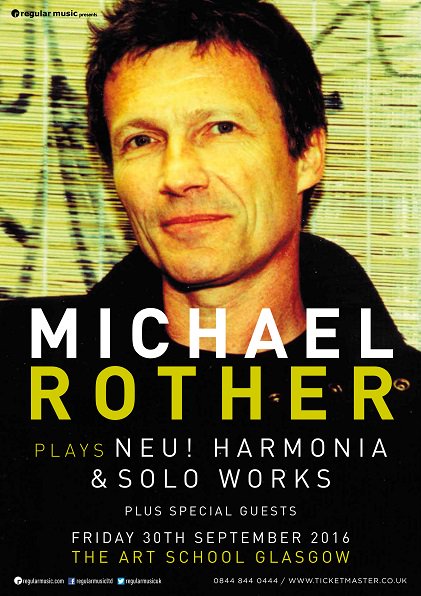
TNPC: You are going out on tour, Japan in July – back to Glasgow in September – what can the fans expect when you are performing?

rother

MR: The billing says it – it will be a mixture of tracks by Neu!, Harmonia and from my solo work. I  guess I am still enjoying playing this fast forward kind of music, just rushing down the road and running to the horizon. This is something I love doing live now. In recent years I have done some film scoresmelodic and abstract music, but playing live, I like to feel the energy. When I played in China 18 months ago, I was totally fascinated to experience the crowd. I didn’t know what to expect but they went wild, jumping around inside the venue, they were so excited. The joy and the positive energy was something to behold, and that is what I intend to bring to Glasgow.

85. NEXT – THE SENSATIONAL ALEX HARVEY BAND (1973) Guest Contributor: Robert King (Scars)

  
It may appear that I have written very few words about the Sensational Alex Harvey Band album ‘Next‘, but in truth I should not say anything. This album is a building-block in my life and also in my development as a musician. It taught me that both extreme raucousness and violins could work, and also that a Scottish accent can make a song sound compelling at the very least. I have, on occasion, been compared with Mr. Harvey, but in my estimation he always precedes me. I am no copyist, I just have a similar accent and for that matter, perhaps enthusiasm.

Anyway, notes on ‘N.E.X.T.’
Never in order, but ordered in no order:

“Let me be your swampsnake ’till the real one comes along”. The listener doesn’t know it yet, but the real one is the laconic voice full of delicious malevolence which seems to celebrate everything your parent ever hated. Thus opens the Sensational Alex Band’s second album. An easy blues with a snide smile towards the contempt that the camp has for the attempt at legit. Fuck it! Easy shit but good.

Gang Bang is essentially a Mott The Hoople song with what are today considered questionable lyrics. Oddly the protagonist is female. Or… is that just another male fantasy?

Next. What can one say? His band performed this never having heard the original. Who followed whom? It is obvious from Zal’s facial excursions on The Old Grey Whistle Test that he connected with the performance of the song in such a way that was to truly identify SAHB. This odd adventure book full of the bizarre, but . . . The TV version is one of the greatest TV performances ever.

http://youtu.be/7vaLi9W6HRc

Faith Healer. .. … . .. … He did put his hand upon me. On a few occasions at gigs. I made sure of that. This song, from my emotion in 1974? was one of violence. A gang song. Simply. Should I analyse the song? I don’t think I should, because then I would be pointing out the stuff that is out of time and the over-use of the compressor… in my opinion. I just like it.

Vambo Marble-eye. Funky thumping start with that out of control controlled shout that the Mr Alex does. Gang song. A period in the seventies when the short T-Shirt that revealed the belly indicated you were a casual. Vambo rules! (Robert King)

84. PUBLIC IMAGE – PUBLIC IMAGE (single, 1978) Guest Contributor: Tim Sommer (Hugo Largo / NY Observer)


“Public Image” by Public Image Limited (1978)
Punk was not a revolution. It was a market correction.

At a different point in my life, I would have regarded that statement as heretical. There are barely words to describe the impact punk had on my teen suburban self. The emergence of punk rock was exactly the right thing at precisely the right time. See, in high school, you are expected to be your most social at precisely the time when it is most horrifying, intimidating, and humiliating to do so. In that devastating, insecure time, I knew that social comfort and musical inspiration was not to be found in the margarine yellow-colored school hallways, amidst the ugly sibilance of slamming lockers, Kansas, and the Grateful Dead; but bands like the Kinks and the Dave Clark 5, not to mention the primitive snarls and chants I heard on the local oldies station favored by the greasers who congregated under wide white skies in the school parking lot, spoke to me. These thumps of rhythm and groans of guitar chords told me there was a visceral, minimalist quality in music that best reached my spine, my soul, my belief that there was more to life than the middling expectations of my education and upbringing. I am sure you recall this, too – we were not black sheep, we were not underachievers, we just saw past the horizon and beyond the edges of the middle of the road.

 So 1976/1977 dawned. It waved a Union Jack and was dressed in narrow trousers, and it seemed to be precisely what I had been searching for. I had absolutely no need nor desire to examine what was superficial or false about the New God, because it rescued me. Those of us saved by ‘77 weren’t fashionable, we were thirsty, and these short, sharp bursts and whirrs were exactly the oasis we had been looking for.

 But I came to realize that punk, regardless of all the extraordinary joy it offered and the inspiration it provided to move my life away from the low expectation of the suburbs and seek The City, despite the lesson it taught me that the greatest deeds could be achieved by those who stood out and not those who conformed, despite the fact that we were presented with some of the most lasting music ever made, despite all those things, the punk movement was, in essence, an energetic and passionate re-assembly of existing pieces, serving the same masters.

 On a purely musical level, virtually all of punk could be traced, almost without hiccupping, to Wilko Johnson or Mick Ronson or Johnny Thunders or Pete Townshend, Dave Davies or Bo Diddley or the Velvet Underground; other times, it was a growled-up return to the brilliantly mongoloid pop values of the more Hodor-like beat bands (which is to say there is a very, very short hop from Herman’s Hermits to the Ramones, and if “I Want You” by the Troggs isn’t a perfect ’77-style punk rock song, I’m not sure what is). And most everyone wanted to be a star, and most everyone was seeking to nurse at the same corporate teat that had suckled all the horrific music punk was supposed to supplant. Not only was the wheel not being reinvented, we were begging the same corpulent salesmen to help us sell it.

 Which is to say, we did not storm the Bastille. We just re-painted it.

 Because the music was so goddamn good and life affirming, only in retrospect did I recognize that the ‘pose’ of punk was deeply misleading. Many listeners, myself very much included, didn’t understand that there was a great gap between slogans and actual activism; despite my deep (and lasting) affection for both the Clash and the Sex Pistols, “White Riot” didn’t incite anything but a pile of haircuts and words on the back of a jacket, and “Give the wrong time/stop a traffic lane” (from “Anarchy in the UK”) literally didn’t do a thing to relieve the oppression of the disenfranchised classes in any country on earth. Listen, despite the stares and sneers it may have gotten you in your school cafeteria, dying your hair pink never fed the hungry or protected a woman from abuse on her way to the abortion clinic.

 But that was not the end of the story. The moment punk rock starts to really live up to its promise and differentiates itself from the renascence of rock and roll’s brilliant old bump, thump, rumble and grind, the moment it stops aping Paul Revere & the Raiders and starts burning the Reichstag, is on October 13, 1978.

 On that day, “Public Image,” the debut 45 by PiL, was released.

 “Public Image” still creates the same utter thrill that it did when it first shocked and elated me 38 years ago. Both reduced and explosive (it mixed maximum minimalism and maximum impact in a way that only, perhaps, “Blitzkrieg Bop” and “Autobahn” ever did), it took the reggae bass of doom and replaced the syncopation with a sturdy metronome, ensnaring you with the snaking snail chord change that knows no equal: E/B, endless, except for that little turnaround between verses. I have often thought this was the chord change that wrapped around the heart of the pharaohs and Siddhartha and maybe accompanied the hymns sung after His body had been lifted, broke, bruised and wasted with a fake death, off of his perch at Golgotha. Driven by the Wobble charge (Johnny and Dee Dee and Aston Barrett and Hütter/Schneider all wrapped up in one instrument and one part), “Public Image” storms forward in a manner that was familiar to punk’s acolytes; but there was a cool blast of air in the unrelenting simplicity, and a sizzling, almost sinister flare of art in the barbed spikes of Keith Levene’s guitar, which tossed punk’s Ronson-isms out the window and replaced it with a brilliantly dumbed-down version of Michael Karoli’s transistor-radio spitfire turn-signal distortion guitar.

 With “Public Image,” PiL announced that the children of ’76 were going to make progressive music of great art and adventure. Today, we take it for granted that elements of art and rock intermingle; with the death of radio as an active interface and promotional tool for rock’n’roll, it has become especially common for even the most high-profile bands to integrate the strangest influences in their sound (exhibit one, two, and three: Radiohead; exhibits four through ten, the entire ranged of far-leftisms introduced by Sonic Youth, and all the unshaven and wide-eyed they sired; and that’s before we even mention Stereolab, Arcade Fire, and all the children of Krautrock). But we forget how shocking that was in the mid/late 1970s, when even the most ‘rebellious’ rock bands were still playing off of a model that had been created in the 1950s and early 1960s (recall the Eddie Cochran slurs that begin both “Neat Neat Neat” and “God Save the Queen,” or the Feelgoods/Who/Kinks/Mott the Hoople mash-ups that comprised the backbone of the style of the Clash and the Jam).

 Back in 1978, the initial, unforgettable bass throb of “Public Image” sounded downright bizarre, but in the most immediate possible way; if Lydon’s adamant lyrical statement that the era of the punk lie was now over (i.e., the new boss was not actually more artistically, morally, or politically superior than the old boss), the bass that kicked off the song immediately alerted us to the beautiful artistic left-turn PiL would represent. Other punk-era bands had opened songs with a bass riff – in fact, it was a standard part of the musical arsenal of first-wave punk, as noted in “Neat Neat Neat,” “Motorhead,” the Strangler’s “Peaches” and Eater’s “Outisde View,” amongst many others – but the four-bar tattoo at the front of “Public Image” was something entirely new. Played with the treble dialed off in replication of reggae’s window-rattling pulse, it was virtually Kraftwerkian in its lack of any filigree; it was like a man-machine dub quadruple-timed (though there is a distinct and odd ‘push’ leading into the second and fourth bars of the riff that no other PiL bassist has been able to accurately reproduce). And then, to ears tuned to punk, Lydon’s “new” voice, his urgent, strident, startling muezzin bleat, also underlined that we were in a new land. Unless you were already familiar with world music or the remarkably similar keen of Amon Duul II’s Renate Knaup, it sounded vastly different from any ‘rock’ singer we had ever heard. True, Suicide, the Eels, Throbbing Gristle and other revolutionaries had sought to marry punk-ish simplicity with an aggressively artistic approach, but John Lydon and PiL were doing this in the extraordinarily harsh light of the mainstream, every torch of every journalist and expectant fan turned their way (imagine if the Beatles had released “Tomorrow Never Knows” immediately after “I Want to Hold Your Hand”).

 Framing this entire highly visible artrock engagement was the manifesto John Lydon delivered on “Public Image.” Lydon’s text, desperately rising from his throat like a prayer fueled by bile, grabbed punk’s narcissistic, photo-friendly head by the hair and forced it to look long and hard into a cold, merciless mirror. Reflecting back was the hypocrisy of the movement, which had the same aspirations for high times and kneeling girls as the worst sort of flared indulgences it claimed to unseat. Lyrically, “Public Image” is goddamn close to perfect, right from the opening hello, repeated five times, which could be a mic check but is far more likely a pronouncement of “This is me! This is the Real Me, You thought you knew me? You thought you understood what this was all about? This is me!” After the initial couplet, the mission is further articulated: “You never listened to a word that I said/You only seen me from the clothes that I wear/Or did the interest go so much deeper/It must have been to the color of my hair.” At this moment, Johnny Rotten, a public invention in the tradition of Billy Fury or Marty Wilde or John Cougar, dies, replaced by a man who recognizes the power of music to make a fiercely personal and accusatory statement that the new boss was the old boss, and the old boss was him, and he’s had enough.  

“Public Image” was an adamant announcement that the same star-making/star begging machinery that had always powered the mammon and mammary-driven superficial spirits of rock’n’roll had been behind punk, too. Now, there’s nothing wrong with the preposterous, monstrous and magical beast called good ol’ rock’n’roll, but there was something distinctly fetid about punk’s adamant claim that it stood for something else. “Public Image” points out just how full of corny dreams, old condoms, and the bells of Old Bowie the supposedly new magicians were. Others – most notably the amazing Mark Perry with Alternative Television, and the Saints’ Chris Bailey on Eternally Yours — had toyed with these concepts, but Lydon was going to build a whole band around the idea that we had been cheated, he had been one of those doing the cheating, and it was time to tell a new story.

 Finally, the release of “Public Image” marks, as firmly as any date on the calendar, when punk becomes post-punk. If you imagine punk as a wall of sound made up of tightly cemented bricks of guitars designed to stop the passenger/listener dead in their tracks and pay attention, post punk was an attempt to blow a few holes in that compactly constructed wall and let in some light, without losing any of the impact. On First Issue, released very shortly after “Public Image,” PiL explored this idea even further, taking cues from Can/reggae/dub and all manners of krautrock and art rock, constructing entire songs that emphasized what was not there. PiL took this fully to fruition on their masterpiece, Metal Box/Second Edition, which conjured deeply compelling magic out of a band that was, for all intents and purposes, reduced to Wobble’s patient, pensive, steady throb, the most minimal kick, snare, and hi hat, the opium-empty absentee guitar of Keith Levene, and Lydon’s emotive pleas crossing the landscape like camels crossing the desert on a moon-lit night.

 By the time of Metal Box’s release 16 months later, the impact of “Public Image” and First Issue had already re-set the musical landscape. A whole new generation of bands had discovered that punk’s minimalism had a logical next step: the removal of instruments, the entry of space, the impact of naked rhythm. It’s impossible to hear the bass and drum driven desperation of Joy Division without believing they were as hugely impacted by “Public Image” as I was. Perhaps most remarkably, U2’s “I Will Follow” is an inventive if fairly transparent re-write of “Public Image,” with both a bass line and a guitar part clearly inspired by the PiL song.

 On so very many levels, “Public Image” remains one of the greatest 45s ever released. Many bands have released singles that were both utterly essential listening and also scene-changers in the history of music; but I am hard pressed to think of anyone who did all that while also making an enormous statement, in just three minutes, about the beautiful and sexy false god of rock’n’roll. (Tim Sommer)


83. SIOUXSIE & THE BANSHEES – THE SCREAM (1978) – Guest Contributor: Johny Brown (Band of Holy Joy)/(A) KALEIDOSCOPE (1980)

 THE SCREAM / A FEW RANDOM FRACTURED THOUGHTS

The bass is prescient, thunder before lightning.                                                  

‘So all the things they said about Communism, that we would lose our homes, our savings, be forced to labour eternally for meagre wages with no voice in the system, has come true under capitalism’.

Overground for normality, overboard for identity.                                   

People do moan! You just take a walk up City Road and take a look at the new builds that tower over the advertising boards to reassure yourself, everything is just as it should be, things are normal here, safe, mate.

The voice on this album is mercury slither and razor.                                     

It’s a nice day. The weather is not too bad and the property market remains vibrant. You’re engaged with your handheld. There’s a strong signal in the area. You always find a strong signal reassuring. It’s all good!

My limbs are like palm trees swaying in the breeze.                                        

There was a terrorist scare earlier on but you’re getting used to them now. It’s like that porn habit you had a while back, it was all out of control but then you got desensitised and once that happened you got bored and it stopped.

The guitar is the sheeted window of a glass box new build crashing to the ground.                                    

Nah, all good mate, proper, normal, you didn’t get the raise you wanted at work and they’ve got you working longer hours but it’s worth it. You got ten sympathetic likes on Facebook. You can never be too popular, can you?

Watch the muscle twitch, for a brand new switch.

You do think though, sometimes, when you pause the digital information overload, that maybe you might be a touch scared inside, that you put a front on everything, keep a lid on things, and that you could crack any moment.

The drums on this album are a hammered clockwork jerk.          

 You’ve been picking up on interior voices lately, fractured thought processes, bad feelings, meaningless impulses, needled reactions, weird obsessions, sudden relapses, wallowing, seething, snapping under your normal self.

 Metal is tough, metal will sheen.      

https://open.spotify.com/track/6cVnCavV3ucFY86rox4v69

You find yourself craving, having ecstatic bouts followed by deep sloughs and the prescription meds don’t help and this Brexit thing just confuses you I mean who should you vote for, they all seem so, ah you’d like to take a hammer…

It’s a psychologically disturbed / disturbing record.                                 

And your boss is back and he’s not smiling like he is waiting for the market to crash the bubble to burst the dam to break the virus to spread the earth to swallow you up, but you, you’re not cracking up, no, it’s all good mate.

Television flickers with another news bulletin.                                          

Smoking again. It’s just a habit. Hand shakes. Driving you insane. Sucking up the fumes. So congested and you feel so claustrophobic, like the city is closing in. Haven’t smiled in days and now YOU JUST CAN’T HELP BUT SCREAM.

I’m sorry that I hit you but my string snapped.                                                 

This record stands alone. PiL and Joy Division would carry the concerns and aesthetic of THE SCREAM further and Test Dept and Einsturzende Neaubaten would take it to the logical extreme and maybe better it.

The sleeve represents every drowning voice.                                                          

But this, for myself at least, was the first of its kind of the time, and maybe time hasn’t afforded it the space it deserves. I’d like to state the case that this is a great record. It’s a good soundtrack to this moment now.

See the nicotine start to spread. It’s in my head, it’s in my head.                  

 It’s timeless, it’s serving just as well for me now as it did when I was a confused and alienated 17 year old, disappointed with punk but still wanting some kind of noise to articulate the feeling of otherness I held close.

The image is no images it’s not what it seems….                                             

There is secret knowledge contained within this record. Souixsie and Severin knew. John and Kenny enabled. The record is unspoiled by overt musicianship but is enhanced by a sense of utility dedication and passion for the cause.

All the signals send me reeling.

https://open.spotify.com/track/3xWTQQm2u9KvPL31DT27eM

It’s a minimal, bleak tour de force; no quarter is given and there is no pandering to the bands that were around them at the time. It is haughty yes, but it has purpose and without being overtly political it is a most political recording.

Well you may be a lover but you ain’t no fucking dancer.                                 

And then it all opens up on the last song with a sax driven hallucinatory pagan chant played out on city rooftops under polluting skies. Just as we think the streets and the times are closing in on us they are blasted open again.

It’s not what it seems.                          

The Scream has its desired effect, it breaks a spell, a new age emerges. Playing it the past few days, I know it still works and with everyone mugged / content / sedated / scared inside, I know that this is a now record. It has soul.

When I get to the bottom I go back to the top of the ride.                              

 ‘So all the things they said about Communism, that we would lose our homes, our savings, be forced to labour eternally for meagre wages with no voice in the system, has come true under capitalism’.

So look out…

(Johny Brown)

(A) KALEIDOSCOPE  – SIOUXSIE AND THE BANSHEES (1980)

The schism of Siouxsie and the Banshees came as a particular shock. It was so (seemingly) sudden, so final – and so symmetrical. The abrupt flight of half of the band, guitarist John McKay and drummer Kenny Morris, somewhere between Aberdeen and Glasgow (my brother was among the jilted fans whose Glasgow Apollo ticket suddenly became worthless) in September 1979 seemed a fittingly terse and tense end for a band whose approach had always been one of collision – between old and new, male and female, dystopian and utopian, sheet metal and gossamer.
If it had been the end. McKay and Morris were seldom heard of again but Siouxsie and Steve Severin had a contract, tour obligations – and, above all, unfinished artistic business. Faced with a choice to fold or continue, after a sundering which they had not committed, they set about filling the gaps in a manner which, on paper, could have been a recipe for the very antideluvian rock/roll cliches they had come to vanquish and obliterate – they effectively turned the Banshees into a supergroup.
But there was never any prospect of them becoming the Sioux-Severin Overdrive – they swiftly recruited drummer Budgie,  initially a face on the Liverpool scene based around Eric’s (on the other side of Mathew Street) in the semi-mythical Big In Japan, who at various times had also featured Holly Johnson, Ian Broudie and Jayne Casey, and later heard on the Slits’ astonishing Cut. Serendipitously, John McGeoch became available following his increasing disillusionment with Magazine – a matter he was reluctant to expand upon but which put him in a position to play on Happy House, which nobody would have dreamed of calling a comeback single but which many wouldn’t have dared to hope would appear.
It was immediately obvious it was a departure, with the dialogue between McGeoch’s giddy guitar and Severin’s two-note bass hums mediated by Budgie, who lent it what was undeniably a disco feel. Above, Siouxsie declaims a lyric said to be  a vinegar-soaked ironic portrait of domestic bliss but which could also be interpreted as a return to her recurring theme of mental health. It’s also the most overt outing to date for her Bromley accent (“There’s room for you/If you say you do”) which might have had George Bernard Shaw reaching for the phonetic alphabet but was a continuation of one of punk’s lasting achievements – building on the foundations laid by Syd Barrett and David Bowie, the mid-Atlantic tyranny of earlier years had, if not been overthrown, then at least challenged and questioned; at last, we’re getting to the core of what ‘alternative’ actually means.
That recurring theme is unambiguously explored on second pre-album single Christine. Siouxsie unequivocally spells out the solitude and despair of schizophrenia as an endless hall of distorted and destroyed mirrors (“Every new problem brings a stranger inside/Helplessly forcing one more new disguise”). The first line also gifts the album its title (“She tries not to shatter, kaleidoscope style/ Personality changes behind her red smile”) in a reportedly true story, the subject of which finally developed 22 identified personalities; overall it’s a, particularly for its time, compassionate treatment of a too often trivialised and brazenly misrepresented subject. Musically, Severin’s bass is again the  torchbearer, drilling through a wall decorated by synth spangles and McGeoch’s 12-string, limbering up for the vertiginous feats of athleticism he and it would perform on the following year’s Spellbound.
Severin once claimed Trophy almost made the cut for Kaleidoscope’s predecessor, 1979’s frustratingly half-formed Join Hands, but holding it over gave McGeoch the chance to remould it in his own image, to the extent that I carried the song’s riff in my head for quite some time without being able to (re)identify it and convinced myself it belonged to Magazine. He locks in with Budgie at least as tightly as Severin does and the result goes beyond the obvious resemblance to Berlin Bowie to reach as far as James Brown. It’s as funky as the Banshees got, certainly more so than on their later, somewhat ill-advised tilt at Ben E King’s Supernatural Thing, and is goaded on by Siouxsie’s rumination on the title’s dual meaning of prizes claimed by “headhunters, headshrinkers and long-distance runners” and an apparent conclusion of futility in competition in the face of its transient nature.
Hybrid positions McGeogh as perhaps the only realistic successor to McKay as he pulls from the hat the secret weapon he shared with his predecessor: the sax. Both saw it as an instrument which was not there to sooth but to unsettle;  if vampires had shadows, they would be the one’s McGeoch casts here. His guitar runs tread a path The Edge would take a few years later  (listen to this and then U2’s Bad – now do you see?) and Budgie takes  an elementary yet completely coercing roll around the traps. Siouxsie, meanwhile, returns to cockney noir in a mysterious tale of cloning, packaging and fragmentation.
For all its glories, genuine beauty was a quality hitherto largely lacking in the Banshees’ music. It emerges twice on Kaleidoscope, firstly on Lunar Camel, where a suitably Levantine melody on lo-fi synth keeps pace with an alluring rhythm box (not drum machine) which could, if this song’s intro were stood next to that of Visage’s Fade To Grey in an identity parade, lead to a case of mistaken identity. It also shields an outrageous pun in what may or may not be a reflection on the space race (“I don’t have to prove I’ll last longer than you/One hump or two, any handicap will do against you”). And then – an unfeasibly lovely chorus, yet one so simple that even I, a non-musician of an order Eno could only dream of, was able to figure it out on piano. You don’t even notice Sinatra being huckled through as Siouxsie entreats: “Oh fly me to the moon/Get me there soon.” The only word for the backing voices is, I’m afraid, sighing. It’s just what they do and they do it formidably.
Even more pulchritude comes from Desert Kisses, which captures that moment when a spell of sweltering heat is about to give way to a fearsome storm, as the impending torrent hangs in the air like a predator, jaws agape, at once airy and claustrophobic. If  the title promises Valentino, the song delivers Mitchum; the flanged bass, which would come to be a blight on the then infant ’80s, drives both the song’s sensual exterior and its sinister core; the backing vocals, appropriately credited to The Sirens, are near-celestial; so, in fact, is Siouxsie, until you hear she’s singing: “Tidal fingers cling to rocks/A deadly grip, a deadly lock” and repeats “sinking down” – a desert of quicksand. Then finally, “the world is flat/There’s no one here to question that” – half a millennium undone in four minutes flat. It came out in one of the wettest summers in living memory and still carries its humidity.

https://www.youtube.com/watch?v=rtu7IMJlevs
The other guest is a kindred spirit from the old Bromley days – Steve Jones, whose guitar tyranny was second only to Lydon/Rotten’s tomcat timbre in defining the Pistols’ sound, had that not been a notion all concerned would have scoffed at at the time. Jones’ performance on Kaleidoscope is as much a liberation from the Pistols’ vaudeville straitjacket (they imploded at exactly the right time – there was absolutely nowhere left for them to go) as Public Image Ltd had been for Lydon – the serpentine squall he uncoils is only a couple of postcodes away from Anarchy In The UK but the space he acquires here, compared with the claustrophobia of that song and its establishment-flaying siblings, is like a stepping out of a cell into an endless corridor – still nobody’s idea of luxurious but with the capacity to stride and sprint, accompanying Siouxsie’s exploration of unnecessary plastic surgery – something of a cliche now but confined at the time in the public imagination to the artifice state of California (“Hide your genetics under drastic cosmetics/But this chameleon magic is renowned to be tragic”).
Jones is also on brief but bracing semi-instrumental Clockface and the closing Skin, a melodica-frilled, staccato snare-studded diatribe against the fur trade – vanity is again Siouxsie’s target (“Shame about the smell but/They’re fine soaked in perfume”). It also makes Kaleidoscope the third of four consecutive Banshees albums to end with the sound of a lone guitar.
The Banshees followed Kaleidoscope with Israel, a colossal stand-alone single which fell short of the top 40, possibly because it was so intensely charged, emotionally, politically and ethnically, and with Juju, which is often seen as one of the founding texts of goth but which, despite the matt-black textures of songs like Night Shift and Voodoo Dolly, still admitted shafts of upful pop light – just fewer than on its predecessor. Equally often, Kaleidoscope is considered a transitional album but it was Juju which utimately proved to be a sidestep and Kaleidoscope which, by opening a paintbox and freeing the Banshees from the constraints of a fixed line-up, set the tone for the remainder of their time on Earth.
As Jonny Brown has so eloquently and ardently described here on TNPC, The Scream remains their high watermark but it was nowhere near their only triumph. On the index of the inexplicably overlooked, Kaleidoscope rates pretty highly (PG).


82. DAVID BOWIE – BLACKSTAR (2016) – Guest Contributor: Paul Haig

 Throughout the 1970s David Bowie’s outstanding and groundbreaking creative output was legendary, with most lifelong fans proclaiming it as his best period. There were a few hits and misses over the following decades, but any new release was always interesting, if occasionally disappointing, only because of the unbelievably high standards achieved in the past.

On January 8th 2013 we witnessed the start of one of the biggest comebacks in music and entertainment history. After a prolonged period of silence with only a few rare appearances and sightings, David Bowie had announced a new song and video on his sixty sixth birthday, taking the general public and music industry by complete surprise. In a day and age where you can feed the cat whilst at the the same time checking out a leaked mp3 via social media of a minor celebrity hiccuping into a empty jam jar, one of the greatest and most important recording artists in history simply released his first new work in a decade, ‘Where Are We Now?’ When I clicked on the link for the video and heard the opening piano chords I thought for a few seconds that it might be just another ballad, until the lyrics kicked in referencing places and streets in Berlin, recalled from his time living there circa 1976-79. To evoke the atmosphere from his greatest creative period in a new song made it all highly emotional and his reflective expression in the video all combined to make an incredibly fragile and moving piece. The album that followed, ‘The Next day’ was indeed a complete return to form invoking classics from ‘Low’ through to ‘Scary Monsters (And Super Creeps)’. I was really happy he was back and felt that if there was another album to come and it was anywhere near as good then we could look forward to a long lasting exciting new phase from a resurgent, rejuvenated and seemingly happy (but still dark) Bowie.

For the next album you wouldn’t expect the same surprise impact that walloped us in 2013, so there were a few early snippets of information including Bowie’s co-producer Tony Visconti announcing: “It would be different and original, unlike The Next Day which gave a good nod to past glories”. “This is fresh, this came from a different space”.  So, after watching the video clip for the title track ‘Blackstar’, I decided I did like it but wasn’t completely sure how much. However, over the next few weeks it started to invade my head and the manic repetition of ”I’m a blackstar” backing vocals wouldn’t give me any peace! Then came the ‘Lazarus’ clip which was a bit unsettling with a tired and fragile looking Bowie talking about heaven and bluebirds in an isolated asylum crypt-like setting brimming with symbolism. Again the track took time to convince me but it proved to be just as infectious if not slightly more disturbing.

January 8th 2016 and (★) is released. The next morning I decided to purchase my first piece of David Bowie vinyl in possibly thirty years! There had just been a fantastic Jimmy King promo image posted online which looked like he was full of beans, grinning manically and resplendent in a neat suit by New York designer Thom Browne. I remember talking to the guy in the record shop and we both agreed that it would be OK to be doing as well as Bowie when you’re sixty nine years old. I took the record home and propped it up by the turntable, I’d already listened to it digitally but was looking forward to the vinyl in a few days. Then Monday morning came and with it one of the worst pieces of news I’d ever heard: somehow he’d passed and wasn’t going to be around any more…

 http://youtu.be/OZscv36UUHo

(★) is a record I’ll only ever play when there’s time to really listen to it all in one go. I think it’s going to be one of my all time favourite albums, yet it’s mixed with so many questions and conflicting emotions which make it not a wholly joyous experience. It will have a time and place and you just have to be in that moment. I was going to write about all the tracks but I see it more as an overall statement. Was it a parting gift or a body of work from a creative genius trying to move onto the next batch before it was too late? (Visconti has said there are later demos). We might never know.. I’d like to look on it as yet another masterpiece, albeit the last.

I read a moving obituary by Tim Sommer on the Observer website that was recommended to me, it contained a sentence that reminded me of discovering Bowie for myself all those years ago : ‘As many, including myself, will tell you, if you needed to find him, he found you, and if you needed his music, you found it’.   (Paul Haig)


81. FRANK SINATRA – WATERTOWN (1970) – Guest Contributor: Sean O’Hagan (High Llamas)


Frank’s a great puzzling character. He always had a surprise up his sleeve. Iconic and as tall (short man I know) as the 20th century, bags of curiosity and a habit of sidestepping the caricature when the need would arise. And so it happened in 1969; it was thought that Frank’s sales were slouching and he needed to take a fresh look at his work. It’s possible he absolutely did look around at the world of 1968/69 and think that the finger snapping post-Brat Pack Frank was out of step, or he might have stumbled over an amazing record written and produced by Bob Gaudio for his group, The Four Seasons. It was called ‘The Genuine Imitation Life Gazette’, and it was a record that told a story. Whatever he thought about his career, he wanted to follow this example and hired Bob and lyricist Jack Holmes to write a record which told a story, a concept record.

The story is that of chap who loses his marriage, his wife, for the city, leaving her husband and 2 sons.Watertown is small town America, commuter land and it’s good enough for the narrator but there is not enough there to hold his disillusioned wife. She may have had an affair, we’re not sure until later. But the narrator’s disbelief that this breakdown could happen and his attempt to come to terms with it, is the constant theme throughout. The format is a clever device, as most of the conversations and developments happen in letter writing.

This is heart rending, maybe not the most groundbreaking, but serves the mini epic so well. However, what is so significant is the idea that New York’s galavanting hero, Sinatra, would make a record about small town America. It just was not done back then. Now it’s everywhere. Small town America in 2016 must not be ignored, another cliche. Back then it had critics scratching their heads. Watertown was dismissed as Sinatra’s least selling record, his failure (??) Get back to it Frank!!!

So, the marriage break up happens over breakfast in an undramatic fashion. Everything happens slowly in Watertown. It rains, the dogs move slowly, the locals shuffle down town, and the healing happens slowly. That overriding weight of inertia is the overriding theme.

And so to the music. The most interesting part for me. This is a Bob Gaudio record for Frank. Frank gave a great performance because he knew that the project was right and groundbreaking. The critics did not know this. Even the idea of a concept record succeeds here where others fail, because the writing is so so strong. The arrangements shine, and the writing is sublime, Jimmy Webb moments, Nelson Riddle moments, sweeping and unexpected tunes but tunes, tunes, tunes.

For me its ‘Michael & Peter’ that illustrates this so well. This is American music at its best, the key changes keep coming, the strings climb, the vibes vibe in just at the right time, and the coda is so wonderful, it rolls and rolls and never resolves. It fades into a yearning desire for more, the lyric over and over ”You’ll never believe how much they ‘re growing’‘. This is all said in a letter between the separated couple. There is still love there and the children are still their children. But there is a slight reference to an affair: “least thats all the news I can say, I’ll find the words some day.” Small talk set to music as big as Bernstein or Sondheim.

The intro to ‘For A While’ is amazing – it could be the modern romanticism that the European composers brought to Hollywood in the 1930s. The song then falls into a lovely stroll. Our narrator is just getting on with things, but he’s not over her. As the record moves on the hope the narrator expresses is lamentable. He just does not get the fact that its over. He cannot move on.

‘Whats Now Is Now’ is pure Jimmy Webb. It moves along on an insistent bass, harps and flutes ever present, the harmonica sneaks in. The narrator begs that she should have spoken about the affair. ‘‘We could have got over it” he begs, ”let’s go back to what we had, I can forget”. The sadness is laid in beauty.

‘She Says’ is stark and voiced on a classical guitar. She indicates that she will return… but she does not, as ‘The Train’ leaves us in a quandary. ‘Lady Day’ is a reissue addition. Recorded for original release it was cut, but Frank revisited the song.

Rewinding to the top, the opener ‘Watertown’ kicks off with a slightly menacing bass but quickly opens into gleaming shuffle which is a bit of a Bob Gaudio signature on the record.

It’s a classy sounding record so it is surprising to learn that the orchestral backing tracks were recorded in a matter of days in August 1969. Frank added vocals in October later that year. The idea of achieving arranged perfection in such short a time is quite something.

Frank Sinatra reminds me of Miles Davis in so far as we know these artists as icons in their respective genres , but both risked their critical sanctity by reaching out to contemporary forces in pop in the hope of refreshing their art. After Watertown Frank made ‘Sinatra & Company’ with Jobim, who at the time would have been another odd choice of collaborator. Sinatra was a music fan, but those around him who even then were more interested in his iconic status and legacy than his ambitions, petitioned for him to either retire a King, or snap back to the Sinatra that the public wanted.

A recent BBC TV special on Sinatra dismissed Watertown as his great failure, the rock bottom that, now reached, could only mean a return to better days. It’s a stunning record which is at last being attributed the credit it always deserved, but it’s a slow mend, just like the record, just like the story, just like Watertown.
(Sean O’Hagan)