75. THE HIGH LLAMAS – GIDEON GAYE (1994) / (A) HAWAII (1996)

GIDEON GAYE (1994) 

 To begin at the beginning…Gideon Gaye is a record which creates a self-contained world, a place unto itself with its own cohesion, internal logic and quite possibly laws as well. It’s the kind of record which redeems the tainted notion of the concept album and shows that they don’t have to recount the stereotypical adventures of the intrepid warrior as he sets out to retrieve the golden artichoke from the five-headed basilisk. They don’t even need to tell a story at all, just have a thematic integrity and unity and, amid its recurring musical motifs, there’s a sense on Gideon Gaye of shifting scenes around a community (possibly the one on the cover, where a Gilliam-like collage depicts cottage, cathedral and skyscraper improbably nuzzling up to each other under glowering De Chirico skies), of delving into lives for a snapshot and all this makes Gideon Gaye nothing as fatuous as a rock opera ( something which began and ended with Tommy) but as close as popular music has ever come to its own Under Milk Wood.

Highest Llama Sean O’Hagan has told TNPC, though, that it wasn’t conceived as a fully-formed suite or song cycle but that “it was obvious a musical theme was emerging” as the record took shape. Following the regrettable but perhaps inevitable demise of Microdisney (for further detail, see review 37 – Against Nature by Fatima Mansions, led by O’Hagan’s Microdisney partner Cathal Coughlan), O’Hagan delivered two engrossing if slightly tentative albums which embellished on the Microdisney template of finely etched, compulsively melodic songs, something he tells us culminated in “stifling professionalism-” always an occupational hazard when a major record company is clamouring for a hit.

A far smaller outlet, Brighton-based Target, would have had no such high-do demands and, under far broader influence than he was often given credit for (Albert Ayler, Fred Neil, Cluster) he declares he was ready for a change and “done with the Byrds and guitars.” Many observers, though, didn’t see beyond the layers of harmonies and the tidal melodies, and the obvious – in fact, somewhat lazy – Beach Boys comparisons must have left O’Hagan feeling like a comedian repeatedly entreated to reprise his catchphrase. Speaking of guitars, this was like the common experience of, say, Big Star or Orange Juice receiving the verdict “sounds like U2/Oasis/Coldplay” for no better reason than their preponderance of guitars.

Some were content to infer that the title of The Dutchman was a nod to the Holland album by all those Wilsons but how often did they have such swooning, swooping strings? Would they ever have sung about “streets that were laid with distress”? In fact, I detect several traces of the Bee Gees in the ’60s, when most everything they did was drenched in overwhelming, almost deranged melancholy, though High Llamas, while not averse to poignancy, never once tip into sentimentality. There’s also a wryness to the closing sound effect of a car hurriedly speeding off – what’s your hurry, Dutchman?
And so to the Escher staircase melody of Giddy and Gay, which has more layers than the Earth’s crust. A forthright organ is the song’s motor, yet more harmonies wonder at the “perfect sunset” and strings offer a wordless, five-note refrain which could get heads swaying at Traitors’ Gate. They have sinister siblings lower in the mix which climb so high that they almost require the invention of a new scale – and even get to kick the whole album off with their own opening track, Giddy Strings – while an almost imperceptible guitar tremolos tremulously and shows Duane Eddy a world he could only have dreamed of.

Checking In, Checking Out gathered respectable – if that’s the word I want and it probably isn’t – as a single, not only in its natural habitat of Mark Radcliffe and Marc ‘Lard’ Riley’s nightime Radio 1 show (my constant companion on hundreds of solitary East Lothian nights in the mid-90s) but also earlier in the day on a station busily establishing its laudable, albeit dogmatic, New Music First policy but still retaining traces of its recent, considerably less radical, past. With its spindly piano and acoustic guitar interplay and its sunburst bridge, it was easily comely enough to draw in listeners yearning for a return to the days of “pure quality” but the breaking-point tension O’Hagan produces on his climactic solo and the curious art installation of “dodgy sculptured licence plates” leave little doubt that the landscape of Gideon Gaye is no place for satin bomber jackets.
Landscaping of a different kind figures on The Goat Looks On, a title we should all give thanks for and a song easily worthy of it. A horrified account of disastrous planning decisions (“A supermarket on the hill/The way things happen makes you feel ill”) and the roughshod approach of those who take such decisions (“I’ll take your money, make it good/Take it to another neighbourhood”) set to the richest sound on the album, utterly belying is low-key origins. It does everything you hope a song like this would – it floats, chimes, gasps, swoops, then climaxes with the rhythm, as tethered as the goat itself, galloping for freedom, though the escape seems doomed.

Probably the most controversial song on Gideon Gaye is Track Goes By, not so much for its 14-minute length as for the manner of its going, a coda lasting well over half the song’s length which consists of sustained repetition of a six-note figure, garnished by flourishes of flute evoking Slim Slow Slider from Astral Weeks. On first listen, the title seems too apt – by the third or fourth, while this may linger, and the song may be more suited to the eight or so minutes it’s been known to be given live, it’s accompanied by a sense that the length is essential to make complete our visit to this place of dreamers, loners, artists, bureaucrats and assorted enigmatic animals.

It was, and remains, a triumph for Sean O’Hagan and his associates. It was probably too refined to have made much headway against Definitely Maybe or Parklife but, along with Portishead’s Dummy, it was the real herald of a belated start in earnest to a decade which had begun disastrously with a surfeit of Stone Roses, Nirvana and Wonder Stuff photocopies being taken seriously as contenders, rather than told to sit back down and eat their greens. It can offer a fresh perspective on this oddest of decades and help you to see its best side – not its worst (PG).

(A) HAWAII (1996) 
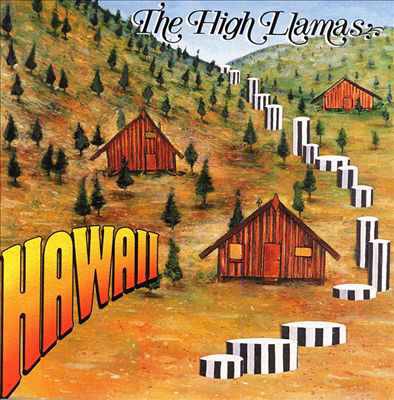
 One of the more curious entries listed in the original ‘Perfect Collection’ was ‘Discover America’ by Van Dyke Parks. Parks is of course the musical genius who worked with Brian Wilson on The Beach Boys’ ‘Smile’ project, his legacy immortalised by the salvaged fruit of that aborted collaboration, songs such as ‘Heroes & Villains’ and ‘Surfs Up’ now universally recognised as amongst the band’s greatest ever achievements. ‘Discover America’, although not the first VDP solo outing, is a very strange album indeed. Originally released in 1972, it was recorded with members of Little Feat and a Trinidadian Steel Band, largely in a bizarre calypso style. I imagine Sean O’Hagan the founder, composer and leader of The High Llamas to be very fond of it. The Llamas’ second full length album ‘Hawaii’ was released 20 years ago this week, and while the two records cannot really be equated stylistically, nevertheless the way they were conceived is not dissimilar, both being highly idiosyncratic panoptic musical odysseys.

Clocking in at over 76 minutes and featuring 29 tracks (although around ten or so serve as seams between the songs) ‘Hawaii’ was a hugely ambitious project, a sun-drenched compendium of chamber pop, bossa nova, sweeping Fordian (John, not Henry) Americana, pacific bluegrass, old-style waltzes, and Morricone inspired exotica, all glued together by bleary string passages and fragments of space-age electronica, reminiscent of O’Hagan’s synchronous work with Stereolab. The album is best listened to in its entirety; and does not lend itself particularly well to an iPod shuffle. Someone once remarked that if the tracks were rearranged on The Band’s second (eponymously titled) LP, it would be like jumbling up the chapters of a great novel. Well, the rupture to continuity would be similar with ‘Hawaii’, which – while on the subject of The Band – even features a nod to the pine forest wooziness of John Simon’s production, on the marvellously evocative ‘Pilgrims’.

If ‘Sparkle Up’ reminds me – in the best possible way – of the music from both the ITV soap Crossroads and Monty Norman’s Bond theme, then the swooning grace of ‘Literature Is Fluff’ calls to mind the soundtracks to Fellini’s ‘Juliet Of The Spirits’ and ‘La Dolce Vita’, with psych guitar buried beneath a swathe of baroque harpsichord and strings. Both ‘Peppy’ and the single ‘Nomads’ are pushed along by jaunty banjo and brass, while the wistful flute of ‘Cuckoo’s Out’ owes a nod to the dusky late summer languor of Joe Boyd’s production on ‘Bryter Layter’.

‘Doo Wop Property’ and ‘Island People’ once again showcase those strings which seem to yearn for a romantic return to a lost (gentler) golden age of America with as much nostalgia as Welles did in ‘The Magnificent Ambersons’. ‘The Hokey Curator’ is short but unbearably beautiful, containing a melting chord sequence ravishing enough to give Burt Bacharach sleepless nights. 

 The closest thing to a centre-piece on the album is perhaps ‘Ill-fitting Suits’, a truly sublime piano piece with slumberous meandering vibraphone, big kisses of brass punctuated with pizzicato, and washes of brooding cello – it makes a welcome reappearance as an instrumental reprise to the album. ‘Dressing Up The Old Dakota’ twists on the last flat note of the verses, giving new impetus to the beginning of each of the following ones, until from the mid-way point the string section and the old ivories get locked in a gloriously discordant tug-of-war. Meanwhile ‘Theatreland’ sounds more contemporary and conventional, the closest O’Hagan gets here to here to revisiting the sound of Microdisney, and ‘Campers In Control’ is R&B a la Llamas with its rising doo-wop rhythm given a shimmering makeover with harmonies befitting the late 60s sunshine pop of The Turtles or The Association. The musicianship throughout is superb, the arrangements beautifully measured, and for that much of the credit should be shared with multi-instrumentalist Marcus Holdaway, whom O’Hagan has credited as “the best musician I have ever encountered [who] has totally visualised the way I work.”

It has been a continual source of frustration for O’Hagan that his music is reduced to something akin to a facsimile of that which The Beach Boys produced between 1966-73. It is unquestionably much more than that. ‘Hawaii’ effortlessly transcends the perennial accusation that it is little more than an omnibus edition of ‘Friends’ or ‘Holland’, being sufficiently capacious to incorporate a veritable potpourri of influences. Speaking to TNPC, O’Hagan recalls: “The critics at the time simply could not keep up. They had no idea where we were going with these influences. There were plenty of British cinema references, a bit too of Gene Clark’s odd floundering LA Sessions, Nina Rota, Bernard Herman, Mingus. No critic heard any of this, even though the clues were jumping up and waving red flags!”

 Nevertheless, ‘Hawaii’ is an album which brought O’Hagan close to a commission to co-create with Brian Wilson a Beach Boys reunion album in the late 1990s. Sean’s brief encounter with the band might read as pure comedy gold (http://uncanny1.blogspot.co.uk/2005/05/brian-wilsonandy-paleysean-ohagan.html?m=1) but one imagines for O’Hagan himself, the humblest of souls, it must have been a most disquieting experience, cathartic even – and certainly, post-Hawaii, the influence of Wilson & co. seemed to be with each subsequent release, ever less discernible.

 The High Llamas never make Top 100 Albums lists, but to those that love their music, O’Hagan is quite simply a musical genius. He is sometimes unfairly criticised for a penchant for slipping all too comfortably into easy listening territory and also for his lyrical obtuseness. As regards the former point, well some people are simply too much the children of 1977 to make allowance for that. As for the lyrics, some have suggested he has cloistered his soul away – taciturn by nature, he seems unwilling to make his music a forum for wrestling with the complexities of existence; some that his rather abstract observations are designed so as not to detract from the sumptuousness of the music, a strategy followed by others such as The Cocteau Twins (few complained of their lyrical ‘deficiencies’). Not so. It is important to remember that O’Hagan’s first songwriting partner was Cathal Coughlan, highly literate, fiercely intelligent, “a writer of such originality and strength, my teacher”. O’Hagan has consciously steered away from writing anything which could be considered emotionally trite in his lyrics, most pop songs being for him “a string of cliche”, and while he acknowledges his own limitations, he has sought refuge and inspiration in the rich poetic strain of wordsmiths such as Parks, Dylan and Will Oldham. 

 And so there is a playfulness to the writing which, rather than invite a personal emotional response from the listener, invites us rather to conjure in our minds specific scenes in the imaginary lives of the songs’ protagonists: (“Take care to avoid the heavy stuff/I give up, this literature is fluff/Trawled through sketches of notes the night before/Chased the baffled employess floor to floor/Hung a ‘do not disturb’ on glass swing doors.”) This is a writer who clearly loves words as much as music, but words of love he shall not write. In their place, he documents the mini dramas of an amateur theatre company unfolding on a creaking old stage or observes a military operation undertaken to cordon off hotel grounds – we listen intently, sufficiently detached from the humdrum of their activities to enable us to create our own little mental retreat, a supine sanctum of uncommonly blissful sound. If ever there was a disc made for a desert island then this is it. (JJ)

73. MAGAZINE – REAL LIFE (1978) / (A) THE CORRECT USE OF SOAP (1980)


REAL LIFE – MAGAZINE (1978)

Like history as a whole, the chronology of music is not a neat, compact narrative. However much some might try to corral it all into tidy, reductive processions of cause and effect, it’s far too multi-layered, unscripted, complex and, in truth, messy, to be so easily, glibly packaged into received wisdom. Did Buddy Holly’s death and Elvis’ draft really lead directly to the neutering and ocean-level dilution of rock ‘n’ roll? Was the Beatles’ vertiginous take-off in America truly the result of a bereft and bewildered nation looking to assuage its grief over its slain leader? And can anyone really definitively call New Rose the first British punk single, as if genre can be as precisely prescribed as geography?

Near the head of this parade of assertions, which marches along the main thoroughfares, bypassing the blind alleys, cul-de-sacs and branch roads which lead to equally captivating destinations, is the notion that the Pistols’ gig at Manchester’s Lesser Free Trade Hall in June, 1976 directly unleashed the ferment that would pour forth from the city for the best part of two decades. Without question, it was a catalyst, but in the literal, chemical definition of accelerating something happening independently. The proof is that the event – an alternative to an evening’s viewing which included Des O’Connor Entertains and Winner Takes All with Jimmy Tarbuck – was organised by two Mancunian minds which had been fizzing with original but hard to fulfil ideas for some time – Howard Devoto and Pete Shelley of the slowly but resolutely burgeoning Buzzcocks.

Shelley had already been exploring electronics for a number of years – his composition Sky Yen, recorded in 1974, resembled a loop of the ZX Spectrum programme he would later include on his solo album XL1 – while ultra-literate humanities student and Dylan fan Devoto (ne Trafford, a name too Mancunially loaded to keep in that city for long) would soon be honing one of the sharpest and most original lyrical styles in music.

After Buzzcocks recorded the groundbreaking and still astounding Spiral Scratch right at the end of ’76, Devoto was out before British punk had even got its Docs on. He already found it had become “aesthetically ugly;” while it wouldn’t be truly straitjacketed until the lamentable arrival of oi!, he was right to be plotting a way out before expectations became too rigid and the horizons of some barely spanned from thumb to forefinger.

His response was Magazine, who announced themselves with Shot By Both Sides, not so much a single as a manifesto, broiling with as much energy as any of its peers but voicing cold war anxiety in a manner which reminded you that these weren’t just pat, flip cliches – if somebody flips a switch, that’s it, for all of us. This, you feel, is what Devoto is getting at when he declaims: “I was shocked to find what was allowed;” no one had ever sounded as sardonic as this – not Dylan, not Reed, not even the Rotten rapidly turning back into Lydon – and you can hear his mouth crumple into a virulent grin at the end of every line. But the shock is not the synthetic outrage of a middle-market tabloid reader. It’s that of someone with a conscience, a moral centre, unable to take in what they see, when “They all sound the same when they scream,” like the creatures at the end of Animal Farm looking from pig to man and man to pig, by now indistiguishable.

Magazine and Buzzcocks actually took closer paths than is often acknowledged – behind the beguiling melodies and ambiguous love songs, the latter were continually messing with texture, rhythm, noise, the Can influence always just a micron below the surface, and Shot By Both Sides was the gene Devoto left behind. With Shelley’s lyrics, it became Lipstick for Buzzcocks, ushering in a small but significant post-punk strand of joint custody songs (also Read It In Books by the Bunnymen/Teardrop Explodes, Adventures Close To Home by the Raincoats/Slits, Sister Midnight by Iggy/Red Money by Bowie and Our Lips Are Sealed by the Go-Gos/Fun Boy Three.

The keyboards are barely audible on Shot By Both Sides but, beneath the fingers of Dave Formula, they would be what most immediately set Magazine apart from most of their contemporaries – apart from Ultravox!, hardly any others dared to commit such a technoflash transgression. Compared with the concert-piano level synths by then being deployed by Bowie and Kraftwerk, Formula’s are harpsichords and spinets but like those instruments, they radiate extraordinary beauty, like the Heath Robinson glories of Eno’s non-musician adventures in Roxy Music or the HG Wells future visions of the BBC Radiophonic Workshop.

Simple Minds’ Jim Kerr – a Magazine fan from the start who would later have the effrontery to purloin the title of Real Life for his own band’s worst album – once declared that, Devoto excepted, they were “wallies…dullheads, completely unaware of the greatness they were part of.” Well, he met them, I didn’t, but it seems an extraordinarily harsh judgement on Formula, a former R & B musician whose youthful imagination had been fired by Yuri Gagarin’s trade union-brokered 1961 visit to Manchester; on bassist Barry Adamson, who would go on to be the heartbeat of darkness on the Bad Seeds’ most unforgiving adventures and to legitimise almost single-handedly the whole dubious enterprise of imaginary film soundtracks (his reward being to get to soundtrack actual films by Carl Colpaert and David Lynch), and on the late John McGeoch, born in Greenock – not 20 miles from where I’m writing – who approached the guitar in the way a brutalist architect might approach bricks, not setting out to make something beautiful and making few concessions to accepted notions of beauty but frequently achieving it anyway.

Take Definitive Gaze, one of the most assured and self-possessed openers in history. Adamson pursues the melody, a vigorous funk figure trapped in proto-video game Pong, while drummer Martin Jackson displays as much flair for tension and release as any chops-wielding session pro, pocketing the odd rimshot when nobody’s looking, and Formula combines freeform discordant piano flourishes with suitably spooky synth (I once put this song on a tape for an obsessive Cure fan who, disappointingly, found no trace of the influence on his heroes, instead hearing only the theme from Scooby Doo). McGeoch plays only what he needs to play – not a note more or less – and Devoto describes an all-seeing eye which appears to be more curse than gift (“Clarity has reared its ugly head again…Now I’m lost in shock/ Your face fits perfectly”).
He takes a similarly skewed view of affairs of the heart on Burst and Parade, the songs which once closed each side. On the former, McGeogh takes Hendrix’s The Burning Of The Midnight Lamp as a tuning fork but heads off in a very different direction, creating a claustrophobic and clenched setting for one of Devoto’s finest anti-love songs (“Once you had this promise/On the tip of your tongue/Needless to say/It went on too long). Despite the title (as in “burst into flames”) it’s compressed, a big crunch waiting to happen as Devoto repeats “You will forget yourself in my happiness,” like the incantation of a contract hypnotist – all as taut and coiled as Television’s Torn Curtain.

Parade is mellower, more refined, with elegant piano by Formula, frissons of wah-wah by McGeoch and a striding rhythm box underpinning Jackson’s tympani-like thunderclaps. But it’s still Howard Devoto out front and he sounds no more comfortable than before, still refusing to bow to sentimentality (“Sometimes I forget that we’re supposed to be in love/Sometimes I forget my position) offering yet more claustrophobia, this time shackled to paranoia (“It’s so hot in here/What are they trying to hatch?”) and proposing desperate courage as a solution (“We must not be frail – we must watch). It’s the fate of all slow and stylish songs to be labelled ballads but it would be an outright misnomer for songs as fraught and gripping as these – if you can think of a better word, let me know.

The fleet and the florid combine in Motorcade, where early languour yields to a pace almost beyond human capacity and McGeoch triumphs again, building on a well-worn siren sound by twisting it into unidentifiable shapes. It seems to allude to the Kennedy assassination but it may be too obvious – and where does the bathos of “The man at the centre of the motorcade/Has learned to tie his boots” fit in? Still, no one ever got right to the root of Oswald’s motive, so enigmatic images of “a snake in the closet” and the choice between coffee and tea are yet more layers on an unfathomable puzzle.

Magazine were never more brilliantly brash than on The Light Pours Out Of Me – come to think of it, not many others have been. Its rhythm could keep a city’s lights on if played on a loop and McGeoch takes a familiar glam riff out of its platform heel into a glass slipper. Formula’s synths are again sparingly used but the space left by their absence creates a canyon for Devoto to descend “like an insect/Up and down the walls.” He’s still accepting no commissions from Hallmark – “It jerks out of me like blood/In this still life/Heart beats up love-” and we’re back to full Buzzcocks circle, with the last line escaping from its earlier appearance on the sleeve of Spiral Scratch. There are more thrilling, elemental, force-of-nature songs than The Light Pours Out Of Me – but not many.

Unfortunately, many of those in awe of Magazine missed the opportunity to make their own magic from their influence. Magazine inspired Simple Minds at their best but were powerless to prevent them sinking to their worst. Mick Hucknall is said to have been a regular at their early gigs. Marti Pellow once averred that, early on, Wet Wet Wet wanted to be Magazine – Magazine, a band of potency and dexterity, utterly devoid of clumsiness, smarm or schmaltz – what happened? I guess it’s just real life but you can always turn to Real Life instead (PG).

THE CORRECT USE OF SOAP (1980)  “I am angry, I am ill and I’m as ugly as sin / My irritability keeps me alive and kicking.” (A Song From Under The Floorboards.’)

One might surmise from his recordings that life for Howard Devoto was a cruel joke. Love meanwhile was a pointless charade, a game played by fools. There’s a 1980 Australian TV interview with him (sporting a Nietzsche baseball cap) larking around in a laundrette – where he discusses ‘superior hygiene’ and ‘ulterior cleanliness’ as well as his imaginary Ni-etz-sche Removal & Trucking business venture. Devoto cultivated the image of irascible bugger, someone to rival Mark E Smith or John Lydon for ultra-contrariness, Scott Walker or Eno for inscrutable mystique. What is more interesting about the interview is Devoto’s response to being questioned about his decision to leave The Buzzcocks in order to form Magazine. He attributes that to his ‘revolutionary idea that one could play slow songs‘. If Magazine harnessed some of the fizz and fury of punk, they also recognised in its mediocre uniformity, something stultifying rather than liberating. Without question, Howard would rather have been Bowie than Strummer, and Magazine likewise Can, Roxy or Ubu instead of The Pistols.

“You could do me a favour/Do whatever you want to/I will let you hurt me/Because I know it hurts you/It hurts you.” Devoto snarls with trademark acridity on the wonderfully odd ‘I’m A Party’, which while featuring a slightly extraneous jazz break, unfurls to reveal Dave Formula’s filmic synth and John McGeoch’s nervy guitar lines. McGeoch was one of the great under-rated lead guitarists; he often sounded like he was working in his own little bubble, nowhere more than here, surreptitiously stitching out taut geometric patterns redolent of a column of ants scratching out a new colony. Or listen to him virtually ignite his fretboard on the magnificent speed-fuelled ‘Philadelphia’. Here is Magazine in all its glory – Barry Adamson’s throbbing bass bubbling like a pregnant geyser, Formula’s shrieking keyboard wizardry and Devoto’s rueful witticisms: ‘Everything’d be just fine/If I had the right pastime/I’d’ve been Raskolnikov/But mother nature ripped me off…‘ Glorious stuff.

In some ways the flamboyance and range of the music is utterly at odds with the bleak cynicism of the lyrics. And Devoto makes true on his promise to play some slow ones, these offering a sharp contrast to their more convulsive companions. The stately piano and soulful backing vocals on ‘You Never Knew Me’ sound warmer, but Devoto’s lyrics remain implacably acerbic (‘Thank God that I don’t love you/All of that’s behind me now/Still seems to be above you’), rivalling Dylan at his sardonic ’65 peak; while elsewhere he confesses to his own (masochistic?) weakness and compulsion: ‘But I still turn to love, I want to burn again.’

That dark sense of humour is accompanied by both political observation (‘Model Worker’ envisages the moral quandary of the Soviet proletarian who dares to dream of a better future: ‘I’m sick of working on the land/I wanna work with machines and look handsome.’) and an incisive eye for detail: ‘We drank from cups on standard issue/Sofas under scaffolding/Informed sources said we were seen/By observers it’s a meeting.’ (from ‘Sweetheart Contract’ – a genuinely classic single).

One can as easily imagine Devoto firing the band and taking himself off in a huff to record the whole thing on an acoustic guitar. Then he might have delivered a rival to ‘Sister Lovers’ or ‘Blood On The Tracks’. But as he says himself: “I know beauty and I know a good thing when I see it” so thankfully Magazine’s audience was gifted with songs like ‘Stuck’, a squelching stinging funk conundrum which comes across as something like a post-punk Weather Report and is quite magnificent.

If their brilliant debut ‘Real Life’ had a bold, metallic and expansive sound, Magazine’s follow up, ‘Secondhand Daylight’ was dense, feverish and – on the colour spectrum – undoubtedly grey. With Martin Hannett – having recently applied the finishing touches to ‘Closer’ by Manchester’s more celebrated musical sons – at the mixing desk, ‘The Correct Use Of Soap’ successfully managed to add a layer of polish to proceedings, but the album’s claustrophobic sound and misanthropic soul gave new meaning to the old cliche ‘all that glitters is not gold’. It sounds as thrillingly vibrant today as ever and stands unparalleled as a gallery of lavish but caustic portraits, a repository of glistening miserabilism. (JJ)

PS. ‘I’ve got a good face for memories’:
The first critics poll of greatest albums I remember (and still my favourite list of this kind by miles), was the MME’s (100) Greatest Records Ever Made, published in November 1985. It was the first time I had ever bought an issue of the NME, and I in my innocence immediately took the contents of its poll as gospel, seeing in it the definitive selection of the essential albums every serious music fan should own. It was a marvellously flawed collection, by turns intriguing (only one Stones, no Sgt. Pepper), eclectic (plenty of jazz, blues, reggae and soul alongside a plethora of post-punk) and bewildering (no Can, Byrds or Fall, while ‘Mad Not Mad’ at no. 55 today looks simply bizarre). To the best of my knowledge, it is the only such list ever to feature The Correct Use Of Soap, a mere five years young at the time.* I built my record collection around that list, beginning with the low/mid-price albums which had the coolest sleeves and graduating on to the more expensive ones afterwards. It was an education of sorts. I eventually got round to buying The Correct Use Of Soap, fittingly from Virgin Records, in January 1987, proudly clutching to my chest its glitzy post-modernist sleeve alongside another purchase I made that day, Sly & The Family Stone’s star-spangled ‘There’s A Riot Goin’ On’. My abiding memory of that evening is hearing two very different but equally blistering versions of Sly’s ‘Thank You Falettinme Be Mice Elf Again’ which to my complete surprise, appeared on both albums.

*[Sounds magazine retorted with their own Top 100 and that one featured Real Life, but as it had four Alice Cooper albums in there, I figured the NME probably had it right. No harm to Alice Cooper, but four!?]

71. RANDY NEWMAN – RANDY NEWMAN (1968)

RANDY NEWMAN – RANDY NEWMAN (1968) 
My introduction to Randy Newman came even earlier than I realised. It was 1974, I was five and I was a few green months into primary school. Before the ruthlessly efficient, stripped-and-stranded TV scheduling of today, unforseen gaps would on occasion appear between programmes, in the grand interlude tradition of the potter’s wheel and the kitten frolicking.
One such hole was plugged by a cartoon accompanying a song which told the commonplace story of a couple travelling through life. I hardly knew anything of such matters at the time but it appeared straightforward enough: meeting; marrying; having children. Only the last line of the song stuck but it haunted me for years: as I recalled, it was a female voice singing: “We’ll play checkers all day/until we pass away,” as the now elderly couple vanish from either side of the board. It may well have been the first time I gave any thought to mortality, so strange and sad did I find it.
Scene fades…it’s now 14 February 1988. Without the remotest prospect of getting a card, it’s just another day for 19-year-old me but, it being a Sunday, Annie Nightingale is on and she’s doing a Valentine’s Day special, in which every song played includes the word ‘love’ in  the title and is one more display of the sheer unpredictability of her show which reached its apogee the night she played Duran Duran and immediately followed  them with Bogshed . I hear what are by now the familiar tones of Randy Newman – droll, drawling, dry – clothed in sumptuous orchestration which gives way to a similarly lush  chorus echoing Spector with precision. Hints of Dixie jazz, hints of minstrel tunes – and then that lifelong  game of draughts again. Love Story by Randy Newman – first part of the mystery solved.
It would take the internet’s reduction of total mysteries to double figures before the puzzle would be complete. The first version I heard, complete with animation, turned out to be by Sonny and Cher – they’d performed it for their own show, even as it was rapidly losing autobiographical status for them.
And Love Story turned out to be the opener of Newman’s debut album. Even in 1968, its subtitle – Randy Newman Creates Something New Under The Sun – must have seemed a shade brazen. Though decades would pass before all the possibilities of Popular Music were finally exhausted, there was already an end-of-history mood prevailing. Psychedelia and its attendant adventures far from rock ‘n’ roll’s roots were already being dismissed by many – and still are to this day – as an aberration. Practically every leading figure released something that year which, while ranking among their best, was again holding fast to Earth rather than exploring further into space, even as the first lunar footfalls approached fast (years later, in his soundtrack for Apollo documentary For All Mankind, Brian Eno would explore the paradox of astronauts listening to country – one of the most Earthbound of all genres – as they ploughed through the vastness).
But like The Band, and to some extent Bob Dylan, Newman was digging back further still. Not quite as far as The Band’s evocations of the Civil War but to the first third of the 20th century,  a superficially genteel land of barbershop quartets, rocking chairs on antebellum porches and straw boaters tipped to every passing parasol-twirling dame, all the stranger for being well within living memory yet utterly bygone. He was steeped in this stuff, with with three composer uncles whose credits stretched from Modern Times, The Grapes Of Wrath and The Best Years Of Our Lives to Cleopatra and Alien. Characteristically, he embraced his heritage but with more than enough guile, bile and style to find favour with the burgeoning Serious Rock audience. As a practitioner of the now thoroughly debased (with a few exceptions, trite, wheedling and spectacularly point-missing in the 21st century) singer-songwriter genre, Dylan comparisons came like death and taxes…but listen to him singing “so hard” on Living Without You and then Boaby’s “so bad” and “so sad” on One Of Us Must Know and it’s valid for a moment at least.
And they’re both controversial voices. Add them to a long list – Ray Davies, Neil Young, Bryan Ferry, Robert Wyatt, Joanna Newsom, Anthony Hegarty; in fact, the oft-told story about Newman’s debut is that Reprise felt compelled to advertise the album with the somewhat backhanded  tag  “Once you get used to it, his voice is really something” but in vain  – low sales followed. True, Newman does usually  sound like he’s never more than a few seconds away from making a wisecrack about your choice of shirt but he sounds genuinely wounded on the aforementioned Living Without You, while the sauntering melodic nonchalance of Bet No One Ever Hurt This Bad belies what seems to be real sorrow – or is it one of the double bluffs which Newman tosses up to keep us on our toes? (see also: Rednecks, which satirises not only the racists but also the smug superiority that wealthy, educated types feel towards them; Mr Sheep, which mocks not the office drone but the arrogant rock star sneering at the office drone, and, most notoriously, Short People, which was proven to be a masterclass in genuine irony by its mass misinterpretation). Maybe they can just be taken at face value after all – I’m not aware of  him having done his own version of I Don’t Want To Hear It Anymore but Dusty Springfield’s interpretation reaches Great Pumpkin levels of sincerity. When Newman sings, though, he just keeps you guessing; the son in So Long Dad seems as devoted as he needs to be but is still impatient and in a hurry (“Just drop by when it’s convenient to/Be sure and call before you do”) yet its mirror image, Old Man (on 1972’s Sail Away) ends with as devastating a line as you’ll find anywhere – “Don’t cry old man, don’t cry/Everybody dies.”
Another likely consequence of the divisiveness of Newman’s voice is that
many of his songs have become  better known through versions by others but few of these have improved on his. One of the best known covers is Three Dog Night’s version of Mama Told Me Not To Come, from 1970’s 12 Songs. Newman is said to have observed that they gave it a chorus he never did but I’ve always found their attempt pretty awful – I’m usually a sucker for electric piano but theirs is a smarmy burble and that chorus is in the type of hammy, overwrought voices which were all too prevalent at the time. They also had a stab at Cowboy, which is on Newman’s first album – it’s more tolerable but again, he triumphs easily – the verses are sotto voce but the arrival of the orchestra for the chorus is truly startling,  batwing doors not so much flung open as  breached with a battering ram.
With Newman’s own arrangement and the deft production of stalwarts Lenny Waronker and Van Dyke Parks, it’s the sort of thing John Ford might have commissioned (commanded?) for one last bold sweep of Monument Valley before the credits roll. The lyrics, though, reflect more a Sam Peckinpah vision of a landscape changing too rapidly for its inhabitants to keep up with (“Cold grey buildings where a hill should be/Steel and concrete closing in on me.”) It was a reality for many as alleged progress rode roughshod over communities – Family offered a British perspective on the same theme later the same year with Hometown.
I Think He’s Hiding is one of Newman’s numerous meditations on the nature, attitude and, ultimately, existence of God. Here, he offers the view of those who believe in both a merciful (“There’ll be no more teardrops/There’ll be no more sorrow”) and a vengeful (“When the Big Boy brings his fiery furnace/Will He like what He sees/Or will He strike the fire and burn us?”) deity before hedging his own bets to a hushed and subdued accompaniment. Even more minimal is I Think It’s Going To Rain Today, which has become possibly Newman’s most covered song – maybe because it’s so spare that there’s a widely felt need to embellish it. There’d be a decent album to be had from compiling the best versions but Newman’s would have to be among them – you strain to hear him whisper (even Leonard Cohen took 20 years to reach this depth of register) and when you catch what he says, it still seems densely enigmatic (“Scarecrows dressed in the latest styles/ With frozen smiles to chase love away). In its strange invocation of solitude in a sparse landscape, like many songs here it’s unequivocally American but deals in universal themes, in style as finely etched as a Whistler and in content as acutely observed as an Edward Hopper – and the whole album packed with these brilliantly crafted miniatures is over in under 28 minutes.
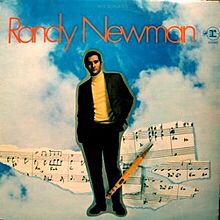
Newman seems so unassuming on the cover; in houndstooth jacket and yellow turtleneck, and minus the curls and glasses which would later be his visual trademark, he could almost be mistaken for Neil Sedaka. There’s no more sign of him as the unofficial biographer of human foibles than there is in some of his more recent, far better known activities. To many, he is just Toy Story Guy, and that’s fine – there aren’t many films that offer more sheer joy (though for what it’s worth, I actually prefer Toy Story 2) but there’s a further frisson to be gained from the knowledge that he could also write (from Laughing Boy): “Find a clown and grind him down/He may just be laughing at you/An unprincipled and uncommitted clown/Can hardly be permitted to/Sit around and laugh at what/The decent people try to do.” (PG)

70. ANNETTE PEACOCK – I’M THE ONE (1972)


Cover versions are more often than not a waste of time, but not always. The best recorded versions of ‘Heartbreak Hotel’ and
‘Love Me Tender’ are not by Elvis Presley, but by John Cale and Annette Peacock respectively. Cale recognised the potential for a sonic overhaul of Mae Boren Axton & Tommy Durden’s classic, in order to provide a more suitably unsettling backdrop to the familiar tragic narrative. Similarly, with ‘Love Me Tender’, Peacock was able to excavate the cracks and crevices of that yawning cave to extract from it every ounce of emotional nectar, every last drop of raw-nerved soul. Hers is one of the most striking cover versions ever recorded and one of the highlights on I’m The One, her first official solo album released in 1972.

In addition to being a great interpreter of others’ songs, Annette Peacock is also a true innovator. I first heard ‘I’m The One’ around 25 years ago. I had given one of my TNPC colleagues a loan of Tim Buckley’s Starsailor LP, and in return he had alerted me to Annette’s solo debut. Comparisons have sometimes been made between the two. However, unlike Buckley, who reputedly eschewed any electronic augmentation of his voice on Starsailor, Peacock was unafraid to embrace new technologies – she had already written, performed and recorded experimental music with the late free jazz pianist Paul Bley in the late 1960s (including a showcase performance at the Lincoln Centre, NYC) and was keen to explore the possibilities of processing her voice through a Moog synthesiser. The story of her acquisition of this equipment and it’s incorporation into the recording of ‘I’m The One’ has been documented elsewhere, including in a brilliantly insightful interview with Annette in The Quietus – see below:

(http://thequietus.com/articles/15423-annette-peacock-interview)

The results were sensational. What I heard then astonished me. Even though the album was almost 20 years old, I felt immediately transported 50 years into the future, as if I was suddenly creeping through a smoky jazz bar in a sparsely populated embryonic human settlement on a Martian plain. A slinky, incredibly hip android fixed me with her gaze. From behind a stack of strange electronic equipment, she sang her visionary take on the blues.

Today, in a world of vapid auto tune and essentially formulaic stylised X-Factor singing, which follows a peculiar trajectory from Stevie Wonder through Mariah Carey and Alicia Keys, and which often values technical virtuosity above authentic soulfulness, how refreshing it is to hear something both at once so earthy, rooted firmly in jazz and blues, yet at the same time wildly unconventional and truly original. Peacock’s musical ethos was simply to sound as contemporary as possible, not to be wilfully obscurant or self-consciously avant-garde, but as a consequence of her enthusiasm to explore and innovate it is only now that I’m The One is getting some long overdue recognition. The world it seems is still catching up.

From the Sun Ra-esque introduction featuring a startling vocal ascent through the scales, Peacock rips through the material, a vivacious blend of avant-garde jazz, funk, blues and soul (‘One Way’ has the lot: space age jazz, swinging cabaret, squawking horns, Annette’s wild shrieking and not least, Tom Cosgrove’s formidable coiled guitar)

On ‘Pony’ the voice processing is integrated so smoothly that it sounds akin to some of Miles’ horn squeezing from On The Corner. Here the electronics bubble and fizz, as if Alan Ravenstine from Pere Ubu has been let loose to roam the stoned corridors of a Curtis Mayfield blaxploitation groove. It’s one of the coolest, funkiest things you’ll ever hear. ‘Blood’s improvisational synth rumblings are darker, befitting Annette’s anguished delivery, but give way to Bley’s more bluesy (almost Touissaint-y) piano at the finale.

But it is the title track itself which best encapsulates Peacock’s vision. I’m trying hard to imagine what this must have sounded like in 1971 when it was recorded. This would have been around the same time as What’s Going On,  Hunky Dory’ etc. Indeed David Bowie was so taken with it, that, a year or so afterwards, he attempted to entice Peacock to contribute to his work in progress, Aladdin Sane. She refused. What sounds initially like a cerebral intergalactic conference becomes a red-blooded alien seduction – a lusty and libidinous Venus flytrap [I’m the one,/I’m the one/You don’t have to look any further/I’m the one/…I’m here, right here, for you/Can’t you see it in my eyes/Can’t you hear it in my voice/Can’t you feel it in my skin/When you’re buried deep within me/I’m the one for you]

Laurie Anderson, Eno and Bjork are amongst many who succumbed to the spell. Peacock would go on to deliver a follow up of equally intense and frank eroticism (XDreams). That one featured an all-star cast including Mick Ronson, Chris Spedding and Bill Bruford. But little of what was happening in 1971 compares to the power and glory on display here. This my friend, is the one. (JJ)

67. SPRING HILL FAIR – GO-BETWEENS (1984)


Gig-going regrets? We all have them- some can still be rectified, others can’t and some, owing to accidents of birth and geography, are too futile to dwell on but my realistic reasons for ruefulness include: never seeing Jeff Buckley or Stereolab; not seeing REM until 1989; being compelled to pass on an Al Green gig owing to farcical ticket prices and deciding to go and see the Cramps a second time.
But my most lingering pang arises from a calamity with the Go-Betweens in 1997. Having fallen hard for them after seing them a decade earlier and mourned their demise three years after that, their resumption was like discovering that a treasured item feared binned had actually been sitting in the cupboard all along. The cupboard on this particular Friday night was Glasgow’s Garage; at this time, I was working some 60 miles from the city and, as a rule, stayed away during the week then returned at weekends.

That evening, I got away from the office later than I’d hoped and arrived, flustered and frustrated, to hear them playing Draining The Pool For You, followed by Bachelor Kisses. Their set ended about 20 minutes later and the intakes of breath which followed my revelation of the first songs I heard told me just how much I’d missed.

The fact that this still rankles to the extent it does 18 years on speaks partly of a petty inability just to let go – but also of how much the Go-Betweens have come to mean to me. And those two songs can be found nestling on Spring Hill Fair, as fine an introduction to them as any of their albums.

Practically everything that’s been written about the Go-Betweens over the past quarter-century – including, I confess, a piece written by me as a callow student in 1990 – has laid great emphasis on the chasm between their critical acclaim and the quality of their music on one hand and their commercial success on the other. I see little value in going over this well-worn ground once again – what counts is that their music exists and is easily tracked down. Those who have yet to hear them are to be envied.

Spring Hill Fair, their third album, captures them in transition. Often, this can mean a patchy record with inconsistent focus – think of Another Side Of Bob Dylan, where there’s a Ballad in Plain D for every Chimes Of Freedom – but here, the subtle shift from the coiled-spring dramas they had so far specialised in to more elegantly crafted portraits is rounded and complete, meaning that the shift is no clunking handbrake turn but is seamless, almost imperceptible, bound together by the unifying theme of the turmoil of adult, but still often quite irrational, romantic intrigue.

Bachelor Kisses (introduced that fateful night at the Garage as “a song from France 1984” despite being the only Spring Hill Fair song not recorded there) opens proceedings and it’s a challenge to put into words how exquisitely beautiful it is. Clouded in a mist of synths so all-enveloping that they haven’t dated a second, it no more strays into sentimentality or smarm than William Blake strayed into limericks, tethered as it is by a rough-edged guitar solo which only casts the song’s sweetness into greater relief – as do the harmonies of the Raincoats’ Ana Da Silva (credited as Anna Silva) . Grant McLennan gives a warning to stay away from the cads and sugar daddies but does so without being patronising – it’s not a message to be given lightly (“Hands, hands like hooks/You’ll get hurt if you play with crooks”) and it can yield rewards (“Faithful’s not a bad word.”)

Five Words captures the Go-Betweens in-between, the looping melody straining and almost snapping but finally pulling itself straight against Lindy Morrison’s marching-yet-still-dragging its-heels beat. The words turn out to be “Bury them don’t keep ’em” – memories? Secrets? We never learn – another enigma from some of the finest purveyors of them. The ’80s produced few songs as restless yet simultaneously sure-footed as You’ve Never Lived, where a laser of a chorus cohabits with guitars that seethe like troublesome insects as Robert Forster delivers some of the finest of his many lines of suavely savage self-deprecation (“I’m no genius, just a former genius, a shadow of the genius/That I am.”) It’s the concoction that Franz Ferdinand have been grasping after for the past decade but have never quite clutched.

He’s at it again on the imperious Part Company, where there’s a brief mock-epic flourish (“From the first letter I got to this, her Bill of Rights”) and Forster’s brilliantly offhanded truncation of the middle syllable in “company,” as if to undercut the elegance that surrounds him, from the solemnly enunicated guitar figure to the ghostly apparel of that most ’80s of accessories, the Prophet synth, which is saved from being trapped in dayglo amber by its near-perfect mimicry of a theremin.

The McLennan monologue River Of Money has been compared more than once to the Velvet Underground’s The Gift but the similarity is more musical than lyrical, with a shared muscular, squealing feel to the backdrops. Where The Gift is a fully-realised short story, with plot, action, shifts of scene and grim twist, River Of Money is more meditative; it observes a general state of mind (“It is neither fair nor reasonable to expect sadness to confine itself to its causes”) and applies it to a particular case of him having to accept she’s gone and won’t be back. He fails, her memory blotted out neither by travel (“Snow which he had never seen before, was only frozen water”), drink (“Bottles had almost emptied themselves without effect”) or even simple domestic pleasures (“The television, a samaritan during other tribulations, had been repossessed). In this, it has more in common with Lou Reed’s solo Last Great American Whale – which appeared four and a half years later. An influence? We’ll probably never know but it’s an intriguing thought.

Forster’s now notorious theory, expounded in his book The 10 Rules of Rock and Roll, that an album’s penultimate song is always its weakest is comprehensively disproved on Spring Hill Fair. McLennan’s Unkind and Unwise is almost the archetypal Go-Betweens song, with a locomotive thrust and a semi-autobiographical lyric speckled with natural imagery (“Burn in a river tangled with reeds/While a crane on the water silently feeds”) and sneaking in at just under three minutes, it dabbles in perfection and decides to hang on to it. There’s some fun had on the lyric sheet of Spring Hill Fair, with droll asides dotted across the songs, and the fade of Unkind and Unwise is heralded with “(repeat till cicadas join in the fun).” Blow me if I didn’t have to reach for the dictionary and discover that the song would be fading long into the night with cricket-like creatures.

In his excellent biography of the Go-Betweens, David Nichols asserts that Spring Hill Fair “doesn’t quite seem to come up to scratch” and suggests it may be too diverse to be cohesive. To me, though, most of their albums are fully-formed, with the right balance of meticulousness and all-too-human humanity to ensure the right songs are chosen and put in the right place; it’s hard to imagine Spring Hill Fair in any other order or form. They also hold Forster and McLennan up as one of the great songwriting partnerships; in true Lennon-McCartney fashion, the co-credit often belies the dominant presence of one half (though Five Words has at least lyrical input from both) but the presence of the other half is always tangible.

It was their only album on Sire – a brief sojourn between Rough Trade and Beggar’s Banquet. Two months later, Sire issued Madonna’s Like A Virgin and there was no competing with that – but there I go into the forbidden territory. I’ll limit myself to observing some of the belated recognition that has come the Go-Betweens’ way, at least in Australia – the Go-Between Bridge in Brisbane, Cate Blanchett declaring herself a fan and Streets of Your Town (from 1988’s 16 Lovers’ Lane) finding its way on to an iPod’s worth of Australian music (which also featured 13 songs by pedestrian rocker Jimmie Barnes) given to Barack Obama in 2011 by Australia’s then Prime Minister Julia Gillard – and to regretting deeply that much of this came too late for McLennan, who died in 2006 at the shockingly premature age of 48.

I bought Spring Hill Fair in Bordeaux for 10 francs – roughly equivalent to £1 or, at the present rate of exchange, €1.42. A week earlier, I bought Robert Wyatt’s Rock Bottom (qv) in the same city for the same price. My spokesman, Pete Townshend, has prepared the following statement: “I call that a bargain – the best I ever had.” (PG).

66. ROXY MUSIC- FOR YOUR PLEASURE (1973) Guest Contributor – Paul Haig (Josef K)


I remember seeing a billboard in Edinburgh for something called Roxy Music, it was 1972. The blown up image was a 1950s-style album cover featuring a stunning female model (photographer Karl Stoecker shot the cover with model Kari-Ann Mullerand) and I thought to myself, what is Roxy Music? It didn’t take me long to find out in the music press that it was the debut album by an English art school band who dressed in totally out-there glam gear and got shouted at when they played live for being somewhat effeminate looking. The first ‘Roxy’ music I heard was the single ‘Virginia Plain’ then I bought the album which was amazing in every way. Unfortunately, I was a bit too young to be going to rock concerts so the closest I ever got to seeing early Roxy Music was when I was on the top deck of a bus going up Lothian Road and saw them get out of a black limousine to walk into the foyer of the Caledonian Hotel in Edinburgh’s West End. They were wearing all their glam clothes and looked amazing so it was a real bummer to miss the concert which I think was at the Odeon cinema.
I first saw the sleeve for the second album ‘For Your Pleasure’ at Bruce’s record shop in Rose Street. Due to lack of pocket money funds I was unable to buy it for what seemed like an eternity so I would go in just to ogle it and try to imagine what tracks like ‘The Bogus Man’ would sound like. It looked dark and sinister and featured model Amanda Lear (who also started a career as a disco singer in the mid-seventies) in a contorted pose, wearing a skin tight leather evening dress and tottering awkwardly on high healed stilettos while leading a black jaguar on a thin leash. The background seemed like a futuristic Las Vegas city skyline and if you opened out the gatefold Bryan Ferry was on the left dressed as a chauffeur beside a black stretch limo, grinning ambiguously from ear to ear.
FYP has always been slightly overlooked as the progressive and cutting edge follow up to the eponymous first album that it was. Released only eight months after the slightly more tuneful eponymous debut it takes things even further in terms of sonic experimentation and artiness. Eno was still in the band at this point and his contribution to the overall atmosphere and ambience was crucial to the depth and texture achieved. He left due to tensions in the band after they toured the album in 1973 and things were never quite the same. Amongst the highlights are the sound effects on the title track and his crazed synthesizer solo, which is pure Sci-Fi jumping out of ‘Editions of You’.

You can just imagine his ostrich feathers being ruffled as he was playing it. Like most great records the opening track demands attention, ‘Do the Strand’ is a precise and accurate introduction and a perfect album opener. Stabbing staccato electric piano chords jump straight in along with the lead vocal:
“There´s a new sensation, a fabulous creation, a danceable solution, to teenage revolution”

which is reminiscent of ‘dance craze’ records from the sixties like ‘The Twist’ and ‘The Loco-Motion’ except ‘Strand’ appears more sinister, as if it could be the clinical answer to placate and quell the rise of the troublesome teenager. However, it’s probably nothing to do with a fictional dance craze we never learn the moves to and more likely an overall present moment coolness encompassing music, fashion, lifestyle and image. If you did the Strand, you were ‘in’ the ‘in crowd.’

There are only eight tracks on the album possibly due to side two featuring the nine minute and twenty second progressive, psychedelic tinged uneasy sounding and weirdly wonderful epic ‘The Bogus Man’ which features saxophonist and oboe player Andy Mackay playing incongruous and a-tonal parts which somehow work in the context of the song. It easily could be the soundtrack to a horror b-movie or a cry in the dark at Halloween. Towards the end you get Bryan Ferry’s heavy exhausted breathing with the faint sound of the backing music track bleeding from his headphones.
‘In Every Dream Home a Heartache’ was one of the songs we covered in TV Art which was the band before Josef K. I have a vague memory of performing it in a cellar bar in Edinburgh and instead of attempting to emulate the flanged psychedelic finale of the original we stopped it dead after the famous climatic line “But you blew my mind”. Probably a wise move. It’s an amazing lyric for the time, a sinister monologue that portrays the dissatisfaction and ennui of the narrator over his self-indulgent living and vast wealth.
Phil Manzanera is an integral part of the sound on early Roxy albums and shows off the uncanny ability to throw really catchy and commercial guitar riffs into most of the songs, as well as punky rhythms and memorable solos. His rhythm part on ‘Editions of You’ really drives the track. The guest bass guitar player is John Porter who became a successful record producer as well as working at the BBC for a couple of years. I actually ended up working with him when I was doing a session for the BBC in 1983, which he produced. One of the tracks,’ On This Night of Decision’ appeared on the B-side of the ‘Justice’ 12-inch single released on Island records. I wish I’d realised that he’d played on FYP at the time!
Eno is again very present in the title track and final song on the album, it is testament to how his synthesizer doodling and taped echo/delays could weird out and enhance a Roxy track, something that was sorely missing in future productions as the band became more commercially orientated from the third album onwards. It’s a haunting kind of stop/start track with precise tom tom fills throughout, one of drummer Paul Thompson’s best recorded performances with Roxy. A Duane Eddy style guitar part follows the vocal melody and warped taped echo/delay piano/keyboards. Mellotron strings and choir (also used on The Bogus Man) build slowly with distant tortured distorted guitar, endless drum rolls and cymbals tumbling around everywhere. I still like the part around two minutes in just before the long finale where everything is stripped away to leave Ferry’s dry a cappella vocal:
“Old man, through every step a change, you watch me walk away, Ta-ra”.

“Ta Ra” repeats over and over until it slowly fades into a cacophony of dark sound then distant monk like chants, before it closes with the voice of Judie Dench sampled by Eno from a poem quietly saying ” You don’t ask why” in the background. What does it all mean..eh? (Paul Haig)

Click the link below for our review of Josef K’s wonderful ‘Sorry For Laughing’, featured earlier in the series:

36. JOSEF K – SORRY FOR LAUGHING (1981*)


65. LAURA NYRO – NEW YORK TENDABERRY (1969)

Can a troubled artist create great art? Not according to Van Morrison, who once claimed that ‘you’ve got to be happy’ to produce your best work. But Van himself sounded like a man in pain when he made the majestic ‘Astral Weeks’, and there is certainly a counter argument to his assertion. Consider for example, Sly’s fractured and frazzled ‘There’s A Riot Goin’ On’, Dylan’s post-marital post mortem ‘Blood On The Tracks’, the austere desolation of Nick Drake’s ‘Pink Moon‘ or the neurotic but bleakly transcendent ‘Sister Lovers’ by Big Star – astonishing albums created under great psychological duress. You may wish to add to that impressive little list ‘New York Tendaberry’, Laura Nyro’s stark but affecting masterpiece from 1969.
Reviews of the album are characterised typically by comparisons with Joni Mitchell and Carole King, alongside a complaint that the arrangements are discomfortingly sparse and the music frustratingly out of character, the least joyous of her career. There is some uncertainty about Laura Nyro’s emotional well being at the time of the recording. The lyrics at times allude to a dark crushing sorrow, an unbearable distress, and the music has an unmistakable solemnity in places, as if she had shut herself away from the world and it’s troubles. And yet, one senses, even in the more introspective compositions, a brooding at times rapturous intensity, where the most intimate secrets are involuntarily unleashed in impassioned bursts which sound as euphoric as they are harrowing.
A more accurate musical touchstone than ‘Blue‘ or ‘Tapestry‘ would be something like ‘Laughingstock‘ by Talk Talk or ‘Climate Of Hunter’ by Scott Walker, perhaps even those John Coltrane albums of which she was so fond. There is an improvisational approach to the performances, a rudderlessness or – if you prefer – a wilful disregard for conventional song structure, which makes New York Tendaberry a comparable listening experience. Nyro was unable to write music. Instead, she “[held] the music in [her] head and [wrote] the lyrics down.” Her memory bank must have been bursting at the seams as she settled down to record some of these complex jazz and gospel inspired pieces for her third and finest album in early 1969.

Nyro empties those lungs, working her tonsils hoarse with abundant expressiveness, showcasing that extraordinary vocal range. Whether her voice caresses and purrs or lets rip piercing shrieks and wails, she is by turns little girl lost, now the bruised bastard daughter of Billie Holiday, or on occasion a frenzied howling banshee – sometimes all of these within a few short moments. The songs themselves frequently traverse several changes of mood and tempo. One (‘Tom Cat Goodbye‘) resurrects itself at least three times just as it’s embers appear to die out – it leaves me feeling exhausted, my head ransacked after Nyro’s dizzying energy-sapping performance.

On the album’s opening track, the exquisitely judged ‘You Don’t Love Me When I Cry‘, Nyro’s affliction (whether drug induced or man induced) yields the most naked of confessionals [‘I want, I want to die/You don’t love me when I cry/Made me love to play/Made me promise I would stay then you stayed away/Mister I got drawn blinds blues all over me’] The production is superb, crisp and understated, and Laura’s supple delivery incredibly heartrending.
Carving out similar territory are the haunting ‘Gibsom Street’ [‘Don’t go to Gibsom cross the river/The devil is hungry, the devil is sweet/If you are soft then you will shiver/Gibsom, Gibsom street/I wish my baby were forbidden/I wish that my world be struck by sleet‘] and the beautifully understated title track which provides a fitting finale to an album replete with references the devil, Lucifer and forbidden fruit – perhaps the reason it is often misconstrued as a thinly veiled narrative documenting a personal narcotic meltdown.

Throughout, the arrangements are superb. While the more upbeat tracks, such as ‘Mercy On Broadway’ retain the buoyancy of some of her ‘First Songs’, the gunshot and gospel break is inspired – infinitely more subtle and imaginative than the more explicitly commercial production of the first two albums. Both ‘Sweet Lovin’ Baby’ and the album’s most celebrated track, ‘Save The Country’ while more readily identifiable as ‘classic Laura Nyro’ bristle with a passion and inventiveness missing from those earlier outings. It is here on ‘New York Tendaberry’, where she presents the fullest exposition of her remarkable artistry.

I first read about Laura Nyro in a Melody Maker series from around 1987 entitled ‘Pop! – The Glory Years’, which turned me on to Tom Rapp and Syd Barrett amongst others. The article on Laura Nyro spoke of a woman who had wrestled with demons, perhaps the devil himself, and one sensed she had come out second-best in the tussle. Implicit in this account – which focused primarily on New York Tendaberry – was Laura’s supposed battle with heroin addiction, subsequently disputed by many. When I finally found an old second-hand copy, it quickly wormed its way into my consciousness. Whatever the truth regarding Laura’s drug use, it was plainly clear that here was someone laying her soul bare for all to hear. I remember exactly where the vinyl crackled in those spaces between the deftly nuanced orchestral and brass arrangements. It is in those very gaps that the album utters it’s unique language and it feels odd to listen now to those silent passages on CD, neutralised by their digital subjugation. Laura herself saw it as her most natural, even visceral recording. “It is not an obvious one…not one that you really even listen to, because it really goes past your ears and it’s very sensory and it’s all feel…it goes inside, like at the back of your neck, or something. It’s abstract, it’s unobvious and yet I feel that it’s very true. I feel that it’s life, what life is to me anyway.” Laura’s own life would of course end tragically prematurely at the young age of 49. Her legacy however is secure – a series of superb albums (all wheat, no chaff), of which this is her greatest accomplishment. (JJ)

64. T. REX – RIDE A WHITE SWAN (1972) Guest Contributor – Johny Brown (Band of Holy Joy)

  Proper albums would follow: Aladdin Sane, Psychomodo, For Your Pleasure, The Slider etc. This was the first record though. The first long playing record that I had bought on my own terms, using my own money to furnish my own, budding, and quite contrary, taste. Ride A White Swan, on the dreaded and much derided Music For Pleasure label. It cost 72 of the new pence and was bought from a Woolworth’s in Nottingham whilst on a family holiday. I was 11 years of age. It was 1972.

It wasn’t remotely proper in the proper sense of what a proper album constituted, it’s impropriety stemming from the fact of it being a tacky cash-in compilation of old material between the cool label Fly and general industry chancer MFP to cash in on Marc Bolan’s newly found superstar success. No matter, I was instantly smitten by the maven weave of magic and dream that flowed out of the grooves.

I loved this first record to death, lost it and found it and then lost it again, and I had quite forgotten about it I must say, until a week or so ago when doing a Marsha Hunt inspired you-tube surf I was confronted by an image of the lurid and hyped Ride A White Swan cover.

It was a bit of a shock to say the least, and I clicked on the link with a bit of trepidation, wondering how it would sound after all these years. No worries though. It was the same raw beautiful sound of youthful memory that bellowed out. Better in fact: it lit up a drab autumnal week and put some proper fire into the leaves falling onto the pavements outside. I posted an Instagram of the cover on Facebook and quite a few other bods said the same thing – it was their first record and much loved after all these years. Way to go MFP!

Things got better still when Ant Cook of the quite superb Church of Elvis emailed to say he had a spare vinyl copy and would trade. Within two days I had the record in my possession and I’ve played it every free moment since. I’m not even going to try to be objective here. In fact, indulge me please as I head into the direction of gush overdrive. I just have out and out love for this record, and for the fourth or fifth time in my life, it’s hit me like a new infatuation. Here are a few thoughts…

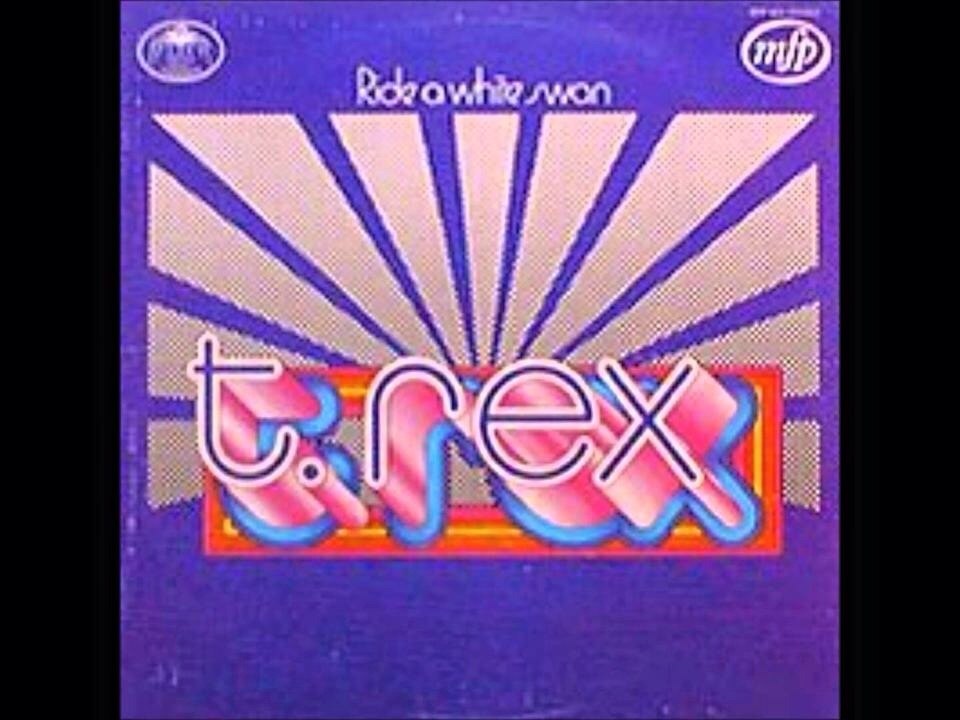
Let’s start with that sleeve. The fabulous purple cover with ultra pink pumped lettering promises a kind of tacky magic. It says T.REX on the sleeve; this is of course a bit of a misnomer, as most songs here should be credited to the earlier Tyrannosaurus Rex incarnation. Made no difference to me at the time and indeed only served as a portal to discovering Bolan’s earlier work. I’m not going to quibble now either: the sleeve still looks magnificent and trashy and casts a weird spell upon the room. How about the music, the sound, the songs, the word, the voice?

The album itself begins with two absolutely monumental pop big hitters in Ride A White Swan and Deborah. This is Bolan at his seductive best, harnessing rock and pop and great surreal poetic couplets to ride out a flight of mad fancy. It’s a ride of cosmic insanity that carries you along all the way as Marc exhorts us to ‘wear a tall hat like a Druid in the old days, say a few spells and baby there you go’ Both songs still sound strong today and serve to put a spring in the step and a cheeky notion in mind.

Two reverb drenched mythical ballads Child Star and Cat Black follow. Child Star seems to be about some kind of Tibetan Wunderkid waiting in exile to return to his country. I’m probably wrong on the Tibetan Wunderkid front. Bolan sets out such a fantastic terrain it’s easy to populate it with mythical beings of your own imagination.

Cat Black is simply beautiful, it employs a classic rock and roll / doo wop chord structure to sing a hymn of lovelorneliness to a supremely distant hippy chick who I’d guess might be Marsha Hunt.  I’m probably wrong again, but I don’t think that matters at all with these songs, they are all wide open to interpretation. Maybe bringing Marsha Hunt to mind is just an excuse to recommend you go on You Tube and search out her sublime cover of Walk on Gilded Splinters, or indeed her take on Stacey Grove.

Conesuela is next, followed by Strange Orchestra, and such a strange orchestra it is too. I have never thought of these songs as overtly psychedelic or psyche despite their cosmic allusions and punk drive, rather it’s kind of a weird ecstatic pop the act forges, never quite druggy but always mystic with one eye firmly on the important teenage things of the day like fast women, smart cars and streamlined clothes. Bolan’s singing often seems both rushed and slurred with a kind of drugged excitement though, and I like that. I like that I can’t always understand the words: again, it allows my own interpretations to flourish. Peregrine Took’s percussion is frantic and intense and propels the sound on in great skittering surges. Mickey Finn was a bit more laid back in the later incarnation. All of them beyond good looking: style-saturated Ladbroke Grove cats, which adds extra pop dust to the starry mix.

Lofty Skies is one of the greatest songs ever, a visionary heroic love song that always inspired a kind of Northern Mysticism on cold winter mornings when I was 19, looking for another world through Magic Mushrooms and Liebfraumilch, and then later in London, in the early hours of coming down off a speed fuelled night, the song always pointed to some other wilful and more Wyrd world beyond this stupid one. I was always prone to a bit of astral flight and imbued with cosmic yearning. Never quite managed the corkscrew hair mind…

Mucho silliness yes, Narnia Glam Racket indeed and pure wilful cosmic escapism without a shadow of a doubt and, all the better for it. Lofty Skies is blessed with one of the greatest wah wah guitar solos ever and I’m happy to report that all these decades later it stands. The whole record in fact sounds better to me now than it did then, makes more sense, fires the spirits, sends new shivers, in a purely different older way of course. The crushed velvet has faded but the fist heart mighty dawn dart remains strong and true and hey…

King Of The Rumbling Spires is magnificent and tribal, tremulously so, with a chorus that makes you feel ten foot tall and ready to be like the true ruler of Narnia, or the outside bet in Game of Thrones and yeah, this monster song, really takes off when the mellotron kicks in. The album ends with the deranged rural boogie of Elemental Child with dance, dancers a dancing as a truly rocking Bolan lays bare the torch girl of the marshes. The songs as a whole have me bopping around the room and Bolan’s voice transports me and even now as a grown man I swoon to a croon that is rare velvet, and as precious and as fragile. Gorgeous!

What I love most about this album listening to it now, are all the clicks and trills and whoops and bangs that flicker through Tony Visconti’s production. These sounds are probably not things that I would have picked up on at the time. The sonic blast has enlightened some blank days of late and transported me to other spaces awhile. He lords it over this record in a manner similar to the way Martin Hannet did with Unknown Pleasures. His use of strings, effects and organs turns every song into a mini pop odyssey. Fuck it, it’s 7 30am and I’m going to play it again, right now, loud.

I lost track of my copy after leaving home but weirdly enough came across it again around 1990 when Band Of Holy Joy played the legendary Surfers club in Tynemouth and I took a pre gig browse in a car boot sale, and found it, with my name written on the insert, and along the balloon typography, much like ‘Andy’s’ on the You Tube post.

The cost that time was 50p and 20p admission fee, so 2p cheaper than the first time around. With all the moving about I’ve done in London I soon lost it again mind and along with my lost copy of Prince Far I’s Under Heavy Manners, the early Pistols and Banshees and some Bowie bootlegs, it was always the slab of cardboard and vinyl I wish I still owned. All of them have the same depth of wonder and perpetrate similar crude sonic magic. Which is always what I look for and want in any piece of music. This time around it cost me a copy of Land Of Holy Joy and I’m determined to hold on to it for a few more years yet. I know one thing, it’s came into my life again at a good time. It is a record that has magic in spades, and stars in buckets, a shiny truth in every glam grain of sand, it’s an exotic treasure of the popular past washed up on the drab shoreline of my present, and for that I’m grateful. Major thanks to both Ant Cook and Marsha Hunt for bringing it back into my life. (Johny Brown)

Click here for our review of The Band Of Holy Joy’s brilliant debut ‘More Tales From The City’:

10. THE BAND OF HOLY JOY – MORE TALES FROM THE CITY (1987)

54. THE BEACH BOYS – SUNFLOWER (1970)

Lairs of Harmony

The customary Liner Notes of the 1960s and early 1970s album demonstrated little variation. Usually they were insipid, vain attempts by unfeasibly witless record companies to promote their artists (Check out the US ‘Meet The Beatles’ issue: ‘You’ve read about them in Time, Newsweek, The New York Times. Here’s the big beat sound of the fantastic phenomenal foursome. A year ago the Beatles were known only to patrons of Liverpool pubs. Today there isn’t a Britisher who doesn’t know their names…’) Occasionally some aspired to be more meaningful or poetic, although sometimes pretentiously so. For The Beach Boys ‘Sunflower’ album however, a novel approach. Neither witty nor poetic, they serve a quite different purpose. Forgive me for reprinting them in their entirety:

‘This album was recorded at the studios of Brother Records and utilizes the most advanced recording techniques in the industry today. All original recording was done on a special 3M 16-track tape recorder, supplied by Wally Heider Recording Inc., of Hollywood, using 2-in wide tape. Microphones used include: Neumann U67, U87, KM-85, RCA DX77, DX44, EV 666, and RE-15. A custom-built 30 position mixing console, manufactured by Quad-Eight Corporation, provided extreme flexibility and special effects for this album. Tape to disk transfer was done at Artisan Sound Recorders, Hollywood, using the latest Model Neumann computer controlled mastering lathe, equipped with a Neumann SX-68 helium-cooled, dynamic feedback cutterhead. The songs on this record were recorded in true stereophonic sound; they are not 16 monophonic signals placed somewhere between the right and left speakers blended together with echo, but rather total stereo capturing the ambiance of the room and the sound in perspective as heard naturally by the ear. Although more difficult to perfect, this type of recording is far more satisfying to hear, as will be demonstrated upon playing this album.’

And there we have it. No sanctimonious homage, no empty promise that the record will change your life – instead we have a convoluted itemisation of the sound engineering and recording equipment which will make this ‘a more satisfying’ listening experience. Of course in one sense, these are liner notes to be avoided altogether, but if you, like me, have over time, nurtured a tremendous fondness for this album, you just may find yourself returning to them to contemplate what it is precisely about the music on ‘Sunflower’ that makes it sound so incredibly fresh 45 years on? Perhaps the SX-68 helium-cooled, dynamic feedback cutterhead? Or surely the addition of the KM-85? (Those old KM-84s were useless, everyone knows that) The latest model Neumann computer controlled mastering lathe possibly provided the crucial ingredient. Those Germans are very efficient you know. Your eyes may be drawn to that EV-666 – which certainly sounds suspicious. Could those nice Christian boys have struck a deal with Satan? After all, isn’t he supposed to have all the best tunes? On the other hand, these liner notes could be the best – or at least the most honest – ever written. For ‘Sunflower’ does exactly what it says on the tin.

I have played ‘Sunflower’ with greater frequency than almost any other album I can think of, since I first purchased it second-hand on vinyl from a small, oft-forgotten Glasgow record shop called Rebel Records in the late spring of 1988. I distinctly remember the occasion as I handed over my £1.99 to Stuart Murdoch, later of Belle and Sebastian fame, who was serving at the till that day. The shop, located right at the very top of Renfield Street, was often deserted and didn’t stay in business long. Presumably, he would have had more than adequate time to nurture his budding songwriting skills while spending endless hours gazing around his deserted environs listening to his favourite tunes. Time would be kind to young Stuart, while in 1988 The Beach Boys were not as fashionable as they were to become in the early to mid-1990s, perhaps due to the monster Brianless (nope, no spelling mistake) comeback US chart-topper ‘Kokomo’ from 3 years earlier.

I hadn’t heard of the ‘Sunflower’ album before I spotted it in Rebel Records. I treasured ‘Pet Sounds’ of course and had the ’20 Golden Greats’ compilation – the blue one with the surfer on the cover. I figured that was all anyone needed of The Beach Boys. As I perused the sleeve, interiorly debating the wisdom of a potential purchase, the only date visible that I could see was 1980, although the puzzling back cover portraits (Mike with his Maharishi toga ‘teaching the children’, Al – minus only the obligatory lederhosen – decked out for a Munich beer fest; Bruce in a wedding chauffeur costume) suggested an earlier incarnation of the group. It may have been prudent to exercise caution for, if truth be told, when The Beach Boys recorded ‘Sunflower’, they had more or less been written off as an antiquated relic from a distant past. It turned out the album in my hand was a later reissue – and was in fact from 1970, in some ways a forgotten period of The Beach Boys story. The reason ‘Sunflower’ doesn’t feature very often in The Beach Boys story is not simply because it wasn’t a big seller (it reached only #151 on the Billboard Album Charts) but because it dates from a time when Brian was no longer undisputed director of operations and for many people, Brian Wilson is The Beach Boys. If any of that post-‘Smile’ stuff was worth listening to, it may have led one to the dangerously heterodox conclusion that there was more to the BBs than Mr. Brian Wilson. But while it would be more than a little foolish to question Brian’s pre-eminent position in The Beach Boys, that is a pill too difficult to swallow for some, for whom any acknowledgement of a positive musical contribution from Mike Love is a concession akin to climbing into bed with Beelzebub. I’m by no means the defence counsel for Mike Love, but that pantomime villain stuff is just plain silly.

Like it or not, ‘Sunflower’ is undoubtedly the best whole group album the band recorded. From around ‘The Beach Boys Today’ through to the ‘Smile’ debacle, the other Beach Boys were really worker bees, buzzing around their consecrated and dominant queen. Brian had been touched by genius – he had outmanoeuvred The Beatles, and out-Spector’d Phil, but his walls of sound were about to come tumbling down. Subsequent post-meltdown albums (‘Smiley Smile’, ‘Friends’, ‘Wild Honey’ ’20/20’) were decent if unspectacular, but there is a sense that the slide in the Beach Boys popularity in the late 1960s was less attributable to any significant artistic decline than with changing fashions. A mere three years after being the only other band to be voted NME Readers’ Vocal Group of the Year (1966) during the imperious reign of the Fab Four, they found themselves suddenly unhip, passe, their angelic harmonies incongruous with a world of blues heavy guitar heroes and rampant hippiemania. But it is to their credit that they remained aloof from changing trends and watched as those around them burned themselves out like comets as the furious rapacious progress of pop fashion devoured many a bright new thing and spat them out, yesterday’s heroes.

From the mid-1970s onwards, The Beach Boys did not exactly cover themselves in glory, producing material almost unspeakably corny and banal (don’t go near the Light Album – the vomit-inducing title is enough) but the period between 1970-1973 is truly a golden one for the band; a new label (Reprise/Brother), a marked growth in the songwriting of the other group members, particularly Dennis, and three exceptionally good albums: ‘Sunflower’, ‘Surf’s Up’ and ‘Holland’ (‘So Tough’ credited to Carl & The Passions, doesn’t quite reach the same peaks) – the former two the best back-to-back classic pairing of their career (‘Smile’ wasn’t released, remember?) The secret? Well, the liner notes give us a clue. And then there are those harmonies… If Bruce Johnston’s melodramatic ballads are too saccharine for some tastes, it is important to remember that The Beach Boys career is laced with such moments – even ‘Wouldn’t It Be Nice’ (at least lyrically) is prime Camembert, but that doesn’t inhibit our affection for ‘Pet Sounds’ – in fact, it’s all part of its innocent charm. Brian and psychedelics, despite some intriguing results, was ultimately, an ill-judged marriage. And the lyrics – despite Van Dyke Parks best efforts – were always secondary to the music. It’s the harmonies that lure you in. So, in keeping with the spirit of the album’s Liner Notes, allow me to illustrate some of its harmonic brilliance with a few technical notes of my own.

Hear the boys soar on the opener ‘Slip On Through’ at 0:50 – a rushing flood of airborne voices almost as if, like an unstoppable force of nature, they had burst through the studio doors, a human tsunami. Or consider for example, the incredibly complex construction that is ‘This Whole World’; it has a career’s worth of hooks packed into its sub-two minute duration – it is difficult not to succumb to those layers of litany between 1:18-1:31, and the mesmerising ‘Thiiis Whoooole Woooorld’ group harmony at 1:41. For an even more impressive exposition, give ear to the remarkable ‘All I Wanna Do’, where the densely echoed production between 1:25-1:45 almost beggars belief. The song has been afforded the dubious credit of being a virtual blueprint for the Chillwave genre, but really deserves a greater accolade. I would rate it one of the greatest pure pop songs ever written. Remember too, that it was co-authored with Brian by Mike, who sings lead beautifully. Whatever you think of Mike Love, he deserves great credit for this little gem.

Vocal duties are shared out evenly on the gorgeous ‘Add Some Music To Your Day’, a perfectly structured beaut, showing tremendous love and care (check out the little vocal flourish between 0:31-0:37), but the great harmonising and string accompaniment through 1:14-1:31 makes it a showstopper and Carl’s flawless solo gives way to heavenly hums at 2:15. Carl shines too on the luscious ‘Our Sweet Love’ and takes the lead on Dennis’ driving frenzied ‘It’s About Time’ which closes Side One, showing that the boys could rock with the best of them… Meanwhile, Dennis himself, with newfound confidence, takes centre stage with the raunchy R&B of ‘Got To Know The Woman’, while on the wistful ‘Forever’ he creates one of the band’s most tender and perfectly realised love songs – hear the harmonies build irresistibly from 1:05-1:16. If Bruce’s gorgeous ‘Deirdre’ is really top tier MOR, it has a melting Bacharach chord change at 1:01, while his ‘Tears In The Morning’ with cloves of Gallic accordion, features an exquisite coda on grand piano which sounds like it’s being recorded in the room upstairs. Even on Al’s slighter ‘At My Window’ the harmonies at the end are breathtaking. The finale, ‘Cool Cool Water’, salvaged from the ‘Smile’ sessions is both a breeze across one’s forehead and somehow playfully buoyant, providing the perfect vehicle for showcasing the mastery of chief sound engineer, Stephen Desper, who conjures miracles from the mixing desk throughout the record.

I once read an interview with John Cale, where he was asked if he would rather have been a Beach Boy than a Velvet Undergrounder. With delicate Welsh diplomacy, he sidestepped the question, but confessed to owning a complete set of Beach Boys albums upon which he struggled to heap a sufficient complement of praise. In particular, for Cale, like many others, ‘those harmonies were unbelievable’ and he recalled listening to the albums endlessly when he relocated temporarily to California in the mid-1970s. Well, if those harmonies are given a greater exhibition on any BBs album other than ‘Sunflower’ then I for one have not heard it. And I’m pretty certain I’ve heard the lot. In Jim Miller’s original Rolling Stone review, he praised the album’s flawless production, noting it possessed ‘a warmth, a floating quality to the stereo that far surpasses the mixing on, say, Abbey Road.‘ He was right, and wise to overlook the lyrical deficiencies in favour of a total surrender to the music. If the Beach Boys did not have a lot to say – aside from cars and girls and surfing – they had a whole lot of love to give in their music, and they let it shine as brightly on ‘Sunflower’ as anywhere else. When Carl belts out the sublime cry ‘music is in my soul’ on ‘Add Some Music To Your Day’ I suspect few will remain unconvinced by his impassioned declaration. (JJ)

53. TELSTAR PONIES – IN THE SPACE OF A FEW MINUTES

Sometimes I think the nineties was the worst decade for music to date. The twin behemoths of grunge and brit-pop may dominate any retrospective reviews of the decade but left very few albums that stand the test of time (to these ears) twenty plus years on. There were of course many other interesting things going on, the rise of electronica and dance culture and the global take over of hip-hop even as these genres blanded out and became the mainstream. Looking back now it is the bands that remained underground and retained credibility in the face of the music industries last hurrahs that I continue to return to and which only seem to improve as time passes. Before the internet removed record labels influence and wiped out the music weeklies.

1995 was the year of the jolly ‘oliday that was britpop. While some see the mid nineties as the time when independent music finally went overground to dominate the mainstream, in truth most of what made the charts was at best a watered down version of the music of the past ten years with particular emphasis on the type of bands who wanted to relive the sixties. As bands began to see the charts and major label deals as a viable option, edges were knocked off and sounds blanded out.

In Scotland however the best of the bands that emerged in the middle of the decade made it with their rough edges intact. While Bis, The Delgados and Belle and Sebastian refined melodic indie pop into new shapes bands like Mogwai and best of all the Telstar Ponies took inspiration from across the pond in the previous ten years of American alternative rock. Ignoring the barely disguised sub-metal that was most of the bands that exploited Nirvana’s success, these bands took inspiration from Sonic Youth, a little of the dream pop of Galaxie 500 and Mazzy Star, and the disturbed sounds of Slint and Codeine, and forged their own sound

While Britpop dominated the music press, it’s easy to see why the experimental post rock of Telstar Ponies might not sit well next to Wake Up Boo, Country House et al. But while contemporaries Mogwai (who they shared more than just a drummer with) continued to bigger and bigger stages, the Telstar Ponies folded after the release of the flawed second album Voices From The New Music. In The Space Of A Few Minutes, however is a downbeat, edgy and intense masterpiece. It’s a restless music that can’t seem to settle, it’s the sound of those too hot city summer nights when you can’t sleep, the windows open to street sounds, the sound of frayed tempers and lovers quarrels, its walking home under orange streetlights anticipating confrontation. It is also tender, frightening and ultimately hopeful.

The songs are split between Brendan O’Hare and David Keenan (five each) and Rachel Devine (three), but there is little to separate them. The songs on this album sit together as a perfect whole. The opener The Moon Is Not A Puzzle, is a tense duet between David and Rachel building and building as she repeats “If you stay then I will go”. The vocals are mixed low so you find yourself leaning in, trying to catch what is going on (a couple of songs – Two’s Insane and Maya the vocals are almost indecipherable). Lügengeschichte (tall tale) is a helter skelter descent with heavy nods to from Neu! 2’s Super to, well, Neu! 2’s Fur Immer with great lyrics (I have no thoughts of self control) and ends with some crazy phasing. The single Not Even Starcrossed (taking its title from a line in a Codeine song)is a doomed romance of a song (wishing on a star, never should be wrong, when you got nothing)building to a beautifully elegiac chorus of “I’m in love with you”. Maya always reminded me of the atmosphere of Tom Verlaine’s Words From The Front.

Right in the middle of the album is a magical re-working of Patty Waters “Moon, Don’t Come Up Tonight” re-imagined as a gorgeous torch song. Sung by Keenan, importantly he doesn’t change the gender of the songs subject (these things matter sometimes). It was hearing the records of Telstar Ponies that led me to investigate Patty Waters, Shizuka, Albert Ayler.

Monster is all anguished pounding before erupting at the chorus. Best of all is “Side Netting” which just aches, heaving under a narcotic drift of guitars like The Only Ones Inbetweens. The menacing Her Name (“Me and her won’t sleep tonight”)  and Innerhalb Weniger Minuten as Rachel Devine intones a mystery tale over a brooding soundtrack . It all ends on a hopeful note with I Still Believe in Christmas Trees.

The Ponies managed one more album. The following years Tales From The New Music may even reach greater heights than the debut, but lacks the consistency of sound of their debut. After that there was the odd single released, but nothing else. Some members released further music under various guises, some of it great, all of it interesting, but not reaching the heights of what was achieved here.

As for the 1990’s, it is only when you start adding up the bands that released classic in that decade (Luna, Low, Teenage Fanclub, Mercury Rev, Bardo Pond, Pastels, Spectrum, Dead Moon, Primordial Undermind etc) that you realise it wasn’t all bad. And In The Space Of A Few Minutes is one of the best. (TT)