49. CAT POWER – YOU ARE FREE (2003)

CatPower-07On an airless afternoon during the height of a clammy Glasgow summer, I first heard her voice. A sluggish drawl, as though vainly battling sleep. In 1999, everyone in Missing Records was listening to Cat Power’s ‘Moon Pix’. I left Missing that summer and forgot all about Chan Marshall and that voice, returning faithfully to my tired LP collection with its familiar sleeves, smells and sounds – like putting on a pair of tattered, but very comfortable old slippers. Only gradually did I rediscover my zest for newer sounds. Four years later, a recommendation from an old colleague during a brief rendezvous in Glasgow’s finest music emporium, Monorail, led me to a (re)discovery. And to one of the very best albums of the new millennium thus far.

In 2003, Chan Marshall was in trouble. One can sense a sombre desolation and sadness on her 5th LP ‘You Are Free’. In her interviews at the time, Chan spoke of her exhaustion with touring and travelling, the conspicuous lack of routine/stability in her life, the meddlesome politics of record companies and the irksome complexities of the nature of studio recording. In the haphazardness of her day to day existence, she perceived the need for a kind of liberation of the soul. They were not the best of times. Live performances were edgy, dysfunctional, often chaotic. She was drinking more, perhaps abusing other drugs. Her latest relationship was nearing its end. A mournful atmosphere pervades the recording, a sense of physical and spiritual dislocation. Some say an artist in emotional turmoil is primed to produce their most soulful art, and in this case, that maxim sings true.

The fourteen songs on ‘You Are Free’ were culled from around forty or so, which Chan had written during a frenetic year of travelling and touring, and were selected carefully for the album with the assistance of engineer Adam Kasper. The songs, at once deceptively simple, uncoil to reveal great depth. Anything superfluous is eschewed. There is no grand gesture, no unnecessary embellishment, no affectation. There is barely a chorus to be heard, and the tempo rarely changes, yet the subtle minimalism of the arrangements provides real depth to the songs.

The opener, ‘I Don’t Blame You’, conversely the last song written for the album, is one of four brilliant piano-led tracks, and contains a reservoir of empathy for the song’s subject. Marshall only very reluctantly revealed the protagonist to be Kurt Cobain, but in truth, that was merely confirming what everyone had long suspected. [‘Last time I saw you/You were on stage/Your hair was wild/Your eyes were bright/And you were in a rage/You were swinging your guitar around/Cuz they wanted to hear that sound/But you didn’t want to play/And I don’t blame you’] Here, the song’s strength lies in its avoidance of any stylistic homage. Rather, Chan’s voice, all raggedy velvet, sounds wise with lifetimes, and over a stark block piano riff she conveys the familiar story with great subtlety in a fitting tribute which reveals a deeper sentiment at the heart of one of the album’s key themes.

The lyrics to ‘Free’ and the album’s title itself could be construed as a rallying call to the listener: [‘Don’t be in love with the autograph/Just be in love when you scream that song’]. The message could be ‘break those fetters’; ‘be who you want to be’, but one suspects it is there to serve as a reminder to the author that she alone holds the power to regain control of her own life?

Amongst the other piano led tracks is ‘Names’, a despairingly tragic account of the abused lives of five of Chan’s childhood acquaintances, and the mysterious closer ‘Evolution’, featuring guest vocal by Eddie Vedder, where a hauntingly cryptic reverie drifts out gorgeously to the album’s close.

At times, there is an Antipodean countryish feel to the album, mirroring the muddied rootsiness of The Triffids circa’ In the Pines’ / ‘Born Sandy Devotional’ or the crawling black death of ‘From Her To Eternity’ era Nick Cave. This is hardly surprising; the aforementioned ‘Moon Pix’ had been recorded in Melbourne with The Dirty Three, and on this outing, Warren Ellis (Bad Seeds) is among the guest musicians. Ellis has a starring role on one of the album’s real highlights ‘Good Woman’, where he manages to conjure an authentically Appalachian violin sound, making this, despite its traditional C&W lyrical content (they could have been written for Tammy Wynette) less Nashville and more Kentucky fried. The childlike backing vocals (credited to ‘Maggie & Emma’) add an eerie quality and the whole arrangement works sublimely.

Elsewhere, over a basic acoustic strum David Campbell’s exquisite string arrangement on ‘Werewolf’ including superb cello accompaniment, lends it a gravitas befitting something from Nico’s’ Chelsea Girl’ or ‘The Clarke Sisters’ by The Go Betweens, and acts as a musical bridge between the sparser solo songs and the more conventional band outings. Starker still is the desperately bleak ‘Baby Doll’, which may be an intimate portrayal of a self-destructive friend, or a confessional autobiographical snapshot?  [‘Baby/Black, black, black is all you see/Don’t you want to be free?/Baby/Red, red fire is what you breathe/Don’t you want to be clean/Honey, the shape you’re in /Is worth every dime you spent/Baby Doll/Turn out the lights/Set yourself on fire/Say good night’] Whatever the case, those little noises scraping along in the background certainly add to the discomfort. And on ‘Keep On Running’, Marshall’s take on ‘John Lee Hooker’s Crawling Black Spider’ there is even less room to breathe freely.

‘Shaking Paper’s little rippling rivulets of feedback groan along queasily, while ‘Speak For Me’ and the single, ‘He War’, are the most conventional rock tracks (drums courtesy Dave Grohl) – both appear to concern Chan’s unravelling relationship. On ‘He War’ she laments [‘I never meant to be the needle that broke your back/You were here, you were here, and you were here/Don’t Look Back’] with an impassioned vocal performance which is palpably soulful and technically dexterous, alongside an infectiously catchy ‘Hey hey hey’ chorus. Marshall was reportedly unhappy with the version recorded for the album, claiming it lacked the raw-ness of the original ‘live band’ recordings.

What it does not lack is soul, and that can be said for everything else on ‘You Are Free’. If I feel uncomfortable labelling American country music ‘white soul music’ (the worst country is often something else altogether) I do so merely to illustrate a point – which is that soul / soulfulness is not confined to any particular musical genre. Chan was already a soul artist long before ‘The Greatest’, most amply illustrated here on ‘You Are Free’. On ‘The Greatest’, she embarked on a soul project that was at times more style than substance. While it is a good album, there was really no need, for Chan’s soul credentials were already well established. ‘You Are Free’ was truly a soul album, it’s rawness and honesty straight from the heart, and conclusive proof that at times, less can certainly mean a whole lot more. (JJ)

45. VAN MORRISON – VEEDON FLEECE (1974)

The ‘other’ Van Morrison album you should own is not Moondance but Veedon Fleece. I say this not because Moondance is a weak album – it is in fact, hugely impressive – but rather because Veedon Fleece outshines it in every department, being the only other occasion in the entirety of Van’s recording career where he sailed close to the magisterial heights of Astral Weeks. Its continual exclusion from Classic Albums lists is akin to inaugurating a Jazz and Blues Hall of Fame and omitting to include Miles Davis and John Lee Hooker, and is at once a great injustice. Classic album it certainly is. So might there be a way to convince a mass of Moondancers to switch allegiance and become fully fledged Fleecers?

Inspired by a trip to the Emerald Isle he made in October 1973, Morrison composed this set of songs, where a Blakeian romanticism inhabits the spirits of ancient Irish Saints and mystics, traversing old streets and monastery ruins, everywhere leaving echoes of its ghostly presence. It is truly one of its kind. But it is more likely to hinder my case if I begin by drawing attention to two songs which, situated incongruously in this most organically Celtic of albums, are US-flavoured fugitives,  defectors from another time another place, that clearly do not belong here: ‘Bulbs’ and ‘Cul De Sac’. The former of the culprits, featuring John Tropea’s countrified guitar and a jarring accelerating tempo, is particularly disconsonant; the latter, a rigid, plodding rewrite of ‘Many Rivers To Cross’ adds little save a frown on this listener’s brow. Of themselves, they are not bad songs any more than Moondance is a weak album, but feel completely at odds with the remainder of the record.

So instead, let me wax lyrical over the remainder, all of which is worthy of the highest commendation. The beautifully judged opener ‘Fair Play’, features stately piano over a gilt-edged acoustic strum – this time by Ralph Walsh who plays sensitively throughout. And that voice! It is sometimes easy to forget that Van possesses one of music’s most towering voices – by turns lion’s growl, fragile falsetto or at times an almost gut-wrenching open-throated bellowing of blues’n’soul. Here, his performance is both restrained and gorgeously melodious: (“Tell me of Poe/Oscar Wilde and Thoreau/Let your midnight and your daytime/Turn into love of life/It’s a very fine line/But you’ve got the mind child/To carry on/When it’s just about to be/Carried on.”)

If Astral Weeks was the sound of ‘a man in pain’ (gratuitous link to Lester Bangs’ unsurpassed review – https://personal.cis.strath.ac.uk/murray.wood/astral.html.), then on Veedon Fleece we hear a new man, a man who is in love and in love with life (his new fiancée Carol Guida accompanied him on the Irish vacation where he wrote most of the songs). Van has always insisted that to write enduring music one has to feel happy, and there is a sense of that inner fulfilment permeating the record’s atmosphere.


‘Linden Arden Stole The Highlights’ is punctuated by a series of repetitive rising piano lines – no chorus – with strings bursting in at 1:42, lifting the music to new heights. Purportedly about an Irish ex-pat living in San Francisco – autobiographical? –  with an ominous closing line hinting at a darker underbelly, “now he’s lonely living with a gun“, the onomatopoeic piano tinkle imitating breaking glass is courtesy Lou Reed’s ‘Berlin’, released the year before. If the guitar on ‘Who Was That Masked Man’ is intricate and understated, Van’s vulnerable delivery is a thing of beauty, so much so that one can forgive the more dubious choice of metaphor, “…or wish on a toilet roll” (whoever imagined they would hear that line in a song? A rival to Arthur Lee’s “Oh the snot has caked against my pants“).

Meanwhile, ‘Streets of Arklow’ introduces atmospheric flute – once again building on a repeated rhythm – this time slightly lengthier, with a dramatic orchestral sweep. Like many of the songs, it’s joyous stream of consciousness poetic impulse contains no chorus, no hook, but draws you in helplessly to its alluring depths. Morrison recalls reading books on Gestalt therapy at the time of the recording and there’s no mistaking the depth of emotion in the music. At the end of Side One, the epic ‘You Don’t Pull No Punches But You Don’t Push The River’ soars at the crest  of a group of songs sometimes considered a ‘suite’ (though not spliced together fragments as on Side Two of Abbey Road), but which are rather linked thematically through an evolutionary passage of music of such ravishingly mysterious beauty it sounds like it’s heading inexorably towards some divinely eschatological revelation – which could be the mythical Veedon Fleece of the album title… “We’re goin’ out in the country to get down to the real soul/I mean the real soul, people/…We’re gettin’ out to the west coast/Shining our light into the days of bloomin’ wonder/Goin’ as much with the river as not/…Blake and the Eternals oh standin’ with the Sisters of Mercy/Looking for the Veedon Fleece“.

The closing trio of songs represents a high watermark in Van’s career. The masterful ‘Come Here My Love’ is one of Van’s most enduring love songs. The antithesis of the rent-a-party floor filler that is ‘Brown Eyed Girl’, it is a song where he sounds entranced by spouse, nature, poetry and life itself. “Come here my love/And I will lift my spirits high for you/Id like to fly away and spend a day or two/Just contemplating the fields and leaves and talking about nothing/Just layin down in shades of effervescent, effervescent odors/And shades of time and tide/And flowing through/Become enraptured by the sights and sounds in intrigue of natures beauty/Come along with me/And take it all in/Come here my love“. It was covered by This Mortal Coil in 1986, but their version stripped it of its transcendent beauty (very unlike them) with Van’s very much the superior take.

Van’s capacity to make the simplest arrangement and verse sound utterly profound is illustrated most clearly on ‘Comfort You’ – any analysis of the song’s structure and content would be notable only for its brevity. By contrast the song seethes into one’s consciousness to be recalled time and time again. Contrast too, the way the spirit moves in the closer ‘Country Fair’, liberated from the technical virtuosity of ‘Cul De Sac’ where the highly accomplished playing is cold and static. Here the sparse sound creates spaces for free form flute, double bass (the songs work better without bass guitar) and washed out ghostly choir, recalling the voices in Tim Buckley’s ‘Morning Glory’. It could fit comfortably on to Astral Weeks and I can pay it no higher compliment.

Listening to the album on CD could be a potentially dissatisfying experience, there being no pause between the album’s centrepiece, the nine minute ‘You Don’t Pull No Punches But You Don’t Pull The River’ (how about that for a dressed-up poetic title for a song where someone is receiving a pretty harsh dressing down?) which closes Side One, and ‘Bulbs’ which on vinyl would open Side Two. At least, lifting the needle could afford the listener a momentary pause and an opportunity to avoid such an abrupt rupture in the album’s flow. But get your mitts on whichever format is accessible to you and hear the blues howler, the jazzman, the mystic folksinger, the poet and Celtic Soul Brother make one of the best albums ever recorded. By anyone. (JJ)

44. SANDINISTA! – THE CLASH (1980)

SANDINISTA! – THE CLASH (1980)


Sandinista! is a profoundly flawed record, one which, even if its 36-song, two-hour plus content were trimmed by a fifth, would still be carrying considerable excess baggage.
So what’s it doing in The New Perfect Collection? For all its flaws, which will also be explored here, the open-minded, restlessly curious spirit in which it was made, an unexpectedly high strike rate against the odds, and its persistence in standing up to 35 years of out-of-hand dismissal secure it a place in this pantheon of the passed-over.
Few bands have polarised opinion as sharply as the Clash. On one side, they were subjected to rigorous expectations from those who wished nothing more from them than a fistful of rewrites of White Riot each year and a few handily digested slogans (something they were exceptionally adept at; in their first year alone, they came up with at least a dozen). These were, of course, disregarded with wilful brio, while those detractors, who by now saw them as little different to those they were thought to have come to obliterate, hunkered down for the new decade with the entrenched likes of the Cockney Rejects and the Anti-Nowhere League.
On the other, they’re right up there with the Stones, the Velvets and Bowie in having been subjected to screeds of unctuous, over-reverential hagiography. While their detractors will trot out the same, admittedly valid, charges time and time again to condemn them (they signed for CBS and called themselves socialists! They sang I’m So Bored With The USA and then spent half the year over there! Daddy was a diplomat, not a bankrobber!) their champions often show little more imagination (they Famously refused to play Top Of The Pops! London Calling was Famously voted album of the ’80s by Rolling Stone  – even though it came out in the ’70s , y’daft Yanks!). Then there’s the ongoing reductive radio campaign to condense their entire career to three or four songs – I Fought The Law, London Calling, Should I Stay Or Should I Go and, at a push, Rock The Casbah. But what everybody seems to agree on is that Sandinista! is nobody’s idea of a masterpiece and there are those who wish that, like the even-more, and this time justly, reviled Cut The Crap, it would just go away lest it tarnish the legacy.
For a start, a triple album? Just after London Calling  Smash Hits printed a picture of the band which, if memory serves, had them  dressed up as morris dancers and the caption declared that their next album would be a triple enitled Yeovil Calling..What?! Hang on, it was just a joke! But a year later, there it was, housed like its predecessor (and, not coincidentally, labelmate Bruce Springsteen’s just released double The River) in a single sleeve to keep costs down and once again for a capped price – £6 this time rather than £5 but when you’re getting an extra disc…
And then there was what was on those three discs (or reels, if you got the boxed cassette version). The aforementioned conservative (upper and lower case, occasionally both) naysayers were joined by those who heard only a directionless mess, chief among them the NME’s Nick Kent, who labelled the genre jumble “a ridiculously self-indulgent communique.” In more recent years, as the – for grievous want of a better term – world music market has grown, and some of its most earnest advocates have become more precious, Sandinista! has increasingly stood accused of dilettantism or, even worse, cultural colonialism, however benign, as the Clash dip their toes in the sounds of Brooklyn, Havana and Kingston, sing of ghettoes and dictatorships then scurry back to the shadow of the Westway with more cash than the authentic practitioners of all this music could ever dream of.
Again, some valid points. Except – firstly , of course, they’d been exploring other styles for years, ever since their interpretation (they couldn’t have faithfully reproduced it even if they wanted to at this stage) of Junior Murvin’s Police And Thieves on their first album. Also, why not try on other clobber? Why should expanding their sound be limited to a couple of other pre-approved sources? It’s not as if they cast the net absurdly wide and attempted  to take on opera or North African folk; theirs was the same approach that Primal Scream took a decade later on Screamadelica and the Beatles a decade earlier on the White Album but, while those albums were tuned into, and responding to, specific times, moods, spirits and cultures, Sandinista! (which was released days after John Lennon’s murder) fitted nowhere at all  despite being by a band who still commanded more attention than almost any other.
Most importantly, it’s a record made by music fans. The Clash were a punk band but, individually, they were not punks. What they did in 1976-7 was unlike anything that had been done before but the myth that it all descended fully formed from the sky and landed in Oxford Street has long since been quashed. They were people with pasts, hinterlands – Joe Strummer’s prior existence as Woody Mellor the squat-dweller is now well-known; far less remarked upon is Topper Headon’s contribution – superficially, he was often seen as a standard punk dustbin clatterer, like Rat Scabies without the  corny stick-juggling, and, well, he wasn’t even with them from the start, but he actually had roots in jazz and was accomplished on several instruments. Not something you shouted about down the Roxy but by the time of Sandinista! the Clash were answerable to no one and there was no punk worthy of the name left to answer to anyway, so Topper was in a position to nudge them in all manner of new directions.
I have a strong aversion to genre identification games but if you must, there are about 14 on Sandinista! and, at its best, it’s an exemplary kaleidoscope of educated pastiche. Far-sighted, even, on the two rap workouts, The Magnificent Seven and Lightning Strikes, which are relatively conventional band performances, rather than deploying scratch or beatbox, and this, paradoxically, means they’ve aged better than some of the more authentic early rap, which at the time was the sound of the future but now faces the, fairly unjust, fate of being considered as quaint as nursery rhymes.
At the opposite pole, The Sound Of The Sinners is a complete one-off in the Clash’s repertoire, such a perfect exercise in gospel that they didn’t need to repeat it. Its evangelical fervour is undercut more than slightly by the voice of a tweedy, Derek Nimmo-esque vicar (rumoured to be actor Tim Curry, though I prefer to think it was recorded straight from a televised Sunday service) bidding “cheerio” to a departing congregation, presumably to contrast the ardent, celebratory nature of gospel with the staid, Conservative-Party-at-prayer perception of churches they might find closer to home.
Rockabilly gets a runout on The Leader, a masterly, 100-second distillation of the Profumo affair which, again, shows that this type of music was closer to Strummer’s heart than punk ever was and that, on form, he was a lyricist with few equals (“Vodka fumes and the feel of a vulture”); also on Midnight Log, a macabre, blues harp-scarred tale of being in the pay of the devil who, we’re told, “ain’t been seen for years/’Cept every 20 minutes, he zooms between my ears.” I always hear the feedback buzz at the end as the latest of those unwelcome visits.

https://www.youtube.com/watch?v=aP9UsFsDji0http://
As always, there’s plenty of reggae but in some unfamiliar guises. Junco Partner, a song shrouded in mystery at the time (to the point of Unknown receiving the songwriting credit) but which turned out to be an early ’50s blues tune; the 12-bar melody always suggested as much but its peripatetic violin was rarely heard in either reggae or blues.
It’s there again in The Equaliser, a dub-heavy, anti-slavery (with or without wages) diatribe which is followed by The Call-Up, uptempo and skanking but deeply melancholy as it contemplates the then very likely prospect of a return to the conscription which had killed so many throughout the 20th century (to remove all ambiguity, NO DRAFT was emblazoned on the label when it appeared as a single), while even deeper reggae is explored on If Music Could Talk and its dub version, Living In Fame, with a toast by the late Mikey Dread, who sternly counsels the young pretenders to live up to their names (“If you say you are Selecter, you’ll have to have a good selection”). Bizarrely, he was at it again years later, when he was by chance captured in a fly-on-the-wall airport documentary lambasting his chosen airline (“Life is not easy with easyJet!!”) . The same tune is re-reprised on the closing Shepherd’s Delight, a poignant finale that turns sinister the second the music stops, to be replaced by what’s always sounded to me like a rocket launch (red sky…). It’s like a bite from a seal. Perversely, they also cover an Eddie Grant song, Police On My Back, and turn it into the most traditionally Clash-sounding thing on the whole album.
Of course, not everything works. About a side’s worth is wholly negligible but one of these songs has to be mentioned as, without recourse to the music, it’s actually the most significant song on the album. Washington Bullets is a Latin/salsa flavoured tune, a style of music I can never help feeling sounds corny, but lyrically, it recounts the 1979 overthrow of the oppressive Somoza regime in Nicaragua by the Sandinista (hence the title) rebels. Unlike the Special AKA’s later Nelson Mandela, it didn’t directly lead to anything but in recounting this episode and other examples of corruption and injustice (notably the odious Pinochet regime in Chile) they raised awareness in many, myself included. And there was plenty to come – Ronald Reagan was preparing to enter the White House and his administration would later pass the proceeds of arms sales to Iran on to the Contra rebels opposing the Sandinista government. I guess the music of Washington Buĺlets is appropriate to the countries it tells of but the arribas and ululations tip it into parody and undermine the power of describing “the cries of the tortured men.”
Ultimately, all the debate, posturing and pontificating you hear about music is irrelevant. All that really matters is what the artists intended when making the music and your own perceptions whenever you hear it. Sandinista! always vividly reminds me of finding my feet at secondary school, so while it evokes Ladbroke Grove, Manhattan and Santiago, it evokes even more double Latin and discovering my ineptitude at throwing the discus. Pre-internet, I didn’t even hear anyone else’s view on many of these tracks for years, such was the sheer volume of material and the bewilderment around much of it, so I was free to form my own images – Sandinista! may be popularly seen as the second biggest runt in the Clash litter but I love it for all these reasons and more (PG).

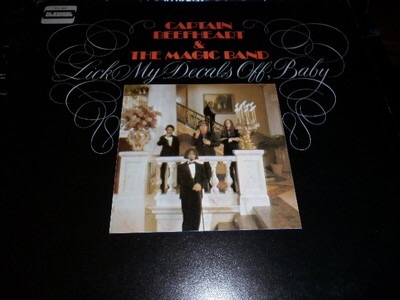
43. CAPTAIN BEEFHEART & THE MAGIC BAND – LICK MY DECALS OFF BABY (1970)

The Art of Beefheart


I imagine my affinity for Beefheart followed a trajectory familiar to many. It began with a bizarrely alluring earful on John Peel; leading next to the perusal of a few rock encyclopaedias and the NME and Sounds Greatest Albums lists of the time (1985); followed subsequently by the purchase of Trout Mask Replica; then swiftly by the indignant return of said item to the record store. Even as I handed my tenner over to the hippy at the HMV till, his derisive expression let me know in no uncertain terms that he fully expected me back within 24 hours. He was of course correct. My virgin ears felt like they had been defiled and my brain pillaged by this artless racket, created by people who clearly had not taken the trouble to learn how to play their instruments. I was inclined to steer clear of Beefheart for some considerable time afterwards, but as I became ever more conscious of Trout Mask’s conspicuously lofty critical approval rating, my frustration began to grow. Was I missing something? Perhaps I was the victim of some cruel hoax? I resolved to find another way to appreciate the Captain’s art, if indeed this really was ‘art’ at all?

Art. Don Van Vliet always had a fascination with art, demonstrated most visibly in his own primitively  idiosyncratic paintings, but extending also to his music, the prime expressions of which are the two albums he made for the Straight label in 1969 and 1970, Trout Mask Replica and Lick My Decals Off Baby. Every Beefheart aficionado has their favourite album and I am no different. In fact, not selecting Trout Mask Replica for TNPC feels in some ways tantamount to a betrayal, but it is a record which has been extensively discussed, written about and salivated over elsewhere, and whilst undoubtedly amongst my own Top 3 Albums of All-Time, I fear there is nothing much else to add to what is a well-worn story. Those who find ‘TMR’ too arduous a listen [I had to strengthen my constitution with the solid meat of the early Fall albums before I persevered and eventually succumbed] tend to plump instead for the crisper cleaner Clear Spot, the warmer more colourful Shiny Beast or more commonly, as in the estimation of the authors of The Perfect Collection, the classic 1967 debut, Safe As Milk, which memorably showcased Ry Cooder’s stunning slide guitar work. While these albums served as friendly pathways to a reappraisal of TMR, my way in to Beefheart actually came with the purchase of Lick My Decals Off Baby. Those who treasure TMR may feel that it’s slick sibling sequel gives it a run for its money as The Magic Band’s greatest moment, despite it having lived forever in the shadow of its illustrious predecessor.

Indeed, there are some who swear that Decals actually eclipses ‘TMR’ as Beefheart’s finest hour, but be as well comparing Ulysses to Finnegan’s Wake. Nevertheless, those will point to the following: Decals – unlike TMR, which bore the imprint of Zappa – was produced by Don himself and is therefore incontestably his own creation; secondly, where TMR is a sprawling mess, Decals by comparison is both streamlined (all killer, no filler) and strangely symmetrical (both sides have overtly lascivious openers, anarchic hornfests to end, and in the centre, two baroque math-folk instrumentals, Bill Harkelrod – aka Zoot Horn Rollo – conjuring that almost medieval lute-ish sound from his guitar); thirdly there is a greater refinement of song composition and structure – where TMR sounds like a bizarre experiment, the playing on Decals sounds more controlled, sophisticated even (visually implicit in the contrasting choice of band costumes for the album sleeves); fourthly, the polished marimba of Art Tripp brings another dimension to the sound, working a similar effect to Bobby Hutcherson’s vibraphone on Eric Dolphy’s classic Out To Lunch. These for some give Decals the edge.

However, the rubbery booglarized guitar sound, which contrasts sharply with the scratch and bite of the guitars on TMR polarises opinion. Additionally, the explicitly carnal lyrical onslaught may not be to everyone’s taste: at times Don sounds almost predatory like a rhinoceros on heat (“Rather than I wanna hold your hand/I wanna swallow you whole/’n’ I wanna lick you everywhere it’s pink/’n’ everywhere you think/Whole kit ‘n’ kaboodle ‘n’ the kitchen sink…”), albeit a rhino with a darkly mischievous sense of humour (check out the even more hilarious ‘I Want To Find A Woman That’ll Hold My Big Toe ‘Til I Have To Go’) and a wild poetic gift…

Yes, the poetry. The lyrics are not all as bawdy but are staggeringly brilliant, full of free association surrealistic impulse (“Glasses look out on the pale hell bent /Moon milk run / O’ lady go home / Lord they done cookin’ done / Black lady, Black leather lady / Done had a white, white, white poor son”) and humane ecological concern (“If the dinosaur cries with blood in his eyes/’n’ eats our babies for our lies/Belches fire in our skies/Maybe I’ll die but he’ll be rumblin’ through/Your petrified forest.”)

If the words are wonderful, then the music is a match for them. The album’s most famous song – covered by The Buzzcocks/Magazine – is ‘I Love You, You Big Dummy’ (‘nobody has love/love has nobody/I love ya y’ big dummy/quit askin’ why!’), a rhythmically straightforward thrash enlivened by Don’s wild harp (it sounds like he’s blown it to pieces), which could be a demented cast-off from Strictly Personal and anticipates the unabashed blues growl of his next studio album The Spotlight Kid, while ‘Woe is Uh Me Bop’ – which ‘crinkles along mechanically like walking Tinkertoys’ (copyright Lester Bangs – I can’t beat that folks) is a virtual blueprint for the triple salvo of Tom Waits Franks Wild Years period, the most obvious comparison being ‘Clap Hands’ from Rain Dogs. The marimba here adds little strokes of light which de-intensify the urgency of the rhythm. Conversely, on ‘The Smithsonian Institute Blues (or The Big Dig)’ the sudden change of tempo, with the marimba and guitar scattering in opposite directions, unseats a vibrant footstomper, yet showcases the band at their most viscerally spontaneous and intuitive. Again there is a delightful play on words (“It sure looks funny for a new dinosaur/To be in an old Dinosaur’s shoes/Dinah Shore’s shoes/Dinosaur shoes”). There are other delights and surprises along the way, not least the interval in the closing ‘Flash Gordon’s Ape’ (great title) where the orgiastic cacophony is halted for a marimba solo.

No-one else in rock music has innovated on the same scale as Don Van Vliet. Oh, The Beatles and The Velvets  could stake a claim, and were undoubtedly even more influential. But with his music, Beefheart invented an entirely new art form. I can’t pretend to be an art connoisseur, and  I’ve never really understood the Jackson Pollock analogy – I’ve always imagined each splash and stroke of his work to be something of an accident. Nor – though I appreciate the visual image it conjures – can I fully agree with Andy Partridge’s contention that Beefheart’s music “sounds like a piece of the Somme, lifted up and put in an art gallery.” Another fairly unsatisfactory comparison would be that of a collection of jigsaw pieces fitted randomly together, as this presupposes a final abstract image without a recognisable pattern or design. Instead, when considering a Beefheart composition from this period, I prefer to visualise four or five light aircraft taking off together which also land simultaneously: but while airborne, the planes might fly at different altitudes; some are faster than others, each creating its own unique flight path, until at certain points, as if jerked by some centrifugal force, their zig-zag wanderings cease and they line up with Red Arrows precision. Again, they may fly off suddenly in wildly different directions before this telepathic convergence repeats itself. From one journey the planes may return to the ground at awkward angles, from the next they arrive in neat lines. This sound has been imitated by many performers of good will – aesthetes, punks and outsiders, but each has been too indebted for true greatness. Beefheart’s innovations are unique in rock history and alongside its big brother TMR, Lick My Decals Off Baby deserves to take its place as a uniquely esteemed example of American art primitivism.

[If there has been noticeable mainstream infiltration by some of today’s more left field artists, it is worth remembering that ‘Decals’ stayed eleven weeks on the UK album chart, peaking at no.20. Sitting imperiously at the summit was Andy Williams’ Greatest Hits] (JJ)

40. BLACK VINYL SHOES – SHOES (1977)

BLACK VINYL SHOES – SHOES (1977)

If history is written by – or at least about – the winners, it doesn’t  mean the ones who are edited out have lost. In music, the small-scale, local but for decades unacknowledged release has been there at every stage, from muffled blues and country 78s stretching either side of the second world war to dimestore rock ‘n’ roll, from ’60s 45s that later became the stuff of Nuggets, Pebbles and Northern Soul, from post-punk DIY by The Night The Goldfish Died and Prevent Forest Fires to the countless, sometimes anonymous, dance 12″s of the ’90s and the upstart start-ups now lurking in the infinite corners of Soundcloud and Bandcamp.
Quality has varied considerably, of course, and for decades this music was seldom heard outside the town/county/state where it was made but it’s always been the sum and substance of the iceberg, underpinning more visible events, and,  at its best, has been fit to take its place alongside more celebrated songs and names, with the added advantage of not having been bludgeoned by repetition.
A case in point: Shoes (distinguishable from French dance act The Shoes through their admirably principled stance on the definite article), a bunch of Hardy Boys doppelgangers who came from Zion, a dot on the Illinois map, and stayed there, opting to keep away from Chicago and any other city to progress, for the most part, at their own pace and on their own terms.
In the pre-punk/new wave ’70s, the sound Shoes were cultivating – drawing on early Beatles, The Byrds and Big Star, was far from obvious and, even allowing for some elements of glam, had few adherents and the proliferation of hyper-proficient, hysterically pompous technoflash bands – Styx, Kansas, Journey – was swallowing airtime and theatre space once reserved for music that wasn’t unintentionally ludicrous.
But Shoes did whatever it took to push their music out. Private press releases were commonplace but their first release, One In Versailles (so named as a nod to  guitarist and architecture student Gary Klebe during his year abroad in France) was neither vanity project nor bizarre affectation. Despite being out of step with tastes defined more by chops than ideas, it had genuine potential to find an audience who may not have realised it was what they wanted, through strong and – on at least one song, Do I Get So Shy – complex songwriting.
They took things a stage further with Black Vinyl Shoes but resources were tight and the album’s sleevenotes make its six-month recording seem an arduous  even harrowing, process, telling of “strenuous conditions” and extreme limitations” as it itemises the equipment used.
The notes assert that it’s a “unique” record – having worked in and around media for  more than 20 years, it’s my firm belief that this most precisely-defined of words should never be used lightly or loosely but the finished results of Black Vinyl Shoes dispose me to give them the benefit of the doubt.
Superficially, it’s as straightforward as these things get – fifteen melodic, uncomplicated songs, mainly on the eternal theme of girl baffles boy. Some of the lyrics would be viewed differently now to the way they might have been then, (eg “Ride you in my car/Make you feel some older”) but they had a penchant for an unexpected turn of phrase (“Better toughen up your middle ground/Get it hard for senseless casualties” or “The fastest way I can find you/Is my justified means to the end”).
And while, to the casual observer, US politics of the ’70s may have been dominated by two areas – foreign policy and the office of President – it always comes back to The Economy, Stupid and on Capital Gain, Shoes have their own Taxman, a slightly gauche but acerbic sketch of a grasping businessman on the make (“Let the the buyer beware if they’re buying their wares from him/And when he’s doin’ a favour, watch out or he’ll do you in.”)
Further hidden depths and textures emerge on closer scrutiny; the unequivocally basic equipment makes the songs swim, swoop and hiss and at times Shoes’ drummer, the late Skip Meyer, sounds like he’s playing on suitcases, but while he’s actually using a full kit, there’s a noble tradition here – the Crickets’ Jerry Allison used a cardboard box on Not Fade Away and his own very knees on Everyday, so the important thing is not what’s used but how it sounds.
Other sounds range from sparing but subtle slide guitar (Running Start, Fire For Awhile),  acoustic 12-string stabs (Someone Finer, Okay) and, on Fatal, the synthesised guitar sound that would later become the trademark of The Cars (and there were  deliberate constraints – third album Tongue Twister would proclaim ‘no keyboards’ as defiantly as Queen’s ‘no synthesisers’). Meanwhile, breathless opener Boys Don’t Lie, which lends its title to the band’s biography by Mary E Donnelly, could fit neatly over the five-a-side scene in the opening credits of Trainspotting.

Shoes would righly look askance at the unseemly term ‘powerpop’ and here show an ability to smuggle in unexpected genres – melodically, the aforementioned Running Start is practically a country song  and there’s a definite groove/swing to Not Me, which has a cowbell intro to match Honky Tonk Women or Low Rider. Then the fuzz bass and staccato rhythms of If You’d Stay echo what Bowie was doing at the time in Berlin and Devo two statelines away in Ohio. It’s also not unlike the radical Eurodisco revamp the Undertones would perform on True Confessions for their first album and Shoes did strike a match to light the Derry gang’s way. Their smilingly lugubrious demeanour and tunes of condensed milk sweetness, together with the equal division of labour (five songs each by Gary Klebe and brothers John and Jeff Murphy) also foreshadowed Teenage Fanclub – Shoes themselves have noted the similarity but, with characteristic modesty, didn’t presume to have been a direct influence.
A spell with Elektra produced three albums, including the magnificent Present Tense, but they then returned to self-sufficiency, at their own Short Order Recorder studio in Zion. For 40 years, they’ve pursued their muse as single-mindedly as the Ramones and are cherished as much by those who are aware of them; they’re there in a rich seam for anyone who cares to look (PG).

35. SWAGGER – BLUE AEROPLANES (1990)

SWAGGER – BLUE AEROPLANES (1990)
Lyrics aren’t poetry – discuss. What sounds like it’s fit to stand alongside Milton and Pope when set to music can be as pre-adolescent doggerel writen down – try “Where did your long hair go?/Where is the girl I used to know?” for starters. Conversely, lyrics that think they’re poetry are almost inevitably doomed to pull up well short – rhyming alone does not automatically qualify anything as poetry and the last writer to get away with using the weather as an emotional metaphor (pathetic fallacy, to give it its proper name) was  Ernest Hemingway.
But any suggestion that lyrics shouldn’t be poetry, shouldn’t even try, leads nowhere except to a place where songs are about nothing but sound and fury and the beast with two backs, where nothing and no one should aspire to anything beyond dancing and getting tanked up.
All these things are absolutely fine as they go but the human experience offers vast source material and if this music had continued to draw on this inspiring, but ultimately limited and limiting, range, it would have quickly ended up trudging in ever decreasing circles, finally perishing quietly some time in 1965.
And this doesn’t mean haughty, heavily-worn erudition or proficient musicianship for its own sake, all of which led to the most flatulent excesses of prog and the type of rock that you always notice rhymes with ‘sock;’ it means having a bit of curiosity, not rejecting things out of hand simply because they aren’t in the orbit of your experience, being prepared to look beyond the limits others try to set for you and which can be all too tempting to set for yourself.
Right on cue, enter Blue Aeroplanes. A densely-populated, loose-limbed,  horn of plenty, they emerged from the ever-fertile Bristol scene with an armful of slim volumes, a quiver full of riffs and more ideas in one song than many could muster in an entire career.
What made them if not quite unique then certainly distinctive were the words and delivery of frontman Gerard Langley. A genuine poet but one utterly enamoured with taking his place in a rock ‘n’ roll band, he frequently demurred at the idea of Blue Aeroplanes as an “intellectual bar band” and, as one which used not only his poems but those of Louis MacNeice, WH Auden, Kenneth Patchen and Sylvia Plath, he caricatured a common perception of them as having their album covers festooned with stickers declaring “includes A-Level syllabus poem.” In fact, he told with pride a story of them being ejected from LA’s Rainbow Room, whose clientele include practically every debauched rock type you could name over three decades. Yet he saw no paradox in having literary aspirations and sybaritic appetites, pointing out that some of the strangest art in history, notably by Shakespeare and Dylan, was also some of the most successful.
I first properly checked in (they were always an endlessly fertile source of punnery) to Blue Aeroplanes in the autumn of 1988. I had heard a small crop of their songs, notably Tolerance, here and there and had been impressed but then came across particularly vivid live reviews and interviews in editions of the late Melody Maker which I had been sent during my year in France, as part of my French degree. To paraphrase Kid Rock’s immortal couplet, we didn’t have no internet but, man, I never will forget how intrigued I became about Blue Aeroplanes. Effervescent guitars, florid lyrics, a scratching DJ, a relentlessly celebratory onstage dancer, live shows which were – as I would discover for myself – as thrilling as a Jason Bourne adventure.
While many of their contemporaries had a stylistic range as broad as Chile from east to west, the ‘Planes ran a gamut the length of Chile from north to south, encapsulated in their double album Friendloverplane which, while made up of b-sides, covers and alternate versions amid new material, made up a redoubtable cohesive whole that was a match for Hatful of Hollow. A year later, I failed to secure a copy which I’d been assured was on sale for £4.50 and it narrowly missed out on being my last purchase of the ’80s. A decade-long search for a modestly priced vinyl copy (the CD had three songs missing) followed and it eventually became my last purchase of the ’90s.
During a week back home in the middle of that year abroad, I bought Tolerance   – the album – and, having received my sterling in large denominations before my return, produced, to the dismay of the guy behind the counter, a £50 note. But he was able to rustle up the change and I was rewarded with a record that was audacious, diverse, intrepid, if a little oddly produced – a matter Gerard was aware of. In the MM interview, he declared that, if his band had a budget to match that of justly forgotten soft metallers Glass Tiger, they could outsell them by five to one.
That budget arrived with a deal with Ensign and Swagger, presided over by Gil Norton (Pixies/Triffids/Bunnymen), presented Blue Aeroplanes in the variegated landscape they required deserved. Blue Aeroplanes are renowned for having a revolving roster to rival the Fall – albeit one where people at least appear to leave on more amicable terms – and Swagger presented a mostly, if not entirely, new string-wielding line-up. Angelo Bruschini, more recently associated with another set of Bristol titans, Massive Attack, had contributed the cameo of one of Tolerance’s outstanding moments, the unsettling Ups, and as a full-time member, proved himself to be a specialist in complex, serpentine epics.
Chief among these were the intertwined Weightless and …And Stones, the former a part stoical, part fulminating reflection on space exploration, alcohol and disease reminiscent of the Smiths’ stately ballads Reel Around The Fountain and I Know It’s Over, the latter a cruise-control lunge across the Clifton Suspension Bridge propelled by the dulcimer of Oysterband’s Ian Kearey, never an official Aeroplane but always their secret weapon.

Bruschini also slots the jewel into the Swagger crown – the closing Cat-Scan Hist’ry, a many tentacled monster which echoes some of Zeppelin’s most epic moments but which, instead of Plant being Plant, has a deceptively calm recitation by Gerard, pushed side by menacing chants and the pulverising tom-toms of his brother John, before it’s all submerged in chaos (in the true, creation of the universe sense) similar to the second half of the title song of the Bunnymen’s Porcupine. I always picture Gerard as an anthropologist recording his observations on to a dictaphone at a safe distance from preparations for a grim tribal ritual, before a hurrricane scatters them all at the last moment. It’s gargantuan and never fails to stagger.
The contributions of Rodney Allen, barely out of his teens when he joined the band, are less incendiary but this doesn’t mean they’re slighter. Your Ages is probably the most beautiful song the band have ever recorded and its circular, accelerating riff impeccably underpins Gerard’s reflections on a drive to the country and possible visions of the future. Allen also weighs in with Careful Boy, one of the moments on most Aeroplanes albums when Gerard steps aside and allows a song to be sung. This particular one was derided by some at the time as a moment to go and put on the kettle, like a Barbara Dickson song during The Two Ronnnies – or, come to that, a Ronnie Corbett monologue – but I’ve always found it tender and affecting, with a modest poetry of its own, though it  makes more sense on the session version for Radio 1’s Nicky Campbell show – available on the deluxe reissue – than on the album proper’s mandolin-driven version.
A rich legacy is also left by former member Richard Bell, who left before Swagger. His setting of Plath’s poem The Applicant, in which a spouse becomes “it” and marriage a job or business transaction, is suitably fitful and carbonated, while What It Is is outwardly tranquil but with a trainload of wheels turning. A guest appearance by Michael Stipe on the latter – Blue Aeroplanes supported REM on the UK leg of the 1989 Green Tour at his invitation – became a selling point for the whole album but, in truth, he’s low-key and Swagger is easily strong enough to stand on its own, a sign that Blue Aeroplanes were rapidly becoming REM’s peers.
But within a couple of years, while REM had gone from big to universe-sized, Blue Aeroplanes had been largely forgotten – in the prevaling climate, dominated by the appallingly dubbed  and often appalling-sounding genres of grunge and crusty, labelling bigots as “assholes” was deemed astute social comment and Blue Aeroplanes were routinely derided along the lines of “chin-stroking noodling” by people who had never seen them rend ceilings with Jacket Hangs, Bury Your Love Like Treasure (a riff for the ages, the equal of Jumpin’ Jack Flash) or Tom Verlaine’s Breaking In My Heart, which often saw the number of musicians on stage going well into double figures.
I yearn for another chance to witness all this but the records could keep you going for years, musically and lyrically – I also had the good fortune to be among the 50 winners of a copy Swagger in the Sounds (which would go out of business a year later) prize crossword and can brandish the compliments slip as proof.

So are lyrics poetry? They don’t have to be but, when written by Gerard Langley, they usually are – and I haven’t quoted a word from them here, so that you can savour them for yourself. (PG).

32. FUNKADELIC – MAGGOT BRAIN (1971)

George Clinton is back, and career retrospectives and reappraisals are being rewritten with relish. He has undoubtedly been one of music’s most colourfully charismatic and anarchic performers over the past 60 years. Yes, that’s right, sixty.  A true eccentric to rival those other freakish musical mavericks, Lee Perry and Sun Ra, Clinton’s influence on the evolution of popular music has been incalculable. So, in assessing the relative merit of his oeuvre of recordings, where should you begin? One might stake a claim for Parliament’s P-Funk bomb ‘The Mothership Connection’ or Funkadelic’s acid-fuelled eponymous debut or it’s insane follow up ‘Free Your Mind…And Your Ass Will Follow’. Perhaps even the later sorely under-rated ‘Cosmic Slop’ could come into contention. Parliament’s ‘Motor Booty Affair’ is also worth a mention. In the NME’s recent ‘500 Greatest Albums of All-Time’ list, the 213th greatest album ever made was reckoned to be Funkadelic’s ‘One Nation Under A Groove’. The inclusion of that album may have been designed to offset a peculiar exercise in bad taste which managed to find room for Green Day, Pearl Jam and Whitney Houston, while simultaneously overlooking the tour de force of psychedelic stoner funk that is Funkadelic’s third album ‘Maggot Brain’. To my mind, even the noblest of record collections is incomplete without it.

‘Mother Earth is pregnant for the third time
For y’all have knocked her up
I have tasted the maggots in the mind of the universe
I was not offended for I knew I had to rise above it all
Or drown in my own shit.’

Along with the mischievous black humour of Clinton’s lyrics, ‘Maggot Brain’ is most often remembered for the guitar solo of its title track. If, like me, you hit your teenage years at some  point after 1977, you probably grew up during an era when the legacy of punk dictated that there was no legitimate place for the guitar solo in music. This was on the whole a good thing. There may have been space for the jagged interplay of Verlaine and Lloyd, but their dazzling art-punk virtuosity stood in stark contrast to the supercilious phallic extension building of the Jurassic ‘guitar heroes’.  The Buzzcocks’ sardonic piss-take of the guitar solo on ‘Boredom’ was a bona fide punk statement of intent if ever there was one. Be as well outlawing the guitar solo right there and then. [During these years, I recall one of my TNPC colleagues and I smuggling ‘Led Zeppelin III’ home to listen to, as if it were contraband material fit only for a brown paper bag hidden under a trench coat]

So, it is important to state that ‘Maggot Brain’ is not simply about that guitar solo. And it has more in common with punk – if not aesthetically then certainly attitudinally – than you might think. Punkadelic? Well, that would be stretching the truth, but it’s fair to say that Funkadelic were punk in their own inimitable way. Not only did they occasionally share the stage with Detroit’s finest proto-punks The MC5 and The Stooges, but ingenuously, they kept sufficiently aloof from the prevailing musical and political trends to cultivate an attitude that may have been construed as nihilistic. Although it was a time of increasingly radical political consciousness for African-Americans, for Clinton & Co. there were darker energies at work, as exemplified by the inclusion in the sleeve notes of extracts of literature from The Process-Church of The Final Judgement with their bizarre syntheses of Satanism and Christianity. And the band shunned the Motor City’s premier hit-making factory, preferring instead to forge their own unique path. Times were changing of course and even Gordy’s Motown marionettes were embracing the new zeitgeist, casting off the oppressive shackles of the two and a half minute pop single to venture out into uncharted musical terrain, this new expressionism pitched against the backdrop of the Vietnam War and the Civil Rights / Black Power movement.

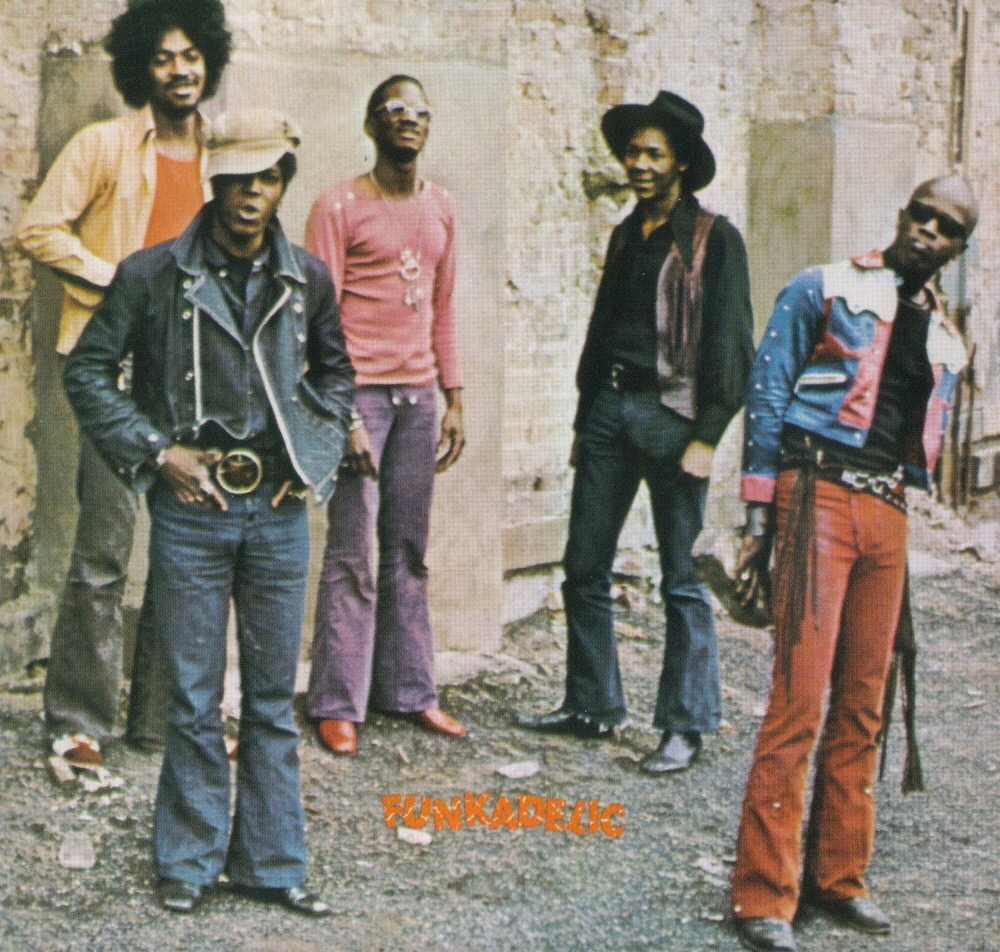
There is no sharp suited foursome instructed to smile into the camera for this album sleeve. Instead, we have a picture of a woman’s head emerging from the earth, which is either screaming in agony or laughing maniacally? Inside, there is an image of the band, standing on a bit of spare ground, looking menacingly hip, no doubt tripping on acid. They did a lot of that at the time. Those smiles may not be friendly ones…

There is a macabre myth associated with the inspiration for the album title: that George Clinton’s brother’s corpse had been lying for such a length of time that maggots were found to be found crawling through the eye sockets of his empty skull when his dead body was finally discovered.  And death seemed very much on everyone’s minds during the recording sessions for the album. Consider for example, the title track, the album’s most celebrated moment. If this brain-scrambling finger-blistering slice of melancholia is a cathartic experience for the listener, just imagine how it may have felt for its protagonist Eddie Hazel. It is well documented that Clinton instructed him to ‘Play it as if your momma just died.’ Some claim that Hazel only discovered his mother hadn’t died after the recording finished. Whatever the truth, and the bulk of personnel involved in the recording have very little recollection of the event, the result was something extraordinary. An impassioned slow burning guitar that cries, weeps and wails its sorrowful eulogy, is only slowly and gradually released from its agony after a gruelling ten minutes. While Hazel sounds on his knees his guitar knocks asteroids off their courses. I imagine the walls of the recording studio sweating blood by the end, the guitar shrivelled up like a piece of dead fruit after it’s exertions. Stylistically, the track could be interpreted as an homage to Hendrix who had died shortly before recording sessions for the album began, but the moment belongs to Eddie Hazel. When Hazel died in 1992, fittingly the song provided the soundtrack at his funeral.

While Hazel was digging Hendrix, there were other influences that shaped the band’s sound, most obviously the rhythmic funk of James Brown and Sly Stone. Listen to ‘Can You Get To That’ or ‘Hit It And Quit It’ where the positive Family Stone influence is at its most bold and infectious, if made even more flamboyant by Bernie Worrell’s intensified keyboard work. On ‘Super Stupid’ Hazel amplifies the decibels with an even heavier sound – George referred to it as ‘a louder Temptations, The Temptations on acid’ – on a song that tells the story of a fatality caused by mistaking heroin for cocaine.

The ten minute finale, ‘Wars of Armageddon’ is the strangest of trips  –  percussive anarchy, frenzied axe-grinding, bubbling organ, screaming, freedom chants, airport announcements and ridiculously crude lyrics merge together in what sounds like one big Parliafunkadelicment orgy. One can divine its influence in the abstract Afro-funk of the title track to Miles Davis’ fabulous ‘On The Corner’, released the following year. It also anticipates the real party to come, aboard that Mothership…

Has there ever been a more fitting name for a band than Funkadelic? Says it all really. Perhaps if Roxy Music had been called Glam Art Trip or if Kraftwerk had simply been dubbed The Robots. In the evolutionary development of Parliament-Funkadelic, and indeed of the music of the period, the album serves as a missing link – both musically and chronologically – between Jimi’s ‘Electric Ladyland’ and Parliament’s aforementioned ‘The Mothership Connection’. There are lots of stopping-off points along the way of course, not just in the Parliament-Funkadelic canon, but this evolution was paralleled elsewhere: in jazz (the post ‘Bitches Brew’ fusion explosion) and in soul [Ernie Isley’s guitar work with The Isley Brothers for example]. Into that melting pot came Clinton and Funkadelic. They partied, preached and pounded, and alongside their monumental guitar solos, they funked it up like nobody else. (JJ)

THE NEW PERFECT COLLECTION Follow @terrytochel @tnpcollection @PgallagheretgGg

The "New" Perfect Collection

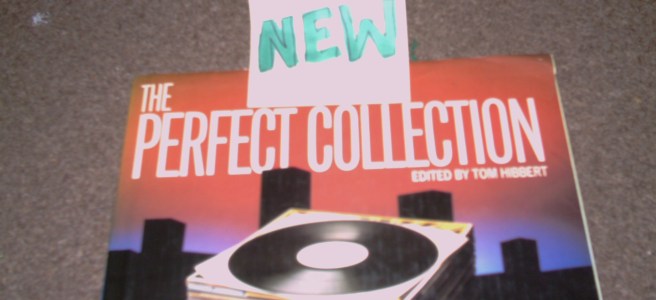
The Perfect Collection was published in 1982. Subtitled “The Rock Albums everybody should have and why”, editor Tom Hibbert and his contributors selected 200+ albums, which would give you, if you bought them all, a “broad, balanced, lively, collection of all thats best in rock music”.

When this book appeared in our local library it consumed and obsessed us. It wasn’t perfect. It didn’t inspire us to track down all of the records like some other lists of the “greatest records ever made” (I’ve still not heard some of them). It included Vanilla Fudge’s The Beat Goes On which it claims is probably the worst album ever made. It included Pat Boone, Cliff Richard and Gary Glitter and omitted Howlin’ Wolf, Link Wray, T Rex and Can.

Where the book got it right was the inclusion of some records which I have never seen included in any other best of lists. It turned us on to records like The Standells’ Try It, The Seeds’ Raw & Alive and The Flaming Groovies’ Teenage Head which remain firm favourites thirty plus years after first reading about them. It included Gene Clark’s No Other and Big Star’s Radio City which were not acknowledged as classics for another decade or two.

While it included many of the big hitters and acknowledged classics, what was clear was that the rest of these albums were the real personal favourites of the contributors, the ones that you would fight for.

What we intend to do is write about the 200 or so albums that we would include in our perfect collection. While it would be tempting to only include records recorded since the books publication, it may include what we would consider glaring omissions from the original book. Like the book, if an artist has two albums of equal artistic merit, an alternative  choice will be denoted with an ‘a’. Various artist compilation were not included in the book, and will not be included here (sorry Nuggets et al) We have tried to avoid the bigger names and shine a light on those names that don’t usually figure in best of lists.

Dedicated to

Tom Hibbert, Andy Schwartz, Brian Hogg, Bill Knight, Chris Charlesworth, C. P. Lee, Chris Welch, Fran Kershner, Giovanni Dadomo, Harry, Shapiro, Ian Birch, John Tobler, Kerry King, Michael Heatley, Mike McDowell, Martin Plimmer, Mark Williams, Nigel Cross, Neville Wiggins, Peter Clark, Patrick Humphries, Paddy Poltock, Paul Whitcombe, Stephen Lee, Sally Payne.