31. THE RAINCOATS – ODYSHAPE (1981)

“We want to put a bit of distance between what we do and the rock’n’roll tradition.”

The Raincoats interviewed by Greil Marcus

The Raincoats initially formed after Gina Birch, inspired by the chaotic energy of The Slits, teamed up with guitarist Ana Da Silva in 1977. An all-female line up was completed the following year with classically trained violinist Vicky Aspinall, and drummer Palmolive jumped ship from The Slits. It was this line up that recorded the ramshackle and scratchy debut album for Rough Trade. However, following its release, Palmolive left, forcing the band to write songs for the next album without a drummer. Just as losing a drummer allowed Spacemen 3 to make the minimalist masterpiece that is Play With Fire, this seems to have freed up their sound, and coupled with the purchase of a bunch of exotic instruments from a visit to New York, and the punk practice of swapping instruments helped to push their songwriting into uncharted territory.

In Simon Reynolds excellent Rip It Up And Start Again, Gina Birch is quoted saying “You couldn’t find a band that rehearsed more than we did, but we always fell apart. We always pushed ourselves a little bit beyond where we were capable of playing”. Listening to Odyshape now, 34 years after it was released and 18 years after I first heard it, just makes me wonder why more bands can’t or won’t push themselves that far, when reaching beyond their abilities resulted in a record that is sparse and spiritual, and almost completely uncategorisable. At the time the NME bemoaned the fact that there were no musical comparisons to be made, not even to their previous album. The Raincoats were now walking through a different musical terrain.

The influence of everything from folk, punk, reggae, krautrock (Can circa Ege Bamyasi) to all  kinds of ethnic music can be heard throughout, but each sound is woven into the fabric of The Raincoats music so perfectly it never sounds like genre tourism that occasionally  plagues music post eighties. Everything here sounds like Raincoats music, just not the Raincoats that had played on the first album. The use of such un-rock instruments as sruti box(?), claves, kalimba, timpani, balafon, ektare and finger symbols sets this record apart from many of its contemporaries and closer to the wyrd atmosphere of records like Dr Johns’s spook-fest Gris Gris or Tim Buckley’s free folk’n’jazz Lorca. Perhaps the appearance of Rough Trade label mate Robert Wyatt on a couple of tracks should give us a clue to the difference in sound from the first album. Maybe Gina Birchs involvement alongside Swell Maps Epic Soundtracks in the Red Crayola was an influence.

So is there any point in trying to describe an album that is as difficult to pigeon hole as this? I think there is.

Shouting Out Loud is a frantic Countess From Hong Kong, bass and drums circling like crows around intense passages of violin and guitar duels. The lack of drums on Family Treet allows the instruments to push and pull at the tempo as its tale of very english melancholy unfolds. Only Loved At Night builds verses around a killer scratchy guitar riff and chorus around kalimba. The epic Dancing In My Head (“Long, long way to go”) always made me think of Debra Keese’s Travelling without sounding much like it. The opening verse sounds like it’s heaving under a heavy weight while the chorus (“My spirit is dancing in my head and in my heart”) with great piano playing from Vicky Aspinall lifts you somewhere completely out of yourself. I would love to hear Joanna Newsom sing this.

The title track kicks off with a circular chiming guitar riffs around a lyric dealing with body image in magazines. The benefits of writing without a drummer seems most pronounced on And Then It’s Ok where the tempo refuses to settle in one place for too long, the guitar switching from a frantic Feelies strum to almost Dark Star Live Dead picking. Baby Song is Congoman put through Can’s Future Days filter, all shimmering rhythms and heat haze harmonies. There’s an almost Cajun flavour to the violin at the start of Red Shoes. Go Away closes the album in fine punky style even as the violin echoes Kashmir.

Odyshape is as classic as anything released during one of the most fertile periods for British music.  Despite people like John Lydon, Sonic Youth and Kurt Cobain heaping praise on the band, it rarely gets mentioned alongside Metal Box or Unknown Pleasures, never mind making those Greatest Records Of All Time lists. Perhaps this is down to its un-rock leanings, or possibly it is down to its influence being harder to trace. I can hear reflections of Vicky Aspinalls violin in Hahn Rowe’s work in Hugo Largo, in P J Harvey at her most English. It doesn’t sound out of place amongst the post 2000 music dubbed New Weird America or freak folk. Whatever. Kim Gordon called their music “defiant in its spirituality without being corny” and that pretty much sums this record up. (TT)

30. PROPAGANDA – SPARKS (1974)

There can’t have been a more unforgiving year in music than 1974. Hardly anything fitted in – its time had either been and gone or was still to come. Glam was over – Bowie and Roxy were still delivering but, post-Ziggy and post-Eno respectively, they seemed in transition and this was doubly so for T.Rex and  Mott, as those desperate dirges Teenage Dream and Saturday Gigs testified.
Music had come so far in the previous decade that it could hardly see back to where it had come from and had little idea where it was going. Revival of early rock ‘n’ roll had become big business but these lingering gazes in the rearview mirror at irrevocably lost pre-Vietnam times – embodied by the admittedly wonderful American Graffiti  – took eyes off the road ahead. Meanwhile, the idealism of seven or eight years earlier had long since curdled, calcified and ossified but many from these periods were still around yet cut adrift and much of what’s now considered classic from ’74 or thereabouts didn’t even gain enough of a profile to be ignored; what audience was there still left for the ex-singer of the Box Tops and his new band? For the guy who left the Byrds after two years? For the guy who sang The Wanderer and Runaround Sue?
Nor was there yet much of an audience for leather-jacketed bubblegum, played faster and louder than it had ever been before, for Who pasticheurs in suits, nor even for Runyon-by-way-of-Scorsese mock epics set in New Jersey. As for the Stones, the Who themselves and sundry solo Beatles, they had crested, peaked, plateaued and were settling in for Olympian sessions of water-treading. Zeppelin and Pink Floyd had the commercial momentum but, as the planet became barely big enough to accommodate them, the controls were already set for them to hit the wall. And then there were the Bay City Rollers… the truism that you have to know where to look, which has sustained many music fans through barren times, was seldom as true as in 1974.

It was in this blighted, benighted, blasted environment that Sparks made their impact and there was no one smarter, fresher or more zestful to be found anywhere. The calcium carbonate and Camembert Mael brothers, Ron and Russell, had started off in their native California as Halfnelson, named after a wrestling hold, and while the camp theatricality of American wrestling had some resonance with the music they produced, their fine debut for Todd Rundgren’s Bearsville label, and its follow-up , A Woofer In Tweeter’s Clothing – their first as Sparks – cut little ice in a market made for the Allmans and the Dead.
The land where Mick McManus plied his gravelly trade in the ring was in thrall to the aforementioned glam gargantuans and had just embraced Lou Reed – if not yet the Velvets – so a move for the Maels, avowed Anglophiles both, made palpable sense. Of course, everything took off swiftly after their no 2 hit, This Town Ain’t Big Enough For Both Of Us, a song which, despite the best efforts of some to wreck it through overplay, I simply never tire of hearing. Received wisdom – something I often find myself concurring with but always strive to avoid taking as gospel –  has it that parent album Kimono My House was Sparks’ early high watermark but my acquaintance with it at this time was fleeting. Its follow-up Propaganda is often dismissed as a hastily-conceived sequel, arriving as it did just six months later, but it’s the one that found its way into our house, that I had the time to get to know, and which confirmed Sparks as the first band I properly got into.
I was in the early stages of primary school and it helped immensely that children are a recurring theme on Propaganda, stories told with directness and empathy from their point of view, and what could have been objectionably twee in other paws is an endlessly productive grin factory instead, albeit with a sober edge. The message Never Go With Strangers, printed on flyers alongside a ghostly silhouetted figure, was being drummed into us and was as horribly urgent as it’s ever been; on Thanks But No Thanks the Maels characterise the strangers as “The merry band of how-are-yous/In tweedy suits and pointy shoes.” in Russell’s incomparable falsetto, I heard nothing sinister and thought instead of Enid Blyton’s mischievous goblins and brownies, who I always favoured over the all–too-human Famous Five, and as a mesmerising extended fade geared up, I sympathised with Russell’s bewildered infant as he mused: “My parents say the world is cruel/ I think that they prefer it cruel.”
Even so, parenthood is made to sound as much unalloyed fun as childhood on Who Don’t Like Kids, though this is as much down to reassured egos as anything else – the kids are “proof that I’m not just a vegetable” and get to chant the title between a circular riff that would have caused more than a few copies to be checked for stuck grooves. Less gleeful is Aaron,  the deserted father narrating BC who, for reasons not fully explained, loses both Betty and Charlie, paradoxically to the most upful, high-kicking melody on an album exploding with the things.
The other most prominent members of Propganda’s cast are flustered would-be suitors. The marauding, propulsive At Home, At Work, At Play recounts the familiar tale of the unattainable girl but this time she’s out of reach not because of mystery or aloofness but because of a relentlessly packed social and professional diary. The extended military metaphor of Reinforcements is characteristically clever, if not quite subtle, but enables the Maels and the piledriving but skilful band they recruited in London to spin another scintillating coda. And there’s real pathos on the album’s first single, Never Turn Your Back On Mother Earth, where brevity – it’s barely two and a half minutes – is no barrier to them executing their most beautiful moment to date, while relating an enigmatic story of emotional chaos and a strange interlude of “three days and two nights away from my friends” before remorse forces temporary abandonment of the wit and smart wordplay: “I’ll admit I was unfaithful/But from now I’ll be more faithful.”
The biggest riot is reserved for Achoo, a song I was warned got loud before I heard it for the first time. A patient bass riff from Ian Hampton and a strangely menacing keyboard fanfare from Ron usher in an epidemic of “La-las with a powrful sting/That’ll stop any opera or any Bing.” Russell once observed that, in true pantomime tradition, the song lent itself to audience participation; by the time the grandstand of mingled Californian and English sneezes is done, quarantine would be strongly recommended.
There can be little doubt that Billy MacKenzie and Martin Fry were listening as closely to Sparks as to their more established contemporaries. Ron’s primitive synths teeter on the edge of Yes-scale pomposity on the closing Bon Voyage, which could redefine every notion you have of bittersweetness, but it was 1974, after all, and Sparks were tossing around incalculably original ideas which helped to ensure pop, or rock if you must, survived its most fraught period to date (PG).

29. TIM BUCKLEY – STARSAILOR (1970)

Oblivion carries me on his shoulder: Beyond the suns I speak and circuits shiver” (‘Starsailor’)

It might sound like baloney to claim that Starsailor killed Tim Buckley, but in his resoluteness to go as far with the voice as ‘Trane went with the horn, he came undone. The culmination of this intrepid expedition to the outer limits was a rejection by his audience and a subsequent descent into psychological chaos, exacerbated by spiralling alcohol and (ultimately fatal) drug abuse.

Starsailor has to be understood in the context of Tim’s recording a career. If you are unfamiliar with his work it would be imprudent to begin here. Having said that, much has been written about Tim’s music, some of which is amongst the best rock literature (for example Max Bell’s NME retrospective (http://timbuckley.net/articles/nme-1979.shtml) and there are even more insightful accounts, such as Chronicle Of A Starsailor by Lee Underwood, Tim’s friend, lead guitarist and along with Larry Beckett, closest musical confidante. (http://www.timbuckley.com/tim-buckley-chronicle-of-a-starsailor/

I suggest you read both of these if you get the opportunity. Underwood captures with particularly incisive brevity Buckley’s remarkable musical odyssey:

“I watched him grow from a Bambi-eyed littleboy poet prattling about paper hearts and Valentines, into a hurricane-haired rock and roller, into a madman/genius improvisational vocalist who blew all the pups away, and finally into a lowdown, roadhouse, sex-thumping stomper who injected steam and blood and juice into an r&b music nobody cared about.”

And that really just about sums up Tim’s development as an artist. Starsailor sits as the pivotal moment in a riveting musical journey which has few parallels in the history of rock. Chronologically, it comes exactly half way through Tim’s recording career (1970)  – despite being album number six of nine – and marks the peak of an assurgent creative curve from his  self-titled 1966 debut onwards. After Starsailor, musical compromise set in and the artistic merit of his recordings gradually deteriorated along with his mental well-being.

The album’s most famous track ‘Song To The Siren’ was successfully resurrected by This Mortal Coil in 1983, sung by Elizabeth Fraser. [Elizabeth of course later had an intense personal relationship with Tim’s son Jeff whose short life bore an eerily tragic resemblance to his father’s]  Buckley’s original is pitch perfect: in the context of the album itself you might say delicate, restrained, and along with the charming Parisian caress of ‘Moulin Rouge’, certainly unrepresentative of the bulk of its content.

Many of Tim’s performances on Starsailor beggar belief, understandably inviting those ‘operatic vocal gymnastics / acrobatics’ descriptions which characterise reviews of the album. But this is over-simplistic journalism. After all, acrobats and gymnasts spend years perfecting rigidly complex routines. The reality for Tim was somewhat different. That’s not to say the musical performances here lack discipline. Far from it, but, liberated from the constraints of the rock idiom, head swollen with Stockhausen, Monk, Mingus, Roland Kirk, Eric Dolphy and Ornette Coleman, he felt compelled to reach further with his voice than anyone had ever gone, and did so with an unbridled and ecstatic inventiveness. 

It is clear from the outset that there are no rigid routines here. No, this is going to be a challenging listen. ‘Come Here Woman’ is a staggeringly ambitious calling card. It begins an ends with an avant-jazz skulk, redolent of the territory explored on his previous proper album Lorca. After the intro, suddenly the song leaps to life with Lee’s dissonantly funky guitar and Tim’s off key bawling. Moments later the skittish electric piano suggests we could be listening to Bitches Brew. It’s complex. It’s all over the place. It’s a fantastic start…

On the brilliant ‘Monterey’ Tim sounds like a lustily crazed chimpanzee who has broken into a Magic Band recording session and wrestled the mic from the good Captain, his yelps,warbles and shrieks providing a bountiful exhibition of his vocal dexterity.

Side Two takes us to rock’s outer limits. ‘Jungle Fire’s moody improvisational beginning is abruptly brought to a close by Buckley’s ludicrously unhinged “deep insi-i-i-i-i-i-i-i-i-de” Tarzan yodel. What follows next is magnificent: an accelerating riff of earthy funk guitar amidst a blizzard of deranged wails and howls.I picture those kids shaking their hair to the Stones at Hyde Park in ’69 and imagine how much further they would have gone to a soundtrack like this.

The title track is extraordinary, an abstract assemblage of 16 vocal tracks laid over one another to create something that seems to take us into the realm of metaphysics…even as it’s last few notes fade, nothing can prepare us for the headlong rush of the introduction to ‘The Healing Festival’ which is genuinely shocking – goosebumps not only stand to attention but fly off my back in fright, seeking refuge from Buckley’s hair-raising vocal assault, the  aural equivalent of the mass slaughter of 10,000 dolphins. The horns, courtesy Bunk and Buzz Gardner from The Mothers Of Invention are wild and free yet still struggle to keep pace with Tim’s five and a half octave vocal range.

The curtain comes down with ‘Down By The Borderline’ where flugelhorn gives way to the relatively more stoic rhythms that would anticipate the earthy soul of his next album Greetings From LA. A good album that, but by then Buckley had descended from the mountain, reclothed himself in flesh and bone and shifted his energies to the lower half of his body. A brief confused and sweaty future would follow, but he had already taken rock music as far as it could go. 

PostScript: A Personal Footnote

[Misleading album sleeve #429] As a teenager, I had heard of Tim Buckley – his album Goodbye & Hello was referenced as the only one worthy of note in most rock music encyclopaedias, although I had recently spotted an entry for Starsailor in a Critics’ Top 100 Albums book (edited by Paul Gambaccini). I flicked past Starsailor onto the album featured on the next page, which if I recall correctly may have been Private Dancer by Tina Turner!

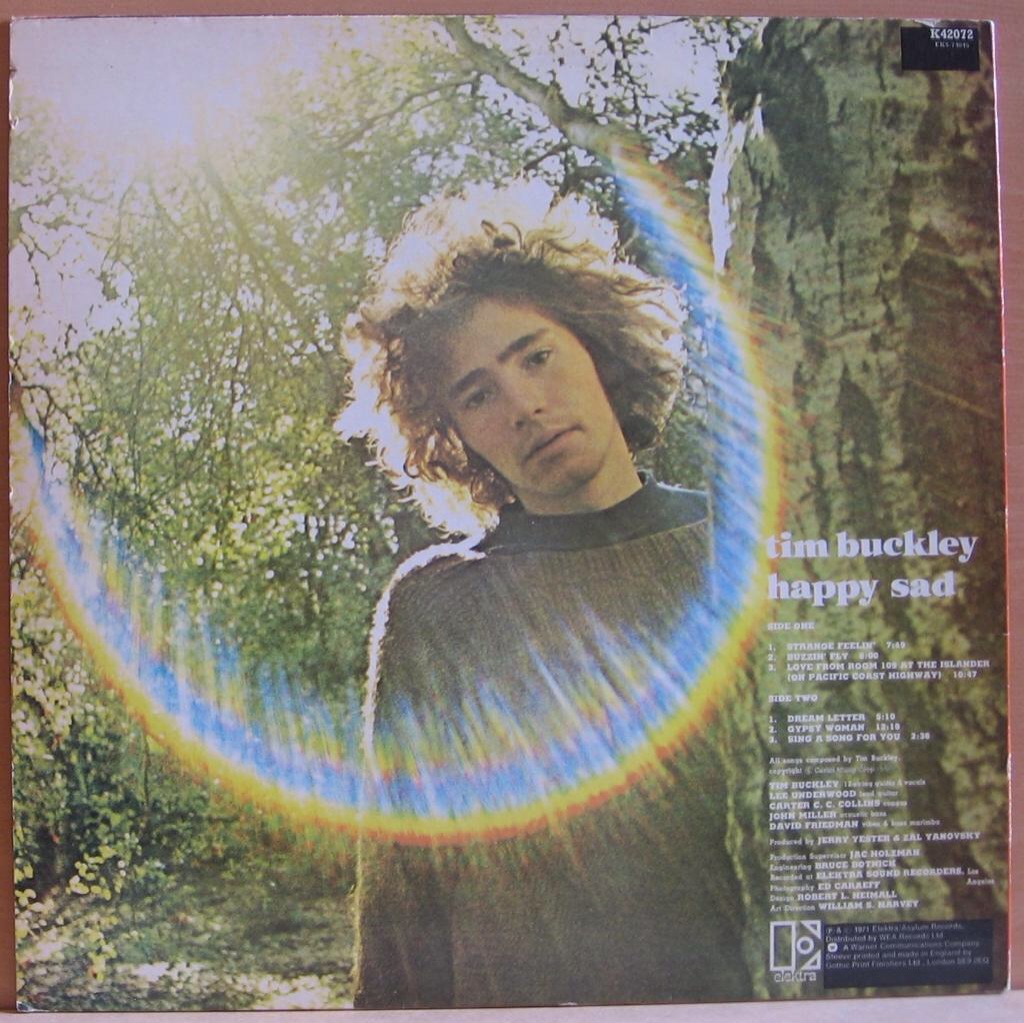
Instead, my introduction to Tim’s music came while browsing the A-Z in Glasgow’s Virgin Records in February 1987. I had a £10 note in my pocket and back then this was enough to buy two, three, maybe even if one was canny enough, four albums. I was keen to make that £10 go as far as possible before inadvertently stumbling upon a US import of Tim’s Happy Sad. It was priced at a prohibitive £8.99, but the picture on the back of the sleeve was of the coolest man I had ever seen. There were only six tracks, which varied in duration from 2 to 12 minutes. Those  Bowie and Byrds albums would have to wait a bit longer. I simply had to have this. As a devotee of Astral Weeks I was naturally captivated by the music – a bewitching spell of jazz-folk reverie – which matched perfectly the image on the reverse of the sleeve with its hazy forest sunlight bursting through Tim’s Dionysian locks.


I returned to the book store once again to gaze at the picture of ‘Starsailor’. Nah, I thought, he looks too happy here – this must have been the contractual obligation album. Its juxtaposition, next to ‘Private Dancer’ did little to allay those concerns. Little did I know at the time that the album would go down in history as one of rock music’s great acts of commercial suicide. (JJ)

28. CROSSING THE RED SEA WITH THE ADVERTS – THE ADVERTS (1978)

CROSSING THE RED SEA WITH THE ADVERTS – THE ADVERTS (1978)
The notion of alternative culture has been diluted enough to leave a gap where the Pacific used to be. What purports to be an alternative is, all too often, scarcely any better than – or even much different to – the thing it’s offered up as an alternative to; trace a line in 2015 from celebrity culture to hipster culture and you’ll hardly travel the length of your own toes; the distinction has been all but erased and there are  far too many intersections at Ukulele Junction, Animals In Adverts Corner and Live Lounge Ring Road. And maybe it’s an inevitable by-product of the passage of time but when some of the most emotionally complex and ideologically committed artists of the last half century – the Smiths, the Jam, REM, Radiohead – end up on a Conservative Prime Minister’s Desert Island Discs, is there anywhere left for anything to go? Yes, I’m well aware that there’s still much that’s radical to be discovered  but even its most ardent champions have seen it all, heard it all and the notion of anything even vaguely subversive penetrating the mainstream now seems as fanciful as the discovery of a bootleg of Geoffrey Chaucer reciting his own work.
Consider, then, what the Adverts and their peers were up against in the late ’70s. There were no politicians or ubiquitous TV presenters self-consciously and ingratiatingly clamouring to prove how really into this groovy punk stuff they were. Who were they surrounded by when the unforgettably gruesome Gary Gilmore’s Eyes became an improbable hit? Smokie, The Dooleys, Brotherhood of Man; Crossroads, Des O’Connor Tonight and Wheeltappers and Shunters Social Club on TV; Keith Joseph and Willie Whitelaw on the news. Punk defined itself against all of these; if they were aware of it at all, the response to it was a deeply-felt revulsion, shown most viscerally towards the Pistols but nobody was immune.

The Adverts stood out as close-quarters observers of the culture they were part of but seemed to be ambivalent towards. On their torrential debut One Chord Wonders (which, along with Gary Gilmore’s Eyes and Safety In Numbers, formed an opening volley of singles fit to stand alongside any), TV Smith berates an indifferent audience which starts off as irate hippies (“Come back when you’ve learned to play”) but turns into fickle, bandwagoneering punks (“We must be the new wave, they’ll like us next year). Safety In Numbers adds a double meaning to its title’s readymade cliche – not only did the scene’s proliferation provide plenty of lookalikes to hide behind but it also eroded its impact. Meanwhile, to the most mellifluous melody of their early period, New Church acknowledges this conformity but urges you to turn it to your advantage (“strength within you, not without you”).
More obliquely, On The Roof slows the headlong charge to a surreptitious tread and Smith appears to be calling for an escape from everyday pettiness (“We’re fighting on the floor for a ha’penny”). On Wheels is much more specific, a reflective and, for its time, bold contemplation of life with disability. It’s less blunt than Peter Hammill’s similarly stark Handicap And Equality, which appeared the following year, but both are notable in dating from a time when a whole lexicon of breathtakingly tactless terms was still applied, without qualm, in official circles to people with disabilities.
The dyspeptic jewel in this tarnished crown is Great British Mistake, one of the most unblinking examinations ever of the nation’s conscience, as lyrically forensic and musically excoriating a dissection as any performed by Weller, Costello or Morrissey. The error is diagnosed as “looking for a way out…getting complacent, not noticing” and personified as people “out of the prepack, into the fear, into themselves.” Torpor and resistance to ideas are the consequence and Smith is fearful – “When will it be over? How can they avoid it?”
It took the Adverts a full year to deliver Crossing The Red Sea… and it appeared a month after the Pistols’ ignominious implosion. I’ve never held with the notion that punk was all over by 1977 – for me, it flourished as late as 1980 – but the Adverts themselves didn’t capitalise on the detonation of this album. A series of strong but sporadic singles came over the next year and a half but the follow-up album, Cast of Thousands, was dangerously flawed. It had one of their finest moments – the untypically gentle, Television-echoing but profoundly sinister I Will Walk You Home – and probably their worst, the hysterical and frankly awful I Looked At The Sun, which ELP would have rejected for being too pompous. But at their peak, they had few equals ; they were once described as “a great band, for a moment” – Crossing The Red Sea… was that moment (PG).

27. GRIZZLY BEAR – YELLOW HOUSE (2006) / (A) VECKATIMEST (2009)

To propose that there might be a genius or two creating popular music in the 21st century may be anathema to those of a certain vintage. After all, Lennon, (Tim) Buckley, Van Vliet, and co. are no longer with us. Indeed one is liable to invite ridicule at the mere suggestion, but I would venture that if people are prepared to look hard enough there are at least a few, one of whom is Daniel Rossen, co-contributor to the wonderful NY foursome, Grizzly Bear.

Grizzly Bear began as a moniker for Ed Droste who, to little fanfare, released a low-fi debut entitled Horn of Plenty in 2004. For the second full-length feature, the ranks had swelled to include three other members, most significantly 23-year old Department of Eagles multi-instrumentalist, Rossen. Droste’s recruitment policy demonstrated shrewd judgement – in fact it was a masterstroke, Rossen’s widescreen West Coast sensibilities were less a musical appendage than the catalyst for a revolution in the band’s modus operandi.

The first fruits of this remoulding, Yellow House (recorded in Droste’s mother’s house), might sound at first like a bunch of (flamboyantly) half-baked ideas toiling in vain to find conventional form, and could be easily dismissed as such by the more casual, less discerning listener. But as the saying goes: ‘a new home slowly reveals it’s secrets’, so too with Yellow House.

Take the album’s opener for instance. ‘Easier’ patiently emerges from atmospheric woodwind and upright piano before being transfigured by Disneyesque harmonising and then an amalgam of sounds which I can only describe as a fantasia of bluegrass-flavoured Impressionism. Like much of the album, it features banjo, autoharp and glockenspiel, and if someone said to you that it was the most beautiful song they had ever heard, you could not feign surprise.

If Marla’s stalking waltzlike piano conveys a sense of foreboding, it is soon transfigured by a string arrangement which sounds like ghosts escaping from one of Debussy’s tone poems, weaving into the solemnity their alluring supernatural tapestries.

But it is not all rhapsody and capriccio. After a breezily acoustic beginning, the guitars on ‘On A Neck And A Spit’ hurtle, crash and collapse together causing an unnerving pile up, before Rossen raises the tempo with a buzzing (Roy) Harper-esque bastard-folk foot stomp. ‘Lullaby’ does what it says on the tin, until half way in it is violently ambushed by a gaggle of Grizzly guitars. While ‘Knife’ is at least more musically orthodox, and easily the closest to a ‘hit’ here, it’s lyrics  ( I want you to know / When I look in your eyes / With every blow / Comes another lie / You think it’s alright / Can’t you feel the knife?) mean it is unlikely it will find its way into your repertoire of songs to sing in the shower.

There is such a range of genre-hopping versatility on show here, that the result is the creation of something almost uncategorisable, and there is some evidence to suggest the band seek further afield than most for their musical inspiration, in particular to film soundtracks. Consider for example the unearthly harmonising on the incredibly complex ‘Central and Remote’, eerily redolent (3:24-4:03) of Krzysztof Komeda’s score for Polanski’s ‘Fearless Vampire Killers’. And is it just me, or does the achingly beautiful ‘interlude’ on the incomparable ‘Little Brother’ parallel Вячеслав Овчинников’s exquisite music for the ‘apples and horses’ dream sequence in Tarkovsky’s ‘Ivan’s Childhood’? In each case the meticulous craftsmanship, borrowed reference points or not, is to be admired and cherished.

The closer ‘Colorado’ with its densely layered vocal overdubs has to be heard to be believed. Imagine the Beach Boys ‘Smile’ version of ‘Cool Cool Water’ being recorded by Big Star during sessions for their ill-fated third album and you may get close. It’s a bewildering end to a bewitching album, one that ranks alongside ‘Forever Changes’ and ‘Spirit of Eden’ as one of music’s great documents of reinvention.

The last time of any note a group of precocious and wide-eyed musicians in their mid-20s retired to an old house to express with such versatility and virtuosity a new musical language, the result was Music From Big Pink’, an album that changed the course of popular music. No far-reaching influence was to follow from Yellow House but it is an historical document that will surely be blessed with similar longevity. It leaves you wondering: why isn’t all music this imaginative? The answer to that question is no secret. Put a sign up outside that Yellow House: ‘Daniel Rossen: Genius At Work’.

VECKATIMEST

What is implicit on Yellow House is made explicit on Veckatimest; what was alluded to is now clearly defined; what was hidden is now revealed; where there was a sophomoric air, there is now professorial authority; what sounded exploratory has now reached perfect distillation.
I can barely bring myself to talk about Veckatimest for fear of allowing some of it’s magic to somehow escape in a cloud of loquaciousness. It will suffice to mention that ‘Southern Point’ is the best one stop introduction to the band’s music, and that ‘I Live With You’ is one of the most impossibly beautiful things I have ever heard. So let me keep it simple: Veckatimest is very probably the greatest album of the 21st Century so far. (JJ)

26. REPRODUCTION – THE HUMAN LEAGUE (1979)

REPRODUCTION – THE HUMAN LEAGUE (1979)
I’ve never quite understood it when people dismiss little-known music out of hand. Equally, I’ve never understood them dismissing well-known music out of hand either. Both equally poxed houses butt heads when the Human League are up for discussion.
 Some, perhaps sincerely but perhaps through sheer wilful posturing, will countenance only The Early Stuff, made before the sundering which produced Heaven 17 and led to the arrival of The Girls, massive hits and, presumably eventually, a fair bit of cash. Others, armed with sometimes justified but often fatuous allegations of snobbery and misogyny, will maintain, with breathtaking snobbery themselves, that only geeky losers are into The Early Stuff and only The Hits matter. Most, though, are oblivious to the existence of a first incarnation and just want to hear Don’t You Want Me once again, sandwiched between Rio and Gold.
If that sounds snobbish itself, let me just say that the only distinctions I draw between the lesser-known and the well-known are that there’s far more of the former, meaning it’s a far deeper seam to mine and that, if a song gets played too often, people WILL get sick of it. Don’t get me wrong, I still have a certain regard for Don’t You Want Me but after more than 30 years of merciless overplay on radio and in public places, I could quite happily never hear it again and would now choose most of the other  songs from Dare – still as smart and scintillating as the day they were minted – or from Reproduction over it every time.
And what of those songs on Reproduction? By the time of its release, the League were already being indicted for selling out after moving to Virgin (by then rapidly morphing from hippy magnet to abode of the synth) from Edinburgh-based independent Fast, where they had released the appallingly recorded but captivating Being Boiled/Circus of Death (the former’s eventual appearance on Top of the Pops was like Colombo showing up at a royal banquet) and the hypnotic, entirely instrumental Dignity of Labour EP, which not only foreshadowed the marvels of fellow Sheffielders Warp Records by a good decade and a half but also showcased the unaffected sense of magic and wonder which shaped the Human League’s universeview, as they debate, among other matters, the record’s cover star, first man in space Yuri Gagarin. As children of the 1960s, they were entranced by space travel, science fiction and spies through genuine affection and a sense of the future as a frontier to be explored, not something to be feared or, just as perniciously, taken for granted, all illustrated by Adrian Wright’s inventive slideshows at their gigs and quite unlike the puny, tiresome humour of those fixated on Back to the Future and Star Wars (if Jedi is a religion, a Jedi prayer would conclude not with Amen or even May the force be with you but with: See what I did there?). Before any of this, they’d begun by covering the Dr Who theme – an astonishing piece of music even eithout recourse to the programme, which had already been sparking youthful imaginations for nearly 20 years.
On Reproduction itself, despite Kalahari-dry production, the songs are deftly executed and often eerie, deploying space and occasional silence as an instrument – from the first sound you hear, of metronomic ticking leading into the Tudor stomp of Almost Medieval to the spoken bookends of the cryptic tale of breakdown in The World Before Last, beginning with what sounds like Labour Prime Minister Jim Callaghan, recently ousted in the 1979 General Election amid industrial unrest, quipping “you will notice- you wil notice that, very appropriately, I’m left handed” and closing with an early assessment of his Downing Street successor, Margaret Thatcher, as “disastrous.” Slowing the classic Spector beat to cortege pace, with synths panning in equally slow motion, the song may not be directly about Callaghan but does tell of someone whose time has come and gone. As for that verdict on Thatcher – she hadn’t even got started.
Even bleaker is Morale, as subdued and closeted a song as pop has ever produced. The aged narrator reluctantly admits a visitor and ponders his trap, cursing not only his own failings but those of others – “I’ve never met anyone who used their knowledge to avoid those mistakes made again and again.” Even Samuel Beckett sometimes hinted at some kind of redemption or resolution.
 Then the synths float and drift and I’ve always imagined we’re being carried across the road to another house, to hear a couple reach the end to the accompaniment of the League’s account of You’ve Lost That Lovin’ Feeling. They play it straight but here the wall of sound is anaglypta-papered, the symphony has been taken out of the pocket, leaving only crumpled hankies, and where Bill Medley sounded wounded and bewildered, Phil Oakey sounds so resentful that there seems no hope of reconciliation.
Lyrics in other League songs have been mocked to the point of tedium for their crassness but Oakey could just as often be poetic and insightful. In the medley Austerity/Girl One, he may offer us “You thought you’d be a nurse/Just like your mother had/ But you make the patients worse/And the doctors know you’re bad” but more than compensates for it with the brilliantly robotic “you brush away a flake of zinc,” then adds: “You push into the bleak/Where all the women walk in fear,” capturing the very real terror that gripped their native county during the Yorkshire Ripper murders of the late ’70s and early ’80s.
There’s also a deadpan narration of a car crash on the closing Zero As A Limit but Reproduction does include songs as bouyant and upful as anything on Dare, just as Dare’s Kennedy documentary Seconds would fit perfectly on to Reproduction. Blind Youth leaps and somersaults as it quizzes punk on its nihilism, while single Empire State Human shares the same Low/Man Machine/Suicide genes as its companions – but could work faultlessly as a song for children. “Fetch more water, fetch more sand/Biggest person in the land” -try it with your kids/nieces/nephews.
They would become huge, in a manner which uncannily paralleled that of Adam and the Ants – both, in turn, uncannily paralleling the rise of T.Rex a decade earlier. In all three cases, seemingly insurmountable splits were overcome with significant switches in direction which still retained  plenty of the original spirit. But all this lay ahead – at this stage, the Human League were throwing Roxy Music, Cabaret Voltaire and Illya Kuryakin into a steel foundry to see what they could manufacture. The result was funny, heartbreaking, thrilling, disturbing, warm and, naturally, Human (PG).

25. BOARDS OF CANADA – IN A BEAUTIFUL PLACE OUT IN THE COUNTRY [EP] (2000)

Somewhere, about a 30 minute or so drive south of Glasgow’s city centre, there is a sizeable windfarm. In some ways it is a desolate place – built on the exposed landscape of the Fenwick moors, but on a clear day, if one can brave the wind, it is a beautiful place. It is one of the locations I visualise when I listen to Boards of Canada’s spellbinding EP ‘In A Beautiful Place Out In The Country’, released in 2000.

We all know the story – the Sandison brothers, Michael Sandison and Marcus Eoin, emigrated with their family from their native Scotland to Canada for a very short period (1979-1980) when the boys were around 8 or 9 years old. BoC was formed in 1986, named after the National Film Board of Canada, producers of several television documentary films the boys had watched while living in North America. Since then, the band has had several line-ups, the only permanent and remaining members being the two brothers. They are one of the most critically acclaimed artists of the new millennium: their shy and reclusive character and dogged determination to allow their music to speak for itself without  any self-promotion, has won them legions of admirers.  

The music is characterised by a profound sense of displacement and dislocation. One might imagine this compulsion to document their childhood experiences would make for an indulgent trawl through their collective memories, but instead it fashions an experience which, with an almost Machiavellian plunder of the subconscious, subjugates the listener, who is beholden to probe into his own sense of nostalgia as the music plays. The idea that their music could actually brainwash people is an attractive one to Marcus and Eoin. “I do actually believe that there are powers in music that are almost supernatural. I think you actually manipulate people with music, and that is definitely what we are trying to do.” (Boards of Canada, 2001)

Listening today, there I am, 1975, sat in the lotus position amongst my friends in the school’s social area, observing as the janitor/technician wheels out this huge mass of electronic boxes and mess of cables (which look like discarded props from Tarkovsky’s ‘Solaris’) before, through the miracle of video recording technology, we settle down to watch an educational feature of highly dubious quality. For me, this image is a recurrent one when I listen to Boards of Canada. The analogy is somewhat apt. In the Soviet science-fiction film, the protagonist – Kris Kelvin – is sent to investigate the strange goings on aboard a space station orbiting the (fictional) planet Solaris. What he finds is that the planet’s ocean possesses the capacity to send ‘visitors’, apparitions or ‘islands of memory’  from the past, compelling the recipient to examine his own conscience, ultimately leading to  psychological devastation. Let’s call it The Boards of Canada Effect’.

So what is the process they use? Well, on the surface the music of Boards of Canada is a kind of intense and brooding electronic introspection. With its utilisation of analogue synths and blending of distorted samples and sounds siphoned from vintage tape machines, it seems at times almost joyless: there is little that sounds rapturous or euphoric. But what lends it weight, is the tremendous patience and restraint in the composition – there is no premature reaching for ecstatic highs. Rather, there is an almost nerveless concentration on the development of each sound, where the most minor change of key or chord is liable to disorientate the senses. The listener is thus rewarded with a far more enduring experience, one which stands up to and bears repeated listens.

From the diaprojektor driven beats of the opener ‘Kid For Today’ to the indescribably beautiful closer ‘Zoetrope’ this is a faultless collection. On the latter, a patient minimalist keyboard begins its teetering search for a hook, which (thankfully) never arrives, the track almost dissolving within its own beauty before fading out. It sounds like the breathless farewell speech of an antique musical instrument which gave joy to many, but whose life is now gracefully ebbing away.

In between we have two tracks which remind us that while the boys rural sensibilities are a vital ingredient in the mix, so also is their discomforting capacity for blending their ‘electro-agrarianism’ (as Pitchfork labelled it) with sounds and themes suggesting something more foreboding. ‘Amo Bishop Roden’, the widow of David Koresh, of Branch Davidian / Waco infamy, lends her name to the title of one of the four tracks; this one features a repetitive almost static drone punctuated by beats which change tempo at regular intervals, while a plaintive keyboard surreptitiously fades in and out of the mix.

The title track features a recurrent BoC motif – the laughter of children, particularly disconcerting in the context of the song’s theme, but its unobtrusive beat is enlivened and beatified by one of the most hypnotic and unsettling keyboard parts you could wish to hear. The seductive but sinister atmosphere is accentuated by a vocoder-processed voice, slowed down, which repeats with chilling effect: ‘Come out and live in a religious community in a beautiful place out in the country’. I believe the voice belongs to Amo Bishop Roden. While eerily disturbing, it is a truly stunning piece of music.

‘In A Beautiful Place Out In The Country’ deserves to take its place in the all-time pantheon of greatest ever EPs, alongside ‘Chronic Town’ ‘Slates’ and ‘Datapanik in The Year Zero’. These may be musically tenuous reference points, but some even unlikelier comparisons could be made. In their approach to recording – where every note is sweated over until distilled to perfection, and each sound subjected to the utmost scrutiny before its inclusion on a record –  BoC employ a similar aesthetic to their fellow compatriots The Blue Nile (at least in Buchanan’s early days). Finally, I was watching the Dexys documentary ‘Nowhere is Home’ on BBC4 last week, and was intrigued by Kevin Rowland declaring he had no interest in forming friendships with fans, but that he was determined to treat them with ‘total respect’ through a commitment to high quality recordings and the delivery of impassioned concert performances. That very admirable ethos mirrors that of BoC, which is based on the following principle:

“We always assume that the listener is the most intelligent person imaginable” (Boards of Canada, 2001)

This is a vision shared by the late great Soviet director, whose austere but visually stunning film-making invited its audience to co-create its own film from each individual’s subjective viewing experience.  It may often not be true that the viewer – or listener – is the most intelligent person imaginable, but he can be sure of one thing: the quality of the music of Boards of Canada is guaranteed by such integrity and this unquestionably purist approach to making records. (JJ)

24. PEARLS BEFORE SWINE – BALAKLAVA (1968)

BALAKLAVA“In peace sons bury their fathers,
In war fathers bury their sons,
Love is silent at the edge of the universe,
Waiting to come in'” (‘Translucent Carriages’)

Balaklava was the second album by Pearls Before Swine, and their second to be released on New York’s legendary ESP, the label responsible for The Heliocentric Worlds of Sun Ra and other uncompromising free jazz recordings of the mid-1960s, as well as oddball counter-cultural rock albums by the likes of The Fugs and The Godz, to whose music I was introduced through a resounding commendation in the original Perfect Collection.

The very first time I heard the music of Pearls Before Swine I knew it was what I had been waiting for my whole life. I had a complete set of albums by The Velvet Underground, Love, The Byrds, Buffalo Springfield, Tim Buckley et al. But something was missing. I never knew what that something was until I encountered Balaklava.

Pearls Before Swine were different. Once fittingly described as “a madman saint leading the asylum band during the rainy season”, Tom Rapp, the band’s leader, songwriter and only permanent member, enjoyed little popular success despite a catalogue of wonderful psych-folk albums in the late 1960s and early 1970s. Perhaps his quivering voice and heavily pronounced lisp – charmingly honest to some – provided an obstacle to commercial credibility. Or his lyrics, so rich in strange Biblical and Blakean imagery, may have alienated others. Whatever the case, success eluded the band during their career. Recognition came late – too late for pop stardom – but a quietly flourishing audience of fans including a number of musicians, resulted in a tribute album, and concert invitations began to flood in during the late 1990s, by which time Rapp was working as a Civil Rights lawyer in Florida.

Their debut offering, One Nation Underground, was initially recorded as a demo and sent to ESP, who promptly signed the band and rush released the album. On first hearing, it’s Dylanesque protest folk – along with song titles like ‘Drop Out’ and tunes as immediate as ‘Uncle John’ – may seem to have captured the zeitgeist well, but the album sleeve featuring the macabre painting The Garden Of Earthly Delights by Hieronymus Bosch, hinted at something more portentous. At this stage the band had not yet ‘turned on’ – indeed Rapp identifies the strongest intoxicant favoured by the fledgling Swine to have been Winston cigarettes! Although it was the only Swine album to sell fairly well (around 200,000) the band claim to have received very little royalties and this may have accentuated a darker worldview which while not quite dystopian, stood in stark contrast to the vacuous euphoria of the ‘flower power’ generation.

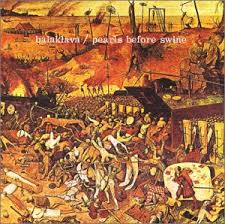
Balaklava which appeared a year later, received Rolling Stone magazine’s dreaded [], it’s lowest possible rating. But in the 1960s Rolling Stone frequently got it badly wrong. Once again the album featured some apocalyptic artwork, this time Pieter Bruegel’s The Triumph of Death, and presented a uniquely harrowing vision of the horrors of war, delineated by Rapp’s (Winston inspired!) hallucinatory and surrealistic poetry.

The album is bookended by two historical recordings: the first, by Trumpeter Landfrey, who sounded the bugle at the beginning of the ‘Charge of the Light Brigade’ at the Battle of Balaklava during the Crimean War; after the second, a barely audible recording of the voice of Florence Nightingale, we hear a tape loop of the whole album rewind to the beginning, surely a commentary on the perennially rapacious nature of the human species, forever embroiled in military conflict, captured at the precise moment when the ugly truth about America’s involvement Vietnam was gradually emerging.

‘Transluscent Carriages’ the most explicitly anti-war song, is shrouded in mystery, Rapp’s ghostly utterances over a plaintive acoustic guitar line, tastefully embellished by atmospheric clavinette. The lyrics to the opening verse are indicative of the album’s sombre mood:

“The translucent carriages
Drawing morning in
Dawn inside their pockets
Like a whisper on the wind.”

‘Images of April’ has a simple swooning bass line but replete with birdsong, flutes, echoed voice, and introducing the intriguing ‘swinehorn’ of Lane Lederer, is the archetype for the album’s peculiar sound.

Even better is ‘I Saw The World’. Warren Smith’s string arrangements provide a panoramic sweep somehow reminiscent of the theme tune to the classic 1960s French children’s TV series The Adventures of Robinson Crusoe (or is that just the augmentation of the sound of sea spray?), while the ghostly atmosphere evoked by the distinctive percussive arrangements sound like they come from the depths of The Black Ark. A strange marriage indeed, but listen and you may hear what I hear…
‘Lepers and Roses’, Rapp’s take on the Orpheus myth, is equally gorgeous . The lyrics may be inscrutable:

“In fields where Susan sings/The leopard brings/Yesterday/In upon a string/And all your dead rainbows/Begin to stain/The lace on your raincoat/So leave the blind/Roses behind/You’

..but the music is drunk on its own beauty. A dreamer’s dream…the songs on the album are less conventional narrative or story and more mood pieces. Rapp once clarified his approach to songwriting in an interview with Goldmine:

“My sense of writing a song was that you started with a mood or a feeling and you just chipped away everything that wasn’t that feeling and in the end you’d have something that had crystallized it somehow’

Despite this concentration on mood and atmosphere, the album has its flaws. Although there is a delicately judged cover of Leonard Cohen’s ‘Suzanne’, there is at least one mis-step along the way, the plodding sub-Donovan (sub-sub-Dylan) folk of ‘There Was A Man’. But, the old gramophone production of ‘Guardian Angels, is exquisite. Here Rapp once again resurrects the voice of the ancient prophets:

‘All of the pain in the world is outside your bed/In the shapes of phantom men tapping your window with rhythms of dread/And all of the silver rosaries hung on the door/Will not drive them away they are going to stay.’

Rapp and a new set of Pearls went onto release four albums for Reprise, two of which at least (These Things Too and The Use of Ashes) are the equal of Balaklava. His influence is slight and could be detected in the likes of Bill Fay (another much under-appreciated songwriter) but it has been left to long-time devotees such as Damon & Naomi (of Galaxie 500 fame) and Flying Saucer Attack to rekindle a flame which never so much burnt out as was ever adequately ignited in the first place. But, still that flame flickers for the chosen few – those seduced by the sounds and visions of an authentic lost prophet.(JJ)

23. CRAZY RHYTHMS – THE FEELIES (1980)

CRAZY RHYTHMS – THE FEELIES (1980)
Any record which features sandpaper, coat rack and shoes among its instrumental credits has emphatically earned the right to be called Crazy Rhythms. The rhythms, and the songs they inhabit, aren’t ostentatiously barmy – for which thanks – so much as markedly unorthodox, squatting in a territory somewhere on the road from skiffle to funk without remotely resembling either.
Taking their name from an undemanding, multi-sensory form of film in Aldous Huxley’s Brave New World,  the Feelies appeared most likely to side with the Gamma, Delta and Epsilon classes of the book, with their unassuming – for want of a better word – preppy image and palpably un-rock ‘n’ roll demeanour, fitting with the most superficially obvious comparison of Jonathan Richman.
 A crude precis of Crazy Rhythms could be that it outlines how the Modern Lovers might have developed if Richman had continued to expand the Velvet Underground template of their first album, instead of proceeding to draw more heavily on rockabilly and doo-wop influences. This also puts them in proximity with the commotion of Josef K and even the early Go-Betweens, while on the Bolt-worthy sprint of Fa Ce La, they provide a blueprint for the sound of the Woodentops.
Repeatedly on Crazy Rhythms, the Feelies prove themselves to be masters of the slow build and slower burn. Many of the songs are one or two minutes down the line before vocals or hooks arrive, meaning that many self-proclaimed cutting edge radio stations
would play them – not that this would ever actually happen – in a severely truncated form, but this would be like skipping all that business with the apes  in 2001: A Space Odyssey and going straight to HAL’s breakdown. The full picture is needed for full power. Funny how this doesn’t seem to apply when the song in question is Stairway To Heaven or Champagne Supernova.
All of this is most explicit on opener The Boy With The Perpetual Nervousness, where hesitant-sounding claves and/or woodblock are spied on by a ticking guitar, which finally springs upon them when goaded by the tom-tom roll of future avant-garde voyager Anton Fier. What follows is a sketch of a silent recluse who either has depths too hidden to be traceable or is just completely withdrawn – a Boo Radley who’s never been allowed anywhere near scissors or a Sheldon Cooper plotting his world domination? Unclear – the Feelies put as little flesh on the bones of their lyrics as their music.
But don’t let this sparsity underestimate their capacity to scorch, particularly with Glenn Mercer and Bill Million proving to be the most quietly potent guitar duo of their era, Verlaine and Lloyd with silencers attached . The solo midway through the similarly elongated intro to Loveless Love – which they’re seen performing in Jonathan Demme’s Something Wild – would have the jocks meekly handing THEIR dinner money over, while another on Forces At Work – seven minutes, practically all one chord – is a proud descendant of Run, Run, run and All Tomorrow’s Parties. The abum’s sweetest melody is on Raised Eyebrows, where it almost feels like a copout for them to introduce lyrics, particularly when they’re so terse, and you feel that they should have had the courage of their convictions and gone for an instrumental. But it ends up structured like a 1930s dance band tune, which gives it a charm of its own.
There’s even a Beatles cover. Their interpretation of Everybody’s Got Something To Hide Except For Me And My Monkey is less drastic an overhaul than Devo’s version of Satisfaction but is conceived in a similar spirit – seemingly ambivalent towards its weighty source material but plainly a product of an utterly different time and culture.
It’s apt that ‘rhythms’ is close to being the longest vowelless word in the English language, as Crazy Rhythms withdraws what might be essential elements to some – big production, deep bass, bravado – and is vastly inventive with what’s left. French music magazine Les Inrockuptibles once likened the record to a UFO – it may come in peace but has little interest in being taken to your leader, as it would much rather take you on a path of its own (PG).

22. THE FALL – DRAGNET (1979) / (A) THE FALL – SLATES (1981)

DRAGNET

It might seem odd to talk about a departure in the Fall’s sound but if there ever was such a moment, it came with Dragnet. Yvonne Pawlett had gone through the exit, on possibly the last occasion before the hinges needed fixed, dragging behind her the endearingly spooky organ that had been as central to their early sound as Tony Book had been to Manchester City a decade earlier.

Enter Craig Scanlon and Paul Hanley, neither of whom could ever be described as lieutenants to Mark E Smith- could anyone?- but who, as dramatically outlined in Hanley’s memoir The Big Midweek, stayed for the best part of two decades as the fist-close witnesses, and unceasingly compelling soundtrackers of, Smith’s, well, ownership of a band that previously borne a vague resemblance to a democracy.

It still (a word that always recurs in Fall reviews) stands as one of their most gripping statements, though I’m quite aware Smith is unlikely to take kindly to such a view about a record made as long ago as 1979. A Figure Walks is as terrifying as you’d expect a song about stalking to be and, along with Muzorewi’s Daughter, shows that tom-tom thunder is possibly the most thrilling sound yet discovered by scientists. They had never yet been so downright tuneful as they are on Your Heart Out and Flat Of Angles, despite reliably unsettling lyrics (“Then they take your heart out/ With a sharp knife, it wasn’t fake”) nor as plain brutal as on Spectre Vs Rector, which served notice that this band were probably not in music to make money and certainly weren’t in it to make friends. Before The Moon Falls sounds like the title of a lovely Al Bowlly-crooned ballad from somewhere around 1932. It isn’t. It’s classic Fall.

And what’s classic Fall? It would be more than slightly churlish to say that if you have to ask, you’ll never understand, so one listen to this song – and this album – should give you pretty shrewd idea. (PG)

SLATES

If I were allowed but one Fall record in my collection I would probably choose Slates. This primordial slab of Salford sludge finds MES at his most cryptically acerbic and blisteringly bewildering and the band making a glorious amphetamine-fuelled racket.

Slates was released in an unusual 10″ format, two years into Thatcher’s premiership at the height of the Brixton Riots of April 1981. It clocks in at a little over 22 minutes. In fact, it’s safer to say that it’s an EP rather than an LP, but with 6 tracks it’s just unclear enough to ignite a discussion on the matter.

The first half kicks off with Middle Mass. Musically, a Velvets-y organ drone breaking into a jaunty Beefheartian guitar break, it is ostensibly a yarn about the drinking habits of football fans during the close season; while others have divined a tirade about Marc Riley (‘The boy is like a tape loop’). More likely the kicking is aimed at Mark’s favourite target the middle classes themselves. Just quite what Mark is getting at with his repeated declaration that ‘The Wermacht never got in here’ is anyone’s guess.

‘An Older Lover etc’ is probably about… well, his older lover (11 years older) at the time, Kay Carroll. Here his cerebral ponderings are rawly laid bare. It’s accompanied by one of those spookily amateurish guitar rumbles, like the Magic Band tuning up, and is punctuated by Mark’s indignant yelps…’Dr. Annabel Lies’ – she being the mythical agony aunt for Mark’s self therapy session

I must have listened to Prole Art Threat around 100 times but I’m none the wiser – one can surmise it has something to do with the surveillance or suppression of working class culture in Thatcher’s new Britain. Or is it? For a more extensive and insightful analysis I refer you to Taylor Parkes’ superb piece in the Quietus (http://thequietus.com/articles/03925-the-fall-and-mark-e-smith-as-a-narrative-lyric-writer) Musically, a magnificent Fall moment – driven by one of those ferocious cyclical riffs, rising, falling, FALL-ing – like only The Fall can – Hanley and Scanlon brutalising their collective ten strings, the groove intermittently suspended by the guitar squealing in protest at its ill treatment. The band were rarely if ever, tighter than on this track – every note sounds both harsh and wild and yet is delivered with military precision.

Mark sounds buoyant on Fit & Working Again, back observing the world around him after an unexplained layoff? For me it’s the slightest musical and lyrical achievement here, Mark chopping away on a solitary piano key over a skiffle-like rockabilly rhythm. But that only makes the final twosome sound even more spectacular.

A million words have been spent attempting to decode and deconstruct The Fall’s ‘definitive rant’ – who or what exactly are the Slags, Slates etc’ of the title? Accountants in suits, the pub bore, plagiarists, ‘dead publisher’s sons, material hardship pawns, The Beat, Wah! Heat – male slags…?’ I’ve even read some analysts identify the slates as vinyl records, particularly 7 inch reggae singles? To be honest one can only ‘have a bleedin’ guess.’ I am sure MES must get a kick out of reading ‘academic male slags’ trying to piece together his cryptic declamations. And their vain attempts no doubt conveniently provide him with useful material for his next rant. So forget the mystery of the subject matter and celebrate instead the vigorous kick in the gonads provided by the huge two chord guitar riff that – combined with Steve Hanley’s bowel bursting bass intro, never seems to relent. It makes for one of the greatest ever Fall tracks, enhanced further by Mark’s immortal interjection to the boys: ‘don’t start improvising for God’s sake’ – demonstrating both a natural flair for tyranny and a sensitive ear for musical purity. Bloody marvellous!

‘Leave The Capitol’ provides a fitting climax. It’s wiry and punchy and bouncily infectious in equal measure, as Mark’s invective spills over in this Arthur Machen inspired tirade at old ‘Lahndan Tahn, (‘this f-ing dump’) where he exhorts himself to ‘Exit this Roman Shell!!’ Holed up in his hotel room where the ‘maids smile in unison’ and where ‘the beds are too clean’ and the water ‘poisonous’ – you can just see him there can’t you? Pining desperately to return north to his fags’n’beer an’ a bit of proper culture…God Bless him!

Selecting one album from The Fall’s extensive repertoire is not a simple task. And the one I’ve picked is not even an album. But with prodigious economy, Slates – more than any other – is a one stop distillation of the Fall sound. Reasonable people may argue with this choice, but perhaps it would be most fitting to let the children of the Wermacht offer the final word on the matter. See below: (JJ)