21. ECHO & AND THE BUNNYMEN – HEAVEN UP HERE (1981)

Everybody has one band who, above all others, are Theirs. Echo and the Bunnymen were Mine.
 It’s hard to explain why they should have snagged on to me more than any other – there were plenty of others, before and after, who came close and with many of them I had the same sense of discovery, both in the sense of finding them for myself and in being taken to places unknown. It helped that the silly name and their distinct difference from, on the one hand, boorish metal and on the other, flagging rock ‘n’ roll revivalists meant they were great for winding up the people who favoured those styles.  They also eschewed many of rock’s fatigued conventions at a time when its last rites were being read, from simple gestures like foregoing the drum riser to have the band in a line on stage, to their khaki stage gear and camouflage set, to event gigs like the mystery tour to a botanic gardens (captured in the short film Shine So Hard) and the celebrated Crystal Day, where Liverpool as a whole became the venue and the gig was just one element of a show which also took in Chinese theatre, a bike ride and a visit to the band’s favourite cafe which was required for tickets to be valid. It may be that these were largely the ideas of their manager, future KLF pop provocateur Bill Drummond, but instead of being overcompensatory gimmicks, they were inspired and complementary to the extraordinary music the band were making.
And most of all, that music and lyrics had a swagger, inexhaustible reserves of cool that I  could never hope to claim for my own but could at least revel in the reflection of, and at the same time a real – to borrow a phrase from contemporary heroes Dexys – knowledge of beauty – which meant it had heart as well as heft. In short, listening to the Bunnymen made me feel 100 feet tall.
Roughly 94 feet taller than Ian McCulloch, the garrulous, big-coated first Bunnyman among equals, who at this stage had as much to say in song as in interview and sang it in a voice which could leap from sardonic drawl to anguished peal and back again faster than you could say “King Kenny.” (his Liverpool fandom even went a long way towards rekindling my own interest in football, which had expired utterly through a combination of Scotland’s 1978 World Cup calamity in Argentina, a realisation that I myself couldn’t play the game for toffee and a sense that, compared with music, it was just plain uncool. Joe Strummer or Terry McDermott?)
Alongside him was Will Sergeant, a guitarist of ideas as much as action, influenced by Eno and Tom Verlaine in equal measure, who could bring textures by the score to a song while rocking like an entire ecosystem of beasts. Further along, the brilliantly athletic rhythm section of bassist Les Pattinson and the – it’ll always be painful to write the word – late Pete de Freitas on drums, elastic, double-jointed, able to switch direction at half a second’s notice and enabling the band to turn the conventions of rock songwriting, as they would put it themselves, inside out, back to front, upside down.
Two particular songs on Heaven Up Here conduct this surgery on the song with a Nobel level of skill and precision. Opener Show of Strength shifts gears, leaps ever higher and steps as surefootedly as a tightrope walker asking for the rope to be hoisted a few more feet, then it disappears like a spy whose mission is accomplished, leaving Mac alone to file the final report: “Hey, I came in right on cue/One is me and one is you.”
Similarly, Over The Wall fades in on a simulation of the sound of the seas that Mac would return to time and again for inspiration, a gently pulsing rhythm box and a three-note riff embodying Sergeant’s economical yet panoramic style. Pattinson goes one better with a rotating four-note bassline as far evolved from root-note jockey playing as the Grand Canyon is from a pothole, while De Freitas knows exactly when to hold back, when to detonate and when to let loose the steeplechases where Mac riffs on Runaway by Del Shannon (who, Mac claimed, was mooted as producer for first album Crocodiles) and pleads, twisting another cliche “come on and hold me tight…to my logical limit.” A year earlier, he’d chosen this for his all-time top 10 in Smash Hits but what would usually be unpardonable hubris actually seemed quite reasonable.
Elsewhere, they offer their own perspective on the parched funk of Talking Heads and Gang of Four – both strong undercurrents in early Bunnymen – on It Was A Pleasure and No Dark Things. The title song takes the triple-jump rhythm of Bowie’s Star and accelerates it to prove that rock that’s foresaken the roll can be its own kind of dance music, while All I Want is equally celebratory amid call-and response guitars and drums tossed on – to quote their Liverpool contemporaries the Wild Swans – a harsh and foaming sea.
Melancholy arrives on The Disease, probably their oddest ever song, a simple, see-sawing riff embellished by backwards vocals, injections of feedback and ominous rumbles. Like Heaven Up Here itself, it also sees Mac contrasting heaven with hell – a device he’s used in at least half a dozen other songs since.
The mood darkens further on All My Colours (aka Zimbo) where Mac ponders desolation and decline to the accompaniment of then-voguish tribal drums but to far more defeated and less triumphant ends than the ones that Adam and the Ants were, coincidentally, pursuing to massive success. This version of the song actually works less well than many live versions, as the vast snare crack which heralds the chorus is needlessly muted – I’d recommend instead the version from the 1982 WOMAD festival with the Drummers of Burundi (“we’re Echo and the Burundimen” quips Mac) which appeared on the 12″ of The Cutter.
It’s often observed that, despite three top 10 hits, the Bunnymen ultimately never achieved the stadium status of U2 and Simple Minds. Just as significantly, neither have they secured the place in The Canon that Joy Division/New Order and the Smiths now routinely occupy. Since reforming in the late 1990s, they continue to produce alluring records and remain an enticing live act but, while I wouldn’t go as far as to say they’re tarnishing their legacy, the songs are now largely linear (the very thing Mac claimed to dislike in early masterpiece Villiers’ Terrace), join-the-dots affairs, glaringly missing the vigour of the original rhythm section, while Mac has long since retreated from his early vivid lyricism (eg “a shaking hand would transmit all fidelity”) to an all too familiar litany of sunandrainandmoonand stars. In view of Oasis and Coldplay’s acknowledged debt to the Bunnymen, he might be held indirectly responsible for the trite, unimaginative lyric writing that’s so pervasive today.
But then I remember what the Bunnymen have meant to me for so many years and, even if they are peripheral in official rock history, it makes me feel even more vindicated. I’m more than happy to share them with anyone but you must understand – they’re Mine. (PG).

20. MATT JOHNSON – BURNING BLUE SOUL (1981)

So much for British psychedelia: Syd’s Pink Floyd the only enduring body of work from a time when the top of the UK charts was ring-fenced by Englebert Humperdinck, the whole hippy dream lampooned mercilessly by the Small Faces and the best we could do aside from letting the mad genius play, was – apparently – Status Quo. Ok, there was The Beatles – who did it well, sometimes very well – and, ahem…’Their Satanic Majesties’. The odd hidden gem such as The Eyes’ ‘You’re Too Much’ or ‘I Must Be Mad’ by The Craig if you looked a little harder, but as for great albums…nothing much doing. Some might point to The Yardbirds or The Creation and of course there was the plain weirdness and wizardry of The Incredible String Band but arguably nothing besides that to take you to the aural outer limits.

The prevailing perception is that psychedelic music was an historical (largely US) phenomenon which materialised around 1965, peaked two years later on the West Coast, and gradually burnt out thereafter as the decade drew to its unhappy close. The long-playing record was its principal currency. But this perspective is a narrow one. When I first heard those Grateful Dead albums, the promise of their garish dayglo sleeves (so intriguing to a teenager with a 1960s fixation) was quickly nullified by the content within. So this is psychedelic? It seemed to me that the copious use of hallucinogenics led only to overinflated egos and particularly unadventurous sets of extended blues jams. This was clearly not the mind-expanding experience I had so enthusiastically sought. And I, in my youthful innocence, was looking for something which might distort my perception of reality just enough to take me to another world for 45 minutes or so…I persisted with my search and soon found an unlikely source.

The The’s debut album ‘Burning Blue Soul’ was released in 1981. For contractual reasons it was credited to its creator, Matt Johnson. He was 19 years old. Even now, few would classify it as a ‘psychedelic’ album. But let me go one step further. I contend that not only is BBS a great ‘psychedelic’ album but it is possibly the greatest ever British psychedelic long player. It is however a particular species of psychedelia, peculiar to a post-punk UK landscape, one brought about by a failing industrial economy, and an emerging nihilistic moral vacuum.
So what makes this record psychedelic? Perhaps let’s begin with a definition:

Psychedelic (adj): of or noting a mental state characterized by a profound sense of intensified sensory perception, sometimes accompanied by severe perceptual distortion and hallucinations and by extreme feelings of either euphoria or despair. (www.dictionary.com)

Nothing here about ’free love’ and getting it together (maan!) Matt Johnson was not the cheeriest of chaps in 1981. While he often claims that this, his debut album is full of wry humour, it frequently reads like a teenage suicide note.

‘I have no future for I’ve had no past
I’m just sittin’ here pullin’ arrows out of my heart.’
‘…See me dwindle, watch me dwell
In my cut out corner, in my plastic world.’ (‘Icing Up’)

‘Saturday night and I was lying in my bed
The window was open and raindrops were bouncing off my head
When it hit me like a thunderbolt
I don’t know nothing and I’m scared
That I never will.’ (‘Another Boy Drowning’)

100,000 people today were burned
I ‘felt a pang of concern
What are we waitin’ for
A message of hope from the pope?
I think he got shot as well.’ (‘Song Without An Ending’)

Johnson’s dogmatic pessimism – such a contrast to the ridiculously utopian optimism of the 1960s – seemed so beguiling to me when I first discovered this album as a 19-year old in the late 1980s. I was helplessly drawn to this strange otherworldly concoction as I stared gloomily at the bedroom ceiling. Today for some, its self-obsession and sixth form existential angst appear naiive and suggest the author was still a little wet behind the ears. But it is the music that really counts here, and for that we can forgive Johnson his lugubrious self-indulgence. Matt was concerned that people would find his lyrics too direct and worked tirelessly to bury the vocals deep in the mix, and this only serves to intensify the disorientation of the listener.

There are all kinds of things going on here: some have criticised the album’s ‘crude tape-splicing’, rather than appreciate it’s brilliant range of guitar and keyboard treatments. Consider for instance the inauspicious and relatively uneventful opener ‘Red Cinders in The Sand’ where a subterranean tribal drum pattern emerges from a piercing sonar tone before breaking briefly into a middle-eastern raga-type dirge. Then we have what sounds like large metal sheets being thrown unceremoniously onto a truck. A pulverising industrial beat emerges accompanied by shards of feedback and a droning tuba (?). It’s an unnerving sound reminiscent of Throbbing Gristle and pre-empting the kind of territory that would be explored by the likes of Test Dept. in the mid-1980s.Or listen to the feverishly voltaic spittle of guitars over a portentously motoric bass riff on ‘Out Of Control’, which could have served as a fitting soundtrack for the classic lost 1970s BBC TV series ‘The Changes’.

‘Song Without an Ending’ is truly astounding. A bass-driven hurdle over nervy jagged guitar lines with the kind of riff the likes of Hot Chip would sell their souls for. Listen to the swell of the surf-style reverb break in to the relentless groove at 1:14, followed swiftly by a paranoiac backwards guitar accompanied by an expansive keyboard part which, synthesised with the galloping clutter of beats manages somehow to make the song feel simultaneously claustrophobic and panoramic. Quite an achievement.

It’s not hard to detect the sleight of hand of Wire duo Gilbert and Lewis on a few of the album’s more abstract moments. They are at work on one of the oddest of all, ‘The River Flows East In Spring’ where the spiderlike guitar picking of the intro is abruptly assaulted by what sounds like a stampeding fanatical Maoist (?) chant.

And to top it all there is the aforementioned ‘Another Boy Drowning’ where Johnson’s palpable despair sits incongruously with perhaps the most gorgeous melody of his career. It’s written like it was his last day on earth – and perhaps he feared it might have been.

Recently, listening to one of my favourite albums from recent years, the justly celebrated Loud City Song by Julia Holter, I was struck by the profusion of ideas on the record. It’s what set it apart from the competition in 2013. A line from one of her songs seemed to encapsulate this: ‘There’s just no room for all our thoughts’ she purrs on This Is A True Heart. Well, although Loud City Song is a more cohesive and assured record than Burning Blue Soul, by comparison with the sheer volume of ideas on Johnson’s debut, it sounds positively anaemic. There is such a proliferation of mindbending moments on Burning Blue Soul that it’s hard to draw comparisons with other ‘out there’ records. It could be a spiritual cousin of ‘Metal Box’ and rivals the likes of ‘Starsailor’ for sheer inventiveness and ‘Sister Lovers’ as a capsule of psychological meltdown. But while flawed and in some ways a sprawling mess, Johnson dazzles us on BBS with his musical dexterity and with a kaleidoscopic palate, which unleashes a deluge of visionary dreamscapes. If psychedelic has anything to do with loss of ego (the ‘I’), then Burning Blue Soul is a spectacular failure. It’s narcissistic traits leave no room for doubt on that front. But if we go by the definition above – while there may be only sporadically euphoric moments, the songs on his debut album take us on those profound and intense hallucinatory journeys from which our fragile minds will never fully recover…(JJ)

19. THE CONGOS – HEART OF THE CONGOS (1977)

Even by the highly spiritual standards of ’70s reggae, Heart of the Congos is a record drenched in soul. Like most roots reggae, it tells of incalculable pain – the inhuman slavery which dragged ancestors from their homes, the alienation and displacement of the here and now and the brutalising poverty of the ‘sufferahs’, to say nothing of the prejudice faced by those who found themselves in the ‘wrong’ place.
Yet it’s also saturated with hope and redemption, drawn from the deepest and most heartfelt convictions. There are those who are only able to rationalise faith (or, if you will, belief system) by caricaturing it but to do so underestimates its complexity and potency – for those who feel it most sincerely, it means everything.
And the sincerity heard on Heart of the Congos is as profound as it gets. Each of its 10 songs is woven from three elements: lyrics recasting the Bible in a Rastafarian setting, bringing comfort, intercession and grave warning in equal measure; the dizzying harmonies, with Cedric Myton’s stratospheric tenor anchored by Roy Johnson’s steadfast tenor, and Lee ‘Scratch’ Perry’s magisterial production, which paints the haze of a Jamaican summer where spiritual tranquility is being pursued but threat and privation are never far away. Aptly, this particular trinity forms an indivisible whole.
Fisherman, the opener and best-known song, depicts the toil of those whom the “hungry-belly pickney…millions of them” rely upon for survival, to a rhythm which, like most of the album, is brisk but not needlessly hurried.  Congoman, meanwhile, sounds like it has the entire population of Kingston on percussion – polyrhythmic doesn’t even begin to cover it – as they yearn for a return to Africa, a theme developed on the following Open Up The Gate, which may well have the most entrancing intro reggae has ever produced.
The scriptural message is as stern as the melodies are solemn on Can’t Come In (“You’ve got to be clean…the door is locked on you”) and on Sodom and Gomorrow (sic), but they’re not averse to punning – you’ll hear the ‘j’ pronounced with relish in “hallelujah” and the invocation “Jah-Jah- judgement come.” I have to admit that I find a couple of the songs tough to listen to because the emotion is so overwhelming – you’d
expect nothing less from a song called Children Crying, while the fear they feel for the pious and the sanctimonious on The Wrong Thing is palpable.
If all this seems too weighty, the downright beauty of the songs triumphs every time, nowhere more so than on the closing Solid Foundation. The harmonies swoop from the highest to the lowest in the space of a few breaths, while the music is the dubbiest and most languid of the whole album – listen to the few seconds at 3:08 where the drums drop out to let Scratch make the sun rise; power has never sounded so gentle.
Heart of the Congos has lived through several cycles. It was patchily available in the UK through the now lost art of import but John Peel was offering access to it by 1978. Three years later, the Beat licensed it to be issued on their Go-Feet label, shamelessly billing it a ‘gold spinner’ for what was even then the bargain price of £2.99 – it was at this time that I got to know it, for free, thanks to my ever-bountiful local library. Although Fisherman – the only song I’d heard previously – suspiciously seemed a minute or so shorter than the version Peel had been playing, I fell hard and fast for the whole thing and it became the unlikely soundtrack to spring in a Glasgow suburb.
In the late ’90s, it received a similarly sensitive reissue on Mick Hucknall’s Blood and Fire imprint, all of which makes it both baffling and irritating that the Congos’ Spotify profile asserts the album was subjected for years to “crappy reissues.”
But this is irrelevant – you could issue Heart of the Congos in chip wrapper festooned with whelks and the strangeness, compassion and outright glory of its music would be undimmed (PG).

18. SONIC YOUTH – SISTER (1987)

When a bands career exceeds 20 years and sixteen plus albums it is difficult to know where to start. To any newcomer to the world of Sonic Youth I would point them in the direction of their fifth album Sister. This is an album often unfairly overlooked in favour of its big brother (Ha!) Daydream Nation or their more heavily promoted major label records released throughout the nineties. 

Sister was released in 1987, arriving in the middle of a perfect three album run (between EVOL and Daydream Nation) that rivals Bob Dylan’s similar run of albums in 1965-66 for inspiration to a rock underground. Recorded at Sears Sound in the middle of Times Square, it fits in perfectly to a line of New York rock that stretches from The Velvet Underground through Patti Smith and the Voidoids. But theres more to it than that. As a band they capture something of the American Night better than any band since the Doors. There is also a real classic psych/garage rock feel to a lot this record – imagine the frantic Feathered Fish through a New York/No Wave Filter, or a post punk take on Voices Green and Purple. 

Sister finds The Sonic Youth (as they are called on the sleeve) moving away from their earlier sound into more arranged songs and sounding all the better for it. The twin guitars of Ranaldo and Moore still coil and snake around each other like Verlaine and Lloyd or Quine and Julian. A lot of Sister reminds me of those early Eno/Island Television demos when Richard Hell was still in the band, when the songs were not quite formed, the guitars still feeling their way into the songs and stripped of the raunch and polish that Andy Johns brought to Marquee Moon. The songs still ebb and flow often breaking down halfway through. That they hold together so well I think is down to Steve Shelley, now fully integrated into the band. 

Opener Schizophrenia comes on like the Cramps covering I Worship The Sun, or is it Felt covering Can’t Find My Mind. Either way, two minutes in the song collapses in on itself the way only Sonic Youth seem to be able to do as Kim takes over vocals from Thurston and the song shifts somewhere else- “The future is static, it’s all in your mind”. It is really quite beautiful.

(I Got A) Catholic Block has such a killer riff. In the summer of 1988 I used to wake up every morning to the live version of this song on the Rhythm and Noise compilation cassette given away with Underground magazine. It was like waking up to someone throwing a firework in your bed. 

Beauty lies in the eye distills Patti Smiths first three albums into two minutes twelve seconds, and yet sounds nothing like her. Take the atmosphere and mood of We Three, add the turbulent guitars of Birdland and transmit it from the furthest reaches of Radio Ethiopia and you might get close to the beauty of this song.

Stereo Sanctity opens with Thurston and engineer Bill Titus trading “Seven”’s (and Seven and Seven is?) before taking us on a white knuckle ride through Phillip K. Dicks psyche. Side one closes with Pipeline/Kill Time – “Stretch me to the point where I stop” such a classic opening line to a rock and roll song.

Side two opens with Tuff Gnarl like folk rock gone wrong, Thurston cutting up fanzine reviews to form the lyrics. Kims Pacific Coast Highway is up next, sounding like the worst hitch hiking experience ever. Again after one minute the song shifts mood to somewhere prettier before grinding back.  A cover of Crimes “Hot Wire My Heart” makes perfect sense here. It took me about another fifteen years before I managed to hear the original and its influence on the Sonic Youth sound was not hard to spot.

Cotton Crown starts like the band trying to ape the Steve Miller Bands “Song For Our Ancestors”, relocating it from the San Francisco Bay to the the Hudson river, before becoming one of Sonic Youths more sensuous songs. Of course it doesn’t stay that way for long. I can never figure out if this is a love song to a person (“Angels are dreaming of you”) or a city (“New York City is forever kitty”) or something else entirely. The album closes with punker White Cross, another catholic guilt song. 

Flashback to Sunday 7 June 1987.  Sonic Youth are onstage at Rooftops in Glasgow, setting up their own gear. they look impossibly cool. Lee Ranado seems to have about half a dozen electric twelve string guitars behind him in cardboard boxes. This is my first time seeing them (I’d missed the Splash One gig the previous year). They kick off with Schizophrenia and end with Expressway To Your Skull. In between they blew my mind. When I picture them in my head this is what I see and Sister is what I hear. Remember them this way. (TT)

17. PHAROAH SANDERS – KARMA (1969)

It begins with a jaw-dropping celebratory blast of sax that snowballs into a technicolour avalanche of horns and percussive instruments, filling out every inch of the sound until breaking point – a joyous burst of spiritual energy loud enough to raise the dead from their tombs. It then retreats into a restrained and breezy tonal blues (with more than a subtle nod to ‘A Love Supreme’) featuring tropical split reeds and bells which shuffle the rhythm along gently, while vocalist Leon Thomas first sings, then as if possessed by some supernatural force, yodels (!) his hymn of praise, until once again, the momentum catapults the song forward towards its brain-scrambling cacophonous heart, which is as dense and aggressive as anything on ‘Trane’s ‘Ascension’. And we’re not even half way in yet! Welcome to Pharaoh Sanders’ ‘The Creator Has A Master Plan’. The awe-inspiring 32 minute masterpiece is brim full of pregnant passages suddenly bursting ecstatically into feverish and tumultuous tenor saturnalia.
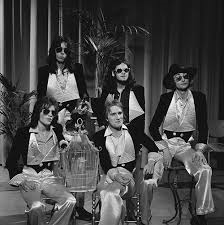
Farrell Sanders, a protege of Sun Ra – who gave him his lordly title – made a series of blinding free jazz albums on the Impulse! label in the late 1960s and early 1970s. Along with Albert Ayler, Archie Shepp, Alice Coltrane and others, this expressiveness became known as the ‘New Thing’. ‘Karma’ with TCHAMP taking up 90% of the playing time, is surely Sanders’ most perfectly realised moment. We hear his progression from the ‘Nubian Space Jazz’ of ‘Tauhid’ gilding his fresh canvass with brazenly psychedelic colours and textures.
In 1969 the hippie dream was over and heading for the horror of Altamont. The kids were faced with an extended conflict in Vietnam, and in pondering these existential crises crept back into their bedrooms where the excesses of ‘prog rock’ began to ferment ominously. Of course, once upon a time jazz and rock were very comfortable bedfellows; rarely today is that fusion apparent. ‘Astral Weeks’, ‘Happy Sad’ ‘Trout Mask Replica’,’The Soft Machine’; all of these effortlessly incorporated their jazz influences into the rock idiom. This unhappy divorce was exacerbated by the growth and development of electronic music, which has been far more accommodating of jazz influences and this has resulted in a seismic shift in the amount of serious exposure afforded by rock fans to jazz, and even to the classic Impulse! records of the late 1960s and early 1970s, many of which would once have been embedded as staple entries in any serious rock and soul LP collection. From the perspective of the rock fan, with only a passing interest in jazz, here is a good place to start. Somewhere on The Stooges debut album is a bass line lifted from Sanders’ ‘Upper and Lower Egypt’ and that influence would be worn more openly on Side 2 of Fun House with its free jazz given a blistering punk makeover borrowing heavily from Ayler, Coltrane, Sanders and ‘The New Thing’. (JJ)

16. COCKNEY REBEL – PSYCHOMODO (1974)

cockney rebel

Curiosity can sometimes take years to be satisfied. Cockney Rebel were, along with Sparks, the first band I was a fan of, as Make Me Smile (Come Up and See Me) became one of the more unexpected number ones of its time, still some years away from its fate as a staple of the unimaginative pub DJ’s record box, along with 500 Miles, Sweet Caroline, Delilah, Daydream Believer and the monarch of them all, Brown Eyed Girl.
Around this time, its parent album, The Best Years Of Our Lives, arrived in our house. Alongside the star of the show, it ranged from the goofy to the melancholy to, on Back To The Farm, the genuinely unsettling. Aged six, I understood little of this but liked it a lot.
Another arrival was, in hindsight, truly life-changing for me. The NME Book of Rock was not so much a window as an elaborately constructed archway to a world I was far too young for but fascinated by nevertheless. Although baffled by the omission of Mud, I was intrigued by names that would make more sense, and have sounds put to them, later – Pentangle, Third Ear Band, the United States of America and scores of others.
But Cockney Rebel’s entry really confused me. Why were they saying their new album was called The Way We Used To Be when it was called The Best Years Of Our Lives? Even worse, the people playing with Steve Harley on that album had solid, sensible names – George Ford, Duncan Mackay – but this book was telling me the group was full of funny names like Jean-Paul Crocker and Milton Reame-James. Why was I being lied to?
Later, amid punk and post-punk, Cockney Rebel were pushed to the back of my mind, a spell punctuated briefly by a splenetic rant from Harley during an NME (them again) interview with Danny Baker about Joy Division, after he had chanced to see their legendary performance on the BBC’s Something Else. It showed him to be grievously out of touch but, for me at least, his time would come again.
In a fit of youthful nostalgia, at 14 I found myself revisiting The Best Years… and its follow-up, Timeless Flight. This included the grandiose but gripping single Black Or White, which might have eclipsed Make Me Smile had it not been issued two weeks after Bohemian Rhapsody; clearly, there was room for only one overblown orchestral six-minute single released on EMI and the superior one lost out. It also had Understand, an aimless seven-minute groan which taught me the true meaning of boredom – but some months later, Bishopbriggs Library added a casette of Psychomodo to its riches and it’s a record where boredom is as remote as minimalism or restraint.
The aforementioned NME book averred that Cockney Rebel took numerous vogueish styles and moulded them into “one seemingly original mode” and sure enough, it’s hard to pin them down, which is where Psychomodo’s splendour lies. It’s not quite glam, though there’s a flirtation on the R & P (rhythm and pop – a genre is born) of the title track and the sarcastic charivari of their second top 10 hit, Mr Soft. Nor is it prog – they came nerve-janglingly close on Sebastian and Death Trip on their debut album, The Human Menagerie, but Harley was far too close at this stage to the Bowie/Roxy end of the spectrum to be devoured by mellotrons; as such, the symphonic tendencies of Cavaliers are moderated by intemperate language and waterfront harmonica, while the delicately orchestrated Bed In The Corner is more Forever Changes than Topographic Oceans. And it’s definitely not metal, though Sling It!’s commotion puts you right in the midst of the shipwreck it describes.
Dylan and Mott were other frequently suggested touchstones but Psychomodo is encapsulated by its uncategorisable side-closers. Tumbling Down is wistful, moist-eyed and slightly daft as Harley mourns “Oh dear, look what they’ve done to the blues” in a song which owes precisely nothing to Chicago or the Mississippi Delta but a good deal more to Mozart’s Vienna. It’s fitting that it was chosen as a climactic song for Venus In Furs, the band in the film Velvet Goldmine, whose set list is cannibalised from the songs of Cockney Rebel and their contemporaries.
At the end of side one came Ritz, a real lost classic, unlike the lost classics which are lost for an excellent reason. The simple, cyclical acoustic pattern suggests Astral Weeks but never apes Van Morrison directly, with strings hovering like the vultures mentioned in Tumbling Down and brass which strolls coquettishly one minute and has a contract out on Jericho’s walls the next. Above it, Harley’s distorted voice, too mannered for many, shows dexterity with some of his most erudite lyrics (“Couch my disease in chintz-covered kisses/Glazed calico cloth my costume this is”). In one of those irresistible coincidences, this and Psychomodo both namecheck Desdemona – and I was doing Othello at school at the same time I discovered the album.
Three-fifths of the band quit soon after – those funny names and bassist Paul Jeffreys, who would be killed at Lockerbie, prompting Harley, touchingly, to dedicate Sebastian to him on tour the following year. The sensibly named, highly proficient new Cockney Rebel made more fine music and provided Harley with his pension (as he calls Make Me Smile) but would never be as effervescent or kaliedoscopic as on those first two albums or the lovable stand-alone hit Judy Teen. Those were magic – the best years of their lives (PG).

15. COCTEAU TWINS – TREASURE (1984) / (A) COCTEAU TWINS – BLUE BELL KNOLL (1988)

TREASURE

There can hardly be a word in the English language more precisely defined, yet more persistently misused, than unique. It’s really not complicated – it simply means something is one of a kind, nothing more, nothing less. Yet more often than not, it’s used when the word that’s really required is distinctive or unusual. It’s rarely that something truly is unique and this means that the word shouldn’t be bandied about like it belongs in a chat about the weather – we should treasure things that genuinely are unique and, however frequently and hamfistedly they’ve been imitated, I contend that the Cocteaus were, and remain, among them.

You can detect the fingerprints of Siouxsie and the Banshees and, to a lesser extent, Joy Division on their first album, Garlands, but by the time of its follow-up, Head Over Heels, they’d grown to a point where it was hard to divine any obvious influences at all. Robin Guthrie was arguably reinventing the guitar even more thoroughly than Kevin Shields would half a decade later, creating labyrynthine textures from what very soon ceased to sound like guitars. Meanwhile, Liz Fraser sang like she had no choice and, as is well known, literally invented a new language as she strove to express the inexpressible. Even their drum machine was more versatile and dextrous than many of its peers – human or mechanical – and wasn’t there simply because it drank less and took up less room.

Treasure came at the end of a year which had seen the vast Pearly Dewdrops’ Drops – where Guthrie’s guitars are transformed into bagpipes playing a pibroch worthy of Culloden – give them a top 40 hit. Guthrie later furiously denounced the album but I’ve always heard it as the most fully-realised and downright beautiful thing they’d done up to that point, despite a tracklist composed entirely of quaint names that could double for a Hampstead school register.

Beatrix has a music-box sound that’s always put me in mind of cloisters, while Otterley plumbs depths of mystery that you’d need Sonar to penetrate and the almost Californian tinge to Pandora is an unexpected yet completely fitting counterpoint to Fraser’s voice tiptoeing up a spiral staircase.

At the risk of heresy, better versions of some songs were done elsewhere – opener Ivo, which had all the conditions for another hit, on an EP given away by the NME, Lorelei on Whistle Test and Beatrix, under the unrepentantly Scottish working title Wheesht, on a Peel session. But none of this dilutes the majesty of Treasure – they’re complementary to it and a reminder that a band who play a song the same way every time will be a very bored band and it will show.

I was 16 when Treasure came out, restless to move on from school and see more of the world. This didn’t necessarily mean far-off lands and was as much about people as place, people I knew nothing of who could be in towns just a few miles away – the Cocteaus’ native Grangemouth, for example. Their music was one of the foremost soundtracks to these times and that’s at least my perception of it – like your perception of it and like the music itself, it’s unique (PG)

(A) BLUE BELL KNOLL

Conventional wisdom identifies two distinct camps of Cocteaus fans. There are those who reckon Treasure their finest moment, and those who prefer Heaven or Las Vegas. Sandwiched between these two undoubted creative peaks are a couple of oft overlooked gems – which for a minority third camp, might well represent the summit of their achievements.

Victorialand is in some ways a transitional album – while it retains some of Treasure’s icy nerve (as on the closer The Thinner The Air) the listener is no longer made to feel like a worm stuck in a glacier. However, Victorialand, the Cocteau’s aural perestroika, was merely paving the way for the majesty of Blue Bell Knoll.

Blue Bell Knoll contains everything you need in a Cocteaus album. And you do need at least one. The song titles have reached new supra-semantic heights: Spooning Good Singing Gum; A Kissed Out Red Floatboat; Ella Megalast Burls Forever. The music itself is dense, playful, exultant. There is a vibrancy about it that sounds a million miles away from their dour gothic beginnings.

The album has a glowing heart. The outer sleeve with its blurry image of cold grey fingertips opens to reveal the same picture burning gently within. And that’s no accident. The one frosty moment – The Itchy Glowbo Blow – transforms itself in a gloriously chiming finale. Everywhere else, the ice has melted. On Phoebe Still A Baby, with its beautiful marimba accompaniment and Cico Buff, Liz is at her ecstatic best – while she recalls recording sessions for BBK as being particularly exhausting, the fruits of her efforts are plain for us to hear. On the magnificent single, Carolyn’s Fingers, and the aforementioned A Kissed Out Red Floatboat in particular, things come together in spectacular style. The latter features a remarkable keyboard part that strangely conjures images of a fluttering locomotive on its way to another solar system.

For some, Robin Guthrie is really more of a producer than a great guitarist. But here even the sumptuous trademark reverb cannot disguise his masterful playing. For me, this is Liz is at her absolute peak and words simply cannot do her performances justice. Indeed when it comes down to it, what do words matter? So if the opportunity to use the familiar adjectives (celestial, ethereal etc) seems wasted, it is only because Blue Bell Knoll transcends these cliches to feel like a meeting with God Himself. (JJ)

14. DADAWAH – PEACE & LOVE (1974)

Ras Michael’s Peace & Love is both a devotional reggae album and a work of great artistic beauty. It transcends the reggae genre musically with its instrumentation more akin to the Temptations’ social consciousness recordings of the early 70’s or even Isaac Hayes’ extended mood pieces from the same time. Think ‘Papa Was A Rolling Stone’ or the piano riff from Hayes’ Hyperbolicsyllabicsesquedalymistic’.

Peace and Love was released in 1974 on Trojan, a label famed for its prolific output of punchy 3 minute ska and rocksteady singles. Not so here: 4 songs stretched out over two sides, hardly a money spinner for the label. Michael’s masterpiece isn’t even referenced in Lloyd Bradley’s otherwise magnificently definitive history of reggae ‘Bass Culture’. Perhaps Bradley doesn’t consider it a reggae album at all. Indeed it dispenses altogether with the classic reggae guitar/piano offbeat rhythms. Instead Willie Lindo’s understated guitar licks wouldn’t sound out of place on a Dylan or Van album from the same period. They drift in and out of the spacious sound, while the burning embers of the Nyabinghi-inspired rhythm section provides an inspired hypnotic backing groove to an album bursting at the seams with Michael’s righteous proclamations of Rastafari.

The purists may scoff – and perhaps this is why the profile of the album is so low – but this is genuinely a spine tingling groundbreaking and genre-hopping high point of Jamaican music, up there with Heart of The Congos or East of The River Nile. Listen to Seventy-Two Nations and go out and make some new disciples. (JJ)

13. THE WOODENTOPS – LIVE HYPNOBEAT LIVE (1987)

Sandwiched between their two studio albums, Live Hypnobeat Live is The Woodentops in peak form, recorded live at the Palace Theatre in Los Angeles. Drawn mostly from their first album and a couple of early singles, here the band take them at break-neck speed, one song blurring into another over a relentless groove. Stripped of the marimba, accordian, trumpet, strings etc that filled in the spaces on debut LP Giant, this is how these songs were meant to sound. But rather than pulverise you, it is a sound that just makes you want to move. Everything revolves around the highly caffeinated bass playing of Frank De Frietas which barely lets up from beginning to end. With the bass carrying the rhythm, this allows drummer Benny Staples to play rather than just hit the drums.

Well Well Well kicks things off with mainman Rolo McGintys frantically scrubbed acoustic guitar, the band builds the song through a series of crescendos punctuated by feedbacking electric guitar. Then we’re straight into Love Train, guitarist Simon Mawby tearing it up like Cliff Gallup on the early Gene Vincent records. Both Mawby and keyboard player Alice Thompson are great throughout, leaving space if necessary, every contribution elevating the sound. As Travelling Man turns into Get It On Rolo announces “Yeah were off now”. There’s no turning back now. Like James Browns first Live at The Apollo LP it is clear there is going to be no let up.

Good Thing (one of the most perfect pop singles of the eighties) provides something of a breather, until it too builds to an incredible climax, Rolo preaching now “Rave ON, Rave ON!” complete with heavenly na-na-nahs and a surging key change. Everything Breaks and Move Me bring this breathless album to a close too quickly, and the only option is to play it just one more time.

The Woodentops were a band that should have thrived during the Indie-Dance years that were just around the corner (Why had been an early Ibiza club hit). Unfortunately they were unable to take advantage of the shift in musical tastes that should have embraced them as much as the Happy Mondays. (TT)

12. THE DISTRACTIONS – NOBODY’S PERFECT (1980)

The thrill of the chase is something that’s  been irretrievably lost in the you-want-it-we-got-it internet. My curiosity, fuelled by Paul Morley’s characteristically evangelical assertion that “their music will move you” and its number one position in an NME Manchester top 10 (yus, above NewJoyFallBuzzSmithMagColumn) drove a lengthy hunt for the Distractions’ 1979 single Time Goes By So Slow. It ended at the magnificent Realistic Records, near Glasgow’s Partick Cross, for the price of a packet of dry roasted peanuts and what emerged was a brisk yet serene, sprightly yet weary, sunny yet crushed tale of an inability to let go that topples into delusion.
It’s a recurring theme on Nobody’s Perfect – which I acquired a few months later and on which TGBSS doesn’t feature – as Leave You To Dream sees her oblivious to his attention on the warmest summer evening of the year and Stuck in A Fantasy evokes another vanished detail while describing profound obsession familiar from age to age: “On my TV when the station closes down/Your ghostly face appears to me, laughing like a clown”.
Most hauntingly and unforgettably, Looking For A Ghost is the sound of the guy who missed his chance slipping into her wedding and sitting in the back row – then staying silent as he accepts that the impediment he knows of is not reasonable but, on the contrary, completely irrational, as he’s yet again imagining she’s still with him, while Wilson and Spector conduct the choir in harmonies so dense no laser could pierce them.
If this extraordinary song ever found its way on to a film soundtrack, ubiquity would swiftly follow – though considering this would inevitably entail karaoke pummellings, tone-deaf whistled renditions and weak jokes about gaps in the lyric’s logic
(“One minute he’s saying she’s floating by my side, the next she’s encased inside my head. Eh? Make up y’mind hehehe”) I hope it never, ever happens.
Driven to Distraction was Mike Finney as he sang of heads ransacked by Cupid, in a voice which told of Saturday nights at the Wigan Casino spent trying to forget Friday nights on Deansgate. By this time there’d have been plenty of those – drummer Alec Sidebottom had late ’60s form with the Purple Gang, who gave us the recklessly twee Granny Takes A Trip, while another highlight of Nobody’s Perfect is their version of Eden Kane’s Boys Cry, where the “someone who says goodbye” in the knock-kneed period piece of the 1964 original is transformed from a soon-forgotten tryst into something bordering on bereavement.
Yet there’s real wit amid the desolation, on each side’s closer. Paracetamol Paralysis is pell-mell cautionary punk with sound medical advice on drinking while trying to fend off the flu – and it really is as innocent as that; when they say paracetamol, they mean paracetamol. That pair from Burnage might have managed to come up with this if only they’d kept trying after 1996. Then it’s all rounded off not with the desperate comfort of the penultimate Looking For A Ghost but the sub-two minute sprint of Valerie, where a palm court piano is caddishly shoved aside by a marauding tune fleeing from Pete Shelley as he tries to grab back the greatest song he never wrote. Even here there’s defeat as Finney faces up to the most pulverising blow a heart can take – “I love Valerie but Valerie loves YOU!!”
They ended up as the band that Manchester forgot and were blighted by lousy luck, signing for Factory at almost exactly the same time as Joy Division and Island at almost exactly the same time as U2. Adulation and legendary status would never be theirs but they’re back, having issued a beguiling album (End Of The Pier) and with a compilation (Parabolically Yours) poised to emerge. Maybe it’ll include their final EP, And Then There’s… which I also saw at Realistic but rashly decided to forego until I’d pounced  on Time Goes By So Slow. By then it had vanished  never to return, and it remains a stranger to YouTube to this day. Maybe  the thrill of the chase isn’t gone after all. (PG)