11. THE CHILLS – SUBMARINE BELLS (1990)

martin phillippsIn another world, the Chills might have been the subject of one of those single-frame Viz cartoons in which a band name is depicted literally. They’d have been stood in a circle, chanting “one times two is two, two times two is four, three times two is six”. Stood in front of them would have been John Travolta, his thumb jerked over his shoulder, declaring solemnly: “I got Chills. They’re multiplyin'”.
It never happened. The fair measure of success they enjoyed in their native New Zealand did not travel, despite at least a dozen songs which could have, very conceivably, lodged themselves firmly in the public consciousness, around half of them on Submarine Bells, their second album proper and their first since their departure from NZ’s immortal Flying Nun to Slash, a subsidiary of London and one of a rash of pseudo-indies established by majors in the late ’80s.
The single from the album, Heavenly Pop Hit, fulfilled the two-thirds of the title’s promise that the Chills had control over. It formed part of a tradition of absurdly tuneful songs by acts not necessarily renowned for such things, like Oliver’s Army before it and Friday I’m In Love and – yes – Shiny Happy People afterwards. Martin Phillips and his compatriot, Donna Savage of the also unjustly forgotten Dead Famous People, exult wordlessly on a chorus which produces grins as surely as rain produces puddles- usually. Once, when called upon to help dislodge an unwelcome earworm, I offered Heavenly Pop Hit as an antidote. “Aw, that’s awful – cheeseorama!”, was the response, to my dismay, and the play of the song didn’t even last 30 seconds.
Maybe it needed to be heard in the context of some of their earlier colossal songs, like Pink Frost or Night Of Chill Blue, or of Submarine Bells’ close to perfect first side. Part Past Part Fiction offers vice-like drama and a solo as breathless as it is deft, all undimmed by Phillipps’ clodhopping pronunciation of ‘cacophony’ to rhyme with ‘lonely’. The Oncoming Day is even more frenetic and as anxious as its title suggests, a return to the runaway runway they visited on Brave Words’ Look For The Good In Others And They’ll See The Good In You. I Soar tells of a flight in the southern hemisphere but its cantering rhythm and synthesised woodwind sumptuously evoke the British autmn in which it was recorded.

Side two is patchier but clutches two real treasures. With its high-stepping upright piano, Don’t Be-Memory has always sounded to me like it was recorded in a living room, suitably enough for such an intimate and heartfelt account of missed opportunities, a “desperate deal” conducted with “this greenhouse on,” a nod to the environmental anxiety of the times which produced a spike in the Green vote at the 1989 European elections and which is eloquently expanded upon in the liner notes of Submarine Bells. The song’s odd structure – not one, not two but three bridges – means its poignancy doesn’t let up for a second.
Submarine Bells itself takes the complexity of a Day In The Life, adds the langour of Good Night and creates the proper ending the Beatles’ career never had thanks to their insistence on finishing with the sheer bathos of Her Majesty. It sounds like an orchestra; it might merely be a mellotron or similar. All that matters is that it has a beauty that can barely be described – rarely has ‘rock’ sounded so majestic, so utterly aloof from the common imbecility of rog an’ roll, but without a scintilla of pomposity. It concludes with a glissando that almost certainly tips a deliberate wink to My Way – but again they’re set on something far finer than that karaoke warhorse’s daft bravado.
Like so many bands of the period, The Chills had all the conditions for a breakthrough. The fact that it never came means they’re still there to be discovered by many, all of whom I promise a lifelong treat. (PG)

10. THE BAND OF HOLY JOY – MORE TALES FROM THE CITY (1987)

Now that we’re long past the 20th century, the vast changes – by no means all deserve to be called progress – it wrought can easily be taken for granted; if you stop to think about them, they defy belief, particularly considering the transformations witnessed by those who lived through them.
The post-war second half alone brought change beyond recognition but the paradox at the heart of More Tales From the City is that, while it sounds like it belongs in the pre-rock ‘n’ roll ’50s, it’s one of the most vivid and eloquent accounts of the fractured, fractious times in which it was made – declared by BoHJ frontman Johnny Brown, with some justification, as “the maddest time ever”; a time when the maddest policies ever somehow earned yet another public endorsement; a time when eminently preventable disasters showed up systematic failings with terrifying frequency; a time of wilfully misunderstood disease, of censorship suddenly and arbitrarily ratcheted up, of savagery in light entertainment as death and bereavement came to sit alongside the usual banality.
Amid all this, BoHJ’s brass and organ-heavy, rhumba-laden sound evoked a Shine On Harvey Moon demi-monde of national service, illicit encounters at the milkshake parlour and seaside towns already showing signs of wear. Morrissey was at this time preparing to touch on these themes but BoHJ delved even further and deeper with a vision that was universal more than it was regional or personal and the squabbling couples, stolen babies and forsaken misfits inhabiting their songs reflected, like those of the Smiths, timeless concerns.
The name of Bertolt Brecht followed BoHJ around like a benign fog but their sound was a complex, heavily loaded broth. Half of the songs on More Tales From the City are wholly or partly in waltz time but this never becomes wearing – why should it any more than an unvarying 4/4 tempo? – while a dancehall organ rhythm box is an equally frequent visitor. The piano that heralds opening track Who Snatched the Baby? brings a classical shade into the parlour, while Don’t Stick Knives In Babbies’ Heads takes a macabre folk standard and uses it to report soberly the facts of the grim case while reserving most of its judgement for the prurient fascination the crime attracts – a theme expanded on the lyric sheet, where the brief verses are compressed and inflated into a single, breathless Niagara of gossip.

Elsewhere among the snapshots of thwarted yet unavoidably resilient lives, Cities ponders “five minutes’ joy, a lifetime of shame” to exquisite mandolin and despairing strings and The Tide of Life ends its dissection of regret and resentment after six minutes but could conceivably carry on for millennia along with the waves it mimics.
The two most ‘modern’ sounding songs are among the best. Mad Dot puts bass in the foreground for the first and last time and, despite the striped t-shirts and anoraks favoured by the band, is the one song that could have galvanised an indie disco – if only there’d been one that had the nous to play it. Closing track (of course) Goodnight, God Bless, Goodbye, meanwhile, is genuinely heartbreaking, Johnny’s rueful memories – “in a way I’m glad what we had we swore was forever” – cushioned by rotating drums, subdued keyboards and a rare-going-on-unique instance of whistling being not only forgivable but essential.
They supported James. Carter USM insisted on quoting them as an influence despite using them to completely misguided ends. Robert Plant is a fan and would have been anyway even if they didn’t have practically the same name as his pre-Zeppelin band. For all this, BoHJ have been persistently forgotten and overlooked but they’ve returned- now sadly without founder member Karel van Bergen, who died in 2013 – and still have plenty to offer. More Tales From the City, though, remains the place to start, as potent and pointed as the day it came about – “I refuse to believe that those days are gone, that there was a time that was once upon”. (PG)

9. THE CLIENTELE – SUBURBAN LIGHT (2000)

In the beginning was the word. And the word was…Felt. Alasdair Maclean saw the word, scribbled on his school chum James Hornsey’s pencil case. The friendship was sealed and The Clientele was born. Or so the legend goes. The band formed in London in 1991, while the boys were still at school. It would be almost a decade before their first fragile songs emerged to a politely indifferent world.

These songs, a compilation of early recordings including singles and B Sides were for the most part recorded on an eight-track portastudio above Innes Phillips’ flat in 1996. Phillips, guitarist and one of the founder members, would leave and go on to form his own band The Relict, before these songs eventually saw the light of day in 2000. As for the collection of songs assembled here on Suburban Light…well you have to trust me on this one…it is arguably one of the most perfect albums from any English band in the last twenty five years. Yes, it is that good.

Comparisons with Felt are obvious (‘We Could Walk Together’s guitar line for example), NZ’s The Chills perhaps less so (listen to the ghostly guitar on ‘An Hour Before The Light’, uncannily reminiscent of The Chills’ classic ‘Pink Frost’), but it is most often claimed the band are musically indebted to The Velvet Underground. Certainly ‘Reflections After Jane’ owes a nod to ‘Candy Says’ or ‘I’ll Be Your Mirror’ but I wonder if the comparison is apt. Indeed, perhaps it’s a little lazy. In reality the two bands inhabit entirely different worlds. The Clientele’s reverb-drenched songs of wistful suburban ennui the perfect counterpoint to the urban brutality and debonaire perversions of the Velvets. The lyrical contrast is even more spectacular: compare The Velvets’ catalogue of junkies, transvestites and freaks who send themselves by long-distance post in cardboard boxes; to the Clientele’s preference for documenting rainy Sunday afternoons in the park, or walking through the crowds with “Miss Jones” (of whom nothing is revealed, but whom I imagine to be a rather pretty but stuffy English Literature student). Perhaps a more intuitive comparison than the Velvets could be made with Galaxie 500 (performing a cover of ‘Waterloo Sunset’). Whatever comparison one makes, the band would never sound quite like this again. The songs on their first album proper, The Violet Hour did not quite match up (with a few mis-steps along the way). Edges would be softened, the production become more sophisticated. The later albums with the exception of Strange Geometry (which is their other indisputably classic record) somehow strangely failed to recapture the thematic harmony of this first release. It is particularly unusual for a compilation to achieve such a singular vision, such a feeling of unity, but it’s there.


Despite greater, though still very limited success on the other side of the Atlantic, The Clientele remain as quintessentially English as an episode of Camberwick Green. Had they been children of a different era they would no doubt have been invited to compose the soundtrack for Bronco Bullfrog, Here We Go Round The Mulberry Bush or some other cult late 1960s Brit youth film. The occasional backwards guitar loop alongside MacLean’s penchant for colourful cravats places the band at least spiritually and aesthetically in that era. So, right place, wrong time perhaps? Well, not exactly…there is nothing contrived about the Clientele’s Englishness. Neither gimmick nor motif, rather it emanates organically from their music like the dispersion of light through a prism.

“If we’re on Delancey Street at night,
In the after train ride quiet,
Barking dogs by Highgate Pond,
Something’s here but something’s gone’ McLean sings on ‘Joseph Cornell’ – it is a typically evocative mood piece and the album is littered with such examples:
‘The taxi lights were in your eyes
So warm against St. Mary’s spires
The carnival was over in the rain
And arm in arm through Vincent Street.
The evening hanging like a dream
I touched your face and saw the night again.” (‘Saturday’)

These lost and unrepeatable moments of nostalgia and yearning, moments so vivid and personal are detailed with such precision for time and place, yet somehow paradoxically become universally tangible and almost unbearably poignant for the listener, who immersed in their atmosphere, casts his own shadow upon those spaces and places. I saw The Clientele play to a sparse audience at The Woodside Social in Glasgow in 2005. Perhaps not an ‘I was there’ moment but imprinted on my memory nonetheless. A few members of Belle & Sebastian, one or two from Glasgow folkies Lucky Luke and a few shy-looking snappily dressed mods. Almost their perfect audience. I remember walking out in the cold air afterward, the hazy drunken glare of the street lights providing the backdrop to the band hurriedly throwing their gear into the back of the van. And walking away into the night. Clearly one of those time and place moments – the spell had worked.

Post-millennium there exists very little consensus of opinion on the greatest albums of our age. It would be more straightforward to ask George Galloway to publicly extol the virtues of US foreign policy than expect acquiescence from others in this regard. Perhaps in a progressively individualistic culture which is post-everything, with few recognisable musical genres or subcultures, we have reached that point where consensus is virtually impossible. So we claim precedence for our individual favourites. And they become all the more precious for it. Suburban Light is one of those to treasure. The Clientele are the great lost English band of the new millennium, as genteel yet vital as Nick Drake, as elusive and undervalued as The Television Personalities, and musically, comfortably the equal of Felt. Their early songs, reflective and melancholic possess an enduring appeal. They will haunt you. Let them into your life. (JJ)

8. IT’S TIME FOR JONATHAN RICHMAN & THE MODERN LOVERS (1986)

jonathanIn appreciation of the long-playing record It’s Time for Jonathan Richman & The Modern Lovers, 1986

‘Hey white boy, what you doin’ uptown?” Lou Reed 1966.

When Lou was writing ‘I’m Waiting’ For The Man’, he would have had a precise picture in his head of the dope dealing character in the song. That’s because Lou would certainly have known him personally, aspiring young hustler that he was. For some reason however, when I hear the song today I think of Jonathan Richman as the naive fresh-faced ‘white boy’, with Lou himself conversely, the cool hipster of the Lower East Side, overseeing young Jonathan’s induction to the dark stuff. Lou fitted that NY boho smackhead chic pretty well, but what about Jonathan? Unlike Lou, he was never really suited to hanging out with druggies and sexual deviants. There was always something incongruous about this Velvets’ disciple, sleeping on Steve Sesnick’s couch and affecting that proto-punk attitude. It just didn’t add up.

Something happened to Jonathan Richman. Something changed in him. This vicious world of adulthood, where everyone smoked, took drugs and cheated one another over record deals or in the bedroom. This new world was not for him. What about the old world?

I imagine this metamorphosis to have occurred in 1973. [A dream: Jonathan is in attendance at a family gathering in late summer in a New Hampshire coastal village. He is experiencing a creative nadir, and finds himself out of the city at a nephew’s birthday party. It’s early evening. There are kids eating ice cream, they’re falling over one another on the porch and there is much laughter around the place. He watches a boy chase a kite along the beach. Some old uncle recalls a few anecdotes. Drinks are spilled and memories shared. ‘Come on Jonathan, play us a tune!’ comes the inevitable invitation. It’s been a while. Jonathan looks over at the old battered acoustic guitar leaning against the family Steinway. He picks up the instrument and knocks out a couple of old Chuck Berry numbers. Everyone cheers. Boy, does this feel good. Jonathan loves an audience. He wanders off into the kitchen. Maybe he hears an old doo-wop track by the 5 Royales or the Flamingoes on the little transistor radio sitting there. He goes upstairs and sitting by the bedroom window, writes the first version of ‘It’s You’, what will become the opening track on It’s Time For Jonathan Richman & The Modern Lovers. It will be 12 years before he records it for posterity but something has clicked. Jonathan recalls the first time he heard music like this on the radio and fondly remembers his carefree childhood. He’s battered and bruised from his walk on the wild side and disillusioned with the excesses of the rock’n’roll lifestyle. Change of plan.

Of course the first fruits of Jonathan’s new approach came long before the release of It’s Time For…. By 1986 he’d recorded a number of Modern Lovers albums, all filled with his own brand of gentle romantic rock’n’roll and all presumably filed nervously in the ‘new-wave’ sections of confused record stores. He had built his reputation on the classic first punk blast of The Modern Lovers: ‘Roadrunner’, ‘Pablo Picasso’, ‘She Cracked’, all moody black-clad Velvets sneer, and then proceeded to confound everyone’s expectations of him with his bizarre Top 10 novelty hit’Egyptian Reggae’.

Fast forward a decade or so and he has cultivated a small but loyal audience for his charming old world vision. This album was my first encounter with Jonathan, and to be honest, looking at the sleeve and seeing this thirty five year old man, looking (most impressively) no more than 21, but clad in an unbuttoned pink linen shirt, was certainly unpromising and frankly, a bit unsettling. I too was a Velvets disciple and well, the image was just…well, so wrong! But what to make of the music inside the sleeve? I could not believe the album had just been released. It sounded at least twenty five years older than that. And yet, there was a freshness, an innocence and a joy in this music which encapsulated the very essence of rock’n’roll. The album veers from the delightfully moronic ‘Let’s Take A Trip’ (‘I got my jeans and things and I’m ready to go!’) to Jonathan’s ridiculous hymn to his favourite milkshake of all (‘Double Chocolate Malted’ – OK Jonathan, no nuts!), and a playful retelling of the classic Persian love story ‘Shirin and Fahrad’. But amidst the somewhat contrived innocence and playfulness are a small bunch of timeless gems.

The opener the aforementioned ‘It’s You’ is a singalong classic – how could one fail to smile listening to it? ‘Neon Sign’ and ‘When I Dance’ sway along beautifully – the latter exuding an ironic sexual confidence, the former conveying a neurotic and nostalgic displacement in the adult world. But it is the triumvirate of ‘This Love of Mine’, ‘Just About Seventeen’ and the closer ‘Ancient Long Ago’, which really set this apart from other sterling Jonathan albums – such as Jonathan Sings!

‘This Love of Mine’ has all the smooth assurance of Sam Cooke, with the honeyed harmonising the perfect counterpoint to Jonathan’s stuttering adolescent awkwardness. He’s in character for sure, but he’s comfortable here. Jonathan and the boys enjoy themselves so much on ‘Just About Seventeen’ that, lost in the moment, they cannot refrain from a chorus of ‘dangdangdoodang wangdangdoodang’ to further accentuate the good vibe. “I’m about seventeen…I guess, well that’s what the calendar says…what do numbers mean? I’m about seventeen”. Pure gold.

It has been well documented that Bob Dylan called Smokey Robinson “America’s greatest living poet” Hearing the angelic ‘Ancient Long Ago’ one might be tempted to disagree. It reveals Jonathan to be the real deal. Listening to it again, I am transported through time, people and places appear and disappear from my mind’s eye, in particular, some very special evenings being charmed by Jonathan’s songs aboard the Renfrew Ferry in the early 1990s. It is a shimmering invocation with an extraordinary musical arrangement which should evoke a heartfelt response from even the most sceptical listener. ‘I am not bound by space or time right now’ he says. Neither am I Jonathan. Not now.

We may be in the late autumn of Jonathan’s recording career, but these songs have been criminally under appreciated for far too long. I listen to them today in the first stirrings of spring, and I embrace summer in full bloom. Go on, as the man himself says, surrender to Jonathan! (JJ)

7. ROBERT WYATT – ROCK BOTTOM (1974)

ROBERT WYATT – ROCK BOTTOM (1974)

If  Rock Bottom were issued today, it would probably receive the flippant response that it was the only occasion in history when a couple performing their infantile private jokes has elicited anything other that irritated nausea. This would gravely short-change, not to mention insult,  both Robert Wyatt and his wife, Alfreda (Alfie) Benge; firstly because, as is well-documented, she had just supported him through the ordeal of paralysis from the waist down after falling from a window the previous year (with characteristic restraint,  Wyatt has since suggested the accident had a liberating effect on music he’d already largely written) but also because the record is genuinely – to use another debased adjective- awesome. The pet names and in-jokes that permeate the Alifib/Alifie medley are affectionate but also more than slightly unsettling, suggesting almost a regression to a childlike state, particularly as Gary Windo’s tenor sax scurries in like a venomous snake seeking prey. There’s another pair of twins in Little Red Riding/Robin Hood Hit The Road- the former in particular almost defies description, as Wyatt pleads “Oh stop it, stop it” and the whole song begins to run backwards like an engulfing mudslide and the matchless Ivor Cutler peers out of the sludge to taunt with talk of “lunchtea” and joining  a hedgehog in bursting tyres, and it all culminates in an endless fade of what sounds like an entire nation sounding a fanfare. In fact, it’s the trumpets of one man, Mongezi Feza, who would die of pneumonia the following year. Then there’s Sea Song, possibly the most aptly named song ever, its restful drift the sound of moorings slipped and shoreline receding further and further until things get choppy with a piano solo which matches Aladdin Sane for sweet discordance and Wyatt calls out wordlessly, not waving…
If Robert Wyatt is, as he once memorably described himself, a “gawping tourist of jazz”, Rock Bottom takes him- and the listener- to the jazz pyramids, Florence and Niagara Falls. Start packing now. (PG)

6. GRANT HART – INTOLERANCE (1989)

Grant Hart - Intolerance (1989)

grantGRANT HART – INTOLERANCE (1989)

Dropped by Warners, Grant Hart found himself back on SST, the label that had released Husker Du’s three best records. Stripped of Bob Mould’s fizzing guitar and his own skittering drums, Harts first release after the acrimonious split of Husker Du is a hypnotic meditation on regret and loss, full of mystery and magic, and littered with characters struggling to make sense of their chaotic lives, and which may include himself and his former band mates.

The opener All Of My Senses offers few clues as to what will follow, coming on like a lo-fi New Order. Warm keyboards and hand claps replace the harsh drones and groans that open the record. According to Michael Azzerad’s book Our Band Could Be Your Life, Hart was using methadone in an effort to conquer his heroin addiction when Husker Du split, although he was sober by the time Intolerance was recorded. Whether or not the song is auto-biographical, its hard to hear Hart singing “I’m using, I’m using” while the gospel backing singers sing “Pulling a plough but I don’t know how” without the feeling that he’s referring to his own struggles with addiction.

The guitars are back for Now That You Know Me. It wouldn’t have been out of place on Warehouse Songs And Stories (it was performed by Husker Du live), but a wailing harmonica gives it an almost Dylanish feel (they are both from Minnesota!).

Fanfare In D Major builds tension in the verses with rolling drums and sawing strings before exploding with one of Grants greatest pop choruses.

Drug references are most explicit on the junkie gospel sea shanty of The Main which creaks and sways like great big clipper ship (I avoided policemen when I went to cop, De Quincey, smack in the middle, the hell that I went through when I stuck it into etc). Grant seems to be saying the experience is universal – “Reeperbahn, Christiana, Pigalle all the same” (these being notorious drug dealing areas in Hamburg, Copenhagen and Paris).

Side two opens with Twenty Five Forty One, nostalgia for a shared apartment after a broken relationship. From the sound of it he’d rather be back where “we had to leave the stove on all night so the mice wouldn’t freeze” than where he is now. Given that the title is taken from the address of Husker Du’s rehearsal house where all the members had lived at some point, you wonder if he’s also missing his former band.

The inconsequential instrumental Roller Rink leads into the soulful You’re The Victim, the only song I can think of that combines jaunty whistling with what sounds like a dentists drill! Another one that has you wondering if it’s directed at a former band mate ”Every thing you do to hurt me makes you the victim”.

On Anything Hart sings of “climbing mountains in my sleep”. She Can See The Angels Coming could almost be a sequel to The Main. Organ drones and cymbals swell, giving the song an oceanic sense of lives pulled this way and that.  Reprise returns us full circle for a minute or so of the banging and clanking drones that open All Of My Senses.

Intolerance, on which Hart reputedly plays all the instruments himself is a warm, personal, confessional record, which despite its subject matter in the end is cathartic and uplifting . A triumph. (TT)

5. BRIDGET ST. JOHN – ASK ME NO QUESTIONS (1970)

Bridget St. John is the forgotten femme of English folk. While Sandy Denny remains the more revered and celebrated, and others such as Vashti Bunyan have been rediscovered and championed by the revivalists, Bridget’s reputation has by contrast, stalled if not in fact, been diminished. As a stalwart of the UK folk scene in the late 60s and early 70s, Bridget was a friend and contemporary of John Martyn (who enjoyed longer-lasting success) and Nick Drake, whose posthumous prestige is arguably unmatched by any other British songwriter.

And yet it could all have been so different. Her first three albums, released on John Peel’s Dandelion label feature her languid and slightly fragile songs, delivered unhurriedly in her solemn Nico-esque murmur. Bridget was big news then, a Peel favourite, touring extensively (even supporting David Bowie!) and featuring regularly in Melody Maker end of year fan polls. After the release of Jumblequeen in 1974, nothing much was heard for the next twenty years. An odd live appearance here and there in the late 90s and then…silence.

It is hard to see why she remains in such relative obscurity. This, her debut album, perhaps lacks the lush orchestral accompaniment of its immediate successor Songs For A Gentle Man, but this merely showcases her intricate guitar playing and husky tone more starkly. And the songs speak for themselves.

‘Autumn Lullaby’ barely gets into first gear but is sweet and gorgeously melancholic. Beside it, while just as stripped down, ‘Curl Your Toes’ and ‘I Like To Walk With You In The Sun’ sound peculiarly buoyant.

On a number of songs Bridget laments the end of a failed relationship. On ‘Broken Faith’ with sensitivity she bids her beau farewell “but if along the way, I hold your hand; be not angry, be not hard”, suggesting some inner turmoil of her own – or could this just be a line symptomatic of a lost libertarian age of ‘free love’? ‘Hello Again Of Course’ seems to return to the same theme: “You never really go away; it’s just the space between us growing; A little more than it ever has before.” Delicate, poignant stuff.

On the spectral ‘Lizard Long Tongue Boy’ however, she sounds almost vampish. Here the atmosphere is given an erotic charge which may lack subtlety but demonstrates there is far more to her armoury than her idyllically nuanced verse.

The last 2 minutes of the finale, the exquisite title track, consist almost entirely of birdsong and the distant peel of church bells. Now this is English folk at its most ambrosial.(JJ)

4. KRAFTWERK – AUTOBAHN (1974)

Kraftwerk- Autobahn

kraftwerk

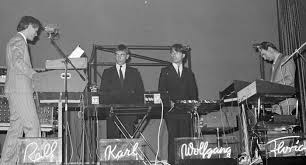
Bournemouth, July 1982. A church fete during a holiday. Amid the ketchup bottles and the jettisoned Hammond Innes paperbacks, this seemed to be the only record on sale. But it couldn’t be for sale- why was a Kraftwerk album being so blithely discarded not even six months after they’d been at number one? “Is it being sold?” I demanded incredulously with an edge of panic, clutching it covetously in its Highway Code-themed sleeve. “50p please” was the wonderful reply. Only much later did I figure out the likely chain of events – somebody had been seduced by The Model’s future-now charms and was eager to discover more but, confronted with a 22-and-a-half minute distillation of a gruelling drive which sounds like it’s being undertaken out of necessity, thought: naah. Whoever you were, es ist deine Sache and this is where I came in. To everyone else: never let yourself be fobbed off with the single version of the title track; it would be like passing off the Q volume of Encylopaedia Britannica as the whole thing. From the sun-dappled valley to the frustration of swelling traffic to the closing lullaby for the passengers asleep in the back  every one of its 1350 seconds is essential. And don’t overlook the supporting cast of jiving comets, babbling brooks and squelching but still sinister bats on the former side two. (PG)

3. THE CHOCOLATE WATCHBAND – FORTY FOUR (1984)

The Chocolate Watchband - Forty Four

The Chocolate Watchband – ‘Forty Four’

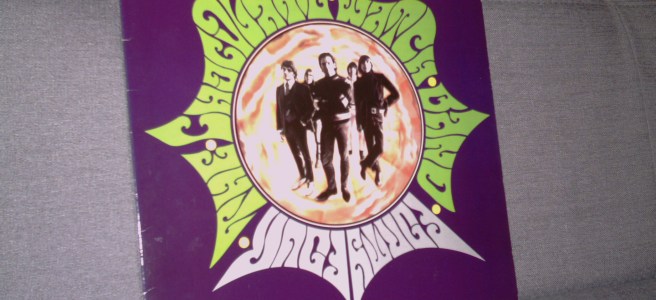
The Chocolate Watchband only recorded three albums in their short lifetime. Unfortunately none of those records was recorded in its entirety by the core line up of Dave Aguilar, Sean Tolby, Bill Flores, Mark Loomis and Gary Andrijasevich. Instead producer Ed Cobb used  a combination of friends and session musicians to fill out their records. Even their most famous song ‘Let’s Talk About Girls’ was released before singer Aguilar could record his vocals. Admittedly some of the longer psychedelic instrumental on their first two records are pretty great. But it is a crying shame as these guys were the real deal, street walkin’ cheetahs on the Sunset Strip, capable of blowing any of their contemporaries away.

Fortunately this situation was rectified in 1984, with the release of Forty Four, which compiles the cream of the San Jose Five’s output. Rockers like Sweet Young Thing, Sitting There Standing, Don’t Need Your Lovin’ and Are You Gonna Be There may show the obvious influences of the Stones and the Yardbirds but are played with the aggression and raw power of the Stooges and the MC5.  Loomis and Tolby’s guitars roar and bite, snarl and zing in the same way that Wayne Kramers and Fred Sonic Smiths do.

There was more to them then mere power merchants. They could dish out gorgeous folk rock like Misty Lane and She Weaves a Tender Trap, out Davie Allen on his own fuzz-toned Blues Theme, psychedelia on No Way Out, genuine weirdness on Loose Lip Sync Ship. Best of all is the shimmering Bo Diddley trance dance of Gone And Passes By.

So what held them back? Could have been their own irreverent attitude (theres a story of them supporting the Seeds, and only playing Seeds covers! That’s my kind of band!). Most likely it was just that the label saw them as a vehicle for Ed Cobb’s more experimental ideas, and the deal they signed gave them no control over what went on the records.

The Chocolate Watchband were one of the sixties biggest could-have-should-have-been bands. Perfectly programmed, Forty Four lays out their legacy for you, and deserves to sit  alongside Safe As Milk, Teenage Head and High Time. (TT)

2. GIRLS AT OUR BEST – PLEASURE (1981)

Girls At Our Best - Pleasure
Pleasure- Girls At Our Best!
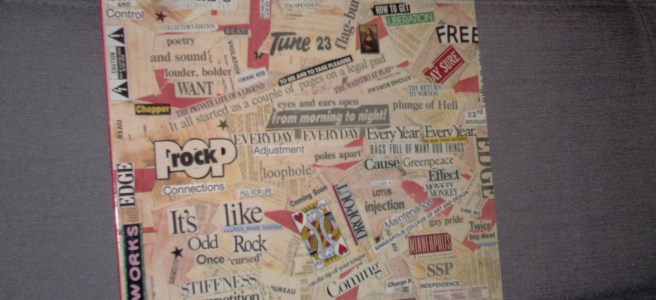
Considering the Jupiter-sized egos usually involved, it’s inevitable that there’s always been plenty of room for self-mythology in music. For two decades and more, it’s been an article of faith in hip-hop but can be traced at least as far back as Bo Diddley, who pulled off the remarkable trick of repeatedly deploying the third person without ever appearing deluded. The Beatles dabbled briefly but memorably in it on Glass Onion and practically every Clash album contained at least one ode to their own legend but what all these had in common was that their mythology either already existed or proved to be self-fulfilling.
This was somewhat less the case with Girls At Our Best!, whose approach appeared to be that if they didn’t mythologise themselves  nobody else would – but was more likely a satire on self-proclaimed legends who were often within their rights to bluster as they did  but could come over a bit daft at the same time.
It all began on Warm Girls, one half of their debut double A-side from 1980.  Discordant and tuneful in equal measure, and  a grotesque caricature of beauty pageants (no one would now even consider writing a line like “I love mental  children”, owing to a combination of  understandably but over-zealously heightened sensibilities and the utterly devalued, bankrupt currency of irony), it ended with a repeated refrain of the band’s  name, followed in the fade-out by a tantalising preview of the song’s sequel (and, with poignant symmetry, GAOB’s final single) Fast Boyfriends.
The other side,  Getting Nowhere Fast, is their best remembered song,  at least partly because of the Wedding Present’s cover from their single-a-month camapign of 1992, but it’s actually fairly untypical, being rawer and scruffier than the rest of their repertoire, while singer Judy Evans pretty much chants the lyric without going anywhere near the stratospheric registers which would become her trademark.
Fast Boyfriends wouldn’t emerge for another year  and a half, when Pleasure was launched to a public who would have been ungrateful if they weren’t so oblivious. Neither song from the debut single appeared on the album – but they were on the lyric sheet, along with  the equally absent and equally magnificent follow-ups Politics!/It’s  Fashion and Go For Gold. It’s as if GAOB knew their tiny-but -massive output – which would amount to just 18 songs, including a cover and a medley – had to be seen as a whole, not an immaculately sculpted oeuvre but every facet of a sparky, at times infuriating  but ultimately downright lovable personality.
With a profoundly English perspective on Blondie’s Manhattan scuzz, GAOB were ultimately left at the gates by Altered Images in the race to take sweet but skewed pop to the  masses but it really didn’t matter as GAOB were a cult in the truest sense – comparatively few people knew about them but just about everyone who did loved them fervently and embraced the shockingly compulsive da-da-da chorus of She’s Flipped,  the aural bouncy castle (a compliment, trust me) of Waterbed Babies and that self-mythology again in the Ants-pulsed sales pitch of £600,000.
This song, combined with the free, more innocuous than it sounds Pleasure Bag (a paper bag with postcards and stencils containing a photo of the band) and the CB radio celebration of Fun City Teenagers, as well as the Stars On 45 medley they did for a Peel Session, lock Pleasure, and GAOB as  a whole, as firmly into 1981 as an episode of Not The Nine O’Clock News. Mercifully, they left the song about the Rubik cube to the Barron Knights but ceased to exist some time in ’82, vanishing like a neighbour on a moonlight flit.
Their lack of success means that there’s no place for them on the sorrowful parade of ’80s nostalgia tours, where the notion that there’s something inherently amusing about the music of that benighted decade is pandered to in an ever downward spiral, but it also means they can be remembered, discovered and cherished unblemished and intact. One day they’ll get caught… (PG)