Trying to find great, life changing music on television in the Eighties was always a bit of a struggle. As the steady supply of punk and post punk acts that sold enough to get on Top Of The Pops seemed to (with a few notable exceptions) dry up, you needed to look elsewhere. There was Whistle Test, but more often than not that sterile studio atmosphere (almost as bad as the forced enthusiasm of the Newcastle fashionistas on the Tube) failed to spur many of the bands towards anything like excitement. The Jesus and Mary Chain crackled with electricity under red and green lights playing In A Hole, despite being recorded at ten in the morning given their notoriety at the time. Contrast this with their rather tame performance of Just Like Honey and Inside Me on The Tube ten months later. (Pete Townshend liked it though, reminded him of Buddy Holly). There was always that clip of the Smiths recording Meat Is Murder, Morrisey and Marr miming along to Nowhere Fast, Marr looking like Johnny Thunders trying to sneak his way onto the back cover of Revolver. Or what about that amazing footage of The Cramps playing The Most Exalted Potentate Of Love live at the Peppermint Lounge and shown on The Tube. These moments were taped and watched endlessly.
It probably didn’t help that TV executives seemed to be more interested in looking backwards – Sounds Of The Sixties, re-runs of Ready Steady Go. There was even The Golden Oldie Picture Show where they would create videos for old hits and shown at prime time. Where were the opportunities for the new bands to get this kind of exposure? It’s not as if the music was not being made. Sometimes you’d get great bands popping up in the most unexpected places. I remember Iggy Pop disembowling a teddy bear on No. 73, Pere Ubu appearing on Roland Rat, Strawberry Switchblade on Cheggers Plays Pop. These may not have been these bands finest hours musically, but even catching a glimpse of them was enough in pre-internet, pre-Youtube barren times. Sometimes you want something so bad you’ll grab anything.
So, towards the end of the eighties Snub TV came along and we could finally see interviews, videos and live clips of the likes of (off the top of my head) My Bloody Valentine, The Butthole Surfers, Wire, Pale Saints, Pixies, Loop, Teenage Fanclub, Ride (before releasing a record I think), Spacemen 3 etc. etc. For me, this is where Ultra Vivid Scene arrived. Cue slowed down grainy over-saturated footage of a cool looking band in a studio. Built around a prowling two note fuzz bass line, the song is called The Mercy Seat. Phhht! Don’t they know there’s already a song called that? It borrowed the template the Mary chain used for Sidewalking earlier that year. Still it drew me in, high sparkling fuzzy Fender guitars, great melody. I was a goner.
After further investigation it turned out that the band was in fact one man, a New Yorker called Kurt Ralske. Recorded in New York, UVS debut does not stray too far from those home turf giants of art rock Lou Reed and Tom Verlaine. Sung in a detached whisper, Lynn Marie #2 sounds like the song Lou Reed would write if you gave him the chords to Bonzo Goes To Bitburg, while Crash fades in just like Train Round The Bend. Blood Line is as pretty a melody as Verlaine’s Days, while the intro to How Did It Feel would not be out of place on Dreamtime or Words From The Front. He may be a guitar virtuoso but there’s no room here for long, meandering solos. There’s hardly any solos at all in fact. Everything here is designed to support the songs, from the chilly keyboards of Nausea to the One Of These Days-like slide guitars of Crash.
The album itself is full of tales of parties and beautiful cruel muses, icy Warholian goddesses (Lynn Marie, like Lou’s Caroline gets two songs named after her), uptight and strung out in equal measure.
It’s not all genuflecting at the feet of New Yorks finest though. The use of a drum machine colours the songs differently and stops them sounding like they are merely aping the Velvets or Television, and drives them closer to some imaginary crossroads where Chromes Slip It To The Android/Kinky Lover schtick meets Soft Cells kinky pop. The album opener She Screamed – could have been a hit single in more sympathetic era – is more like Metal Urbain piling into the disco on a night out. Like a lot of his contemporaries (Nick Cave, Jesus and Mary Chain, Spacemen 3) Kurt likes his Religious imagery (Whore of God, Hail Mary), and he’s not scared to cop a title from Ballard or Sartre. But most of all there is a romance and tenderness that more than balances any sleaze. This isn’t Real slows down Buzzcocks Walking Distance and adds a lyric about a B-movie sob story mystery. He saves his most heartbreaking lines for A Dream of Love
A dream of love is haunting me
a dream of love is taunting me
Misguidedly labeled shoegazing, this album deserves to be rated alongside the cream of the eras visionary dream pop like My Bloody Valentine, early AR Kane, late Spacemen 3, Mazzy Star et al. An album this good should not be languishing out of print as it currently is. (TT)
When a state of emergency was declared in Baltimore in April 2015, some might have been forgiven for imagining they had entered a nightmarish time warp. But this would have betrayed a political perspective deficient in its awareness of snowballing social inequalities in the USA today. For African-Americans in particular, the barriers to social and economic equality remain intact. For them, the wealth gap remains, along with persistently high unemployment rates – twice the level of white unemployment – a statistic depressingly similar to that of 1971. Too many go home to impoverished environs, nearly six in ten living in segregated neighbourhoods. It is clear that the effort to attain social and economic equality has some way to go.
These statistics would have made disheartening, if familiar reading to the late Curtis Mayfield. As a driving force in black music from the early ’60s through the mid-’70s, he was a seasoned documentor of the struggle of black Americans through his music and lyrics, which blended fluid, at times lush, melodic funk/soul with measured social commentary. Before launching a highly successful solo career, Mayfield was a member and later leader of Chicago-based vocal group The Impressions. Of all the mid-60 R&B vocal group heavyweights, their music, despite significantly lighter radio rotation, is arguably the most enduring. While the likes of The Temptations only began to produce socially conscious records around 1968-69, Mayfield and The Impressions had been consistent in doing so since the departure of original lead vocalist Jerry Butler in 1962. Paralleling the Civil Rights movement, it took different forms, but was invariably dignified and gently righteous, whether urging black Americans to ‘Keep On Pushin’ in their struggles, landscaping utopian visions which mirrored the more famous dreams of more famous others (‘People Get Ready’) or lending encouragement during times of uncertainty and setback (‘It’s Alright’, ‘We’re A Winner’).
But it would be amiss of me to suggest that the music of The Impressions was a polemical belligerent brew. In fact, for the most part, it was as sweet as sweet soul music could be, the lion’s share of the songs occupying themselves with that most perennial of concerns; finding, keeping or losing the girl. A shrewd move, guaranteeing an audience sizeable enough to ensure the other message found its way into as many homes as possible. Despite great success, and perhaps due to complications with record company distribution, their reputation seems to have declined over the years, certainly by comparison to their more conspicuous Detroit-based contemporaries. For example, Big Sixteen*, a magnificent 1965 compilation of their early ABC singles (curiously placed at No. 51 in consecutive NME Top 100 Polls of 1974 and 1985) seems to have disappeared without trace from Greatest Albums lists. It would be tempting to reassert its rightful place in the canon, but the album has long since been unavailable and its inclusion here would not be in keeping with our aim to favour those albums that tend to drop beneath the radar.
[*It took me a long time to track down Big Sixteen, finally doing so at the immortal vinyl Valhalla that was Beanos in Croydon around 1992, but not before I had been introduced to The Impressions’ music a few years earlier, through the purchase of their 1965 People Get Ready LP, which I acquired – after a somewhat briefer excursion – to the late lamented John Smiths’ Bookstore in Byres Road. A veritable goldmine that shop. It always seemed to have the good stuff]
Mayfield’s output was prolific, but unlike some of his peers, Marvin Gaye for instance, he has no single universally recognised classic album, although Superfly and There’s No Place Like America Today often vie for the accolade of his most accomplished long player. But almost everything he put his hand to between 1964 and 1976, turned to gold.
The Impressions’ This Is My Country (1968) was the first release on Mayfield’s own Curtom label. It remains their finest studio album, featuring Curtis’ trademark falsetto and skilful if unobtrusive guitar work [self-taught, he utilised open tunings to create a unique sound and claims to have slept with the instrument, so that when the muse was upon him, he could wake up in the middle of the night and write], showcased most eloquently here on the gorgeous ballad ‘I’m Loving Nothing’. By contrast ‘Stay Close To Me’ comes on like a Northern Soul floor-filler, recalling The Isleys’ This Old Heart Of Mine’, and ‘Fool For You’ is hard-hitting brassy blues, characteristic of Ray Charles. Curtis is in control throughout and pulls the (heart) strings more confidently than ever on the achingly tender ’It’s So Unusual’ which also features some melancholic brass dispersed with dazzling effect following an unexpected momentary pause in the rhythm. ‘You Want Somebody Else’ is even better – the couplet “But my love is still true, for only you”may indeed sound banal but when Curtis drips the honey as sublimely as this, it reminds me why I was given a pair of ears in the first place.
The album is bookended by the two ‘message’ songs, first of all ‘They Don’t Know’ where with familiar restraint, Curtis laments the recent assassination of MLK:
“Another friend has gone / And I feel so insecure / Brother if you feel this way / You’re not by yourself / We have lost another leader / Lord how much must we endure / If you feel this way / You’re not by yourself”
It is street smart R&B, and although perhaps not all of the lyrics date very well (“Every brother is a leader / Every sister is a breeder”) the song’s loose earthy arrangement, replete with organ, strings, guitar and horns is a winning combination.
On the closing title track, the call to action is rousing. One can feel chests simultaneously bursting with pride and righteous indignation:
“Some people think we don’t have the right / To say it’s my country / Before they give in, they’d rather fuss and fight / Than say it’s my country / I’ve paid three hundred years or more / Of slave driving, sweat, and welts on my back / This is my country”
Along with People Get Ready, This Is My Country is The Impressions’ crowning glory. Times were changing fast and less than two years later, Mayfield had left the group, embarking on a solo career that would take him in new directions and bring him unprecedented success. On his first solo outing Curtis (1970) he delivers the record he always wanted to make, a self-penned socio-political concept album (don’t worry, this isn’t prog rock!), a clear precursor to What’s Going On. An edited version of its most celebrated track, the nine minute uptown funk classic ‘Move On Up’, was a huge success in the UK, but strangely failed to chart back home, its aspirational message ignored by the public, who paradoxically lapped up the equally lengthy, blitzkrieg of pent-up venom that was the album’s opener, ‘Don’t Worry If There’s A Hell Below, We’re All Going To Go’. And how about that opening line?
“Sisters! Niggers! Whities! Jews! Crackers! Don’t worry, If there’s a Hell below, we’re all gonna go!”
proclaims Mayfield over amplified fuzz-funk guitar and echo-laden infernal screaming, as he anticipates the tempest brewing in American inner cities, reproaching those responsible for the fragile state of race relations. This theme is explored more subtly on ‘The Other Side Of Town’ where Mayfield’s innate sensitivity to the plight of the downtrodden is laid bare:
“I’m from the other side of town / Out of bounds / To anybody who don’t live around / I never learned to share / Or how to care / I never had no teachings / About being fair”
But here and elsewhere on the album, the augmentation of harp and harpsichord lends to the proceedings a sweeping expansive sound which is simply irresistible. And the closer, ‘Give It Up’, Mayfield’s heartbreaking confessional, would melt the hardest of hearts
“All concern and the trusts that never happened with us / The walk of embraces and the love of our faces / It never happened you see and I’m so sorry”
On Curtis, Mayfield blends in everything from full orchestrations, exquisite balladry to experimental funk, ably abetted by arrangers Riely Hampton and Gary Slabo. He would go onto even greater success with his soundtrack for Blaxploitation classic Superfly, but Curtiswas his album, the one where he flaunted his talent most liberally.
And what of his influence? Well, it wasn’t only black teenagers in Chicago who were taken with The Impressions’ gospel and blues-tinged harmonising, and their influence was not restricted to young R&B wannabes. They made regular visits to play the Kingston dance halls, and their influence is clearly discernible in the rocksteady sound of late 1960s Jamaican music. A production line of eager JA vocal groups would record cover versions of Mayfield-penned classics. Among them, a young Bob Marley would have been listening intently and it is no exaggeration to say that without Mayfield, Cash and Gooden, then there would have been no Marley, Tosh and Livingston. At the very least, it is indisputable that The Wailers’ sound would have evolved into something quite radically different. Later reggae acts such as The Congos would add a third vocalist (Watty Burnett) in a bid to replicate The Impressions’ sound. Further afield, a young Belfast boy christened Ivan was similarly smitten; one doesn’t need to look very far to hear how The Impressions shaped his sound (try Crazy Love from Moondance or Gypsy Queen from His Band & The Street Choir for starters). Mayfield’s socially conscious lyrics undoubtedly cleared the path for eighties / nineties urban hip-hop / rap acts concerned more with the brutal realities of inner-city life. His legacy in soul music endures today, the voice of Pharrell Williams for example, a carefully studied imitation.
However, his legacy is also a social one. In response to criticism of the subject matter of his music for Superfly, Mayfield famously quipped “I don’t see why people are complaining about the subject of these films. The way you clean up the films is by cleaning up the streets. The music and movies of today are the conditions that exist. You change music and movies by changing the conditions.” His compassion for people caught up in poverty was matched by his hope for a brighter future for all. As Gaetana Caldwell-Smith in her Obituary in ‘Socialist Action’ notes: “Mayfield inspired three generations of musicians to infuse their work with his idea of the meaning of soul. He wrote and composed with the aim toward getting people to think about themselves in relation to the world around them, to make this planet a better place for everyone.” He had personal obstacles to overcome, his own crosses to carry: raised by his mother and pastor grandmother in poverty, he became hard-nosed enough as a record producer to ensure he retained songwriting and production credits in a world where most other artists were being ripped off by record companies. More significantly, in his later life Curtis had been a quadriplegic since 1990, after being felled by a lighting rig which collapsed on him at a concert in New York, crushing his spine. But in addition to being a beacon for black Americans he became an inspiration to the disabled as well. After his accident, he remarkably found he could still sing, using gravity’s pull on his chest and lungs as he lay flat. His death in 1999, at the age of 57 was attributed to complications related to diabetes as a result of his accident. Music lost one of its greatest voices, poor black Americans one of their greatest champions. At his funeral, The Rev. Fred Taylor of the Southern Christian Leadership Conference said, “Curtis Mayfield’s music told us that despite all odds, we are here and we will continue to fight until we become equal partners in the social fabric of this country.” Baltimore, Chicago, America and the world today need a few more prophets and peacemakers like him. But there will only ever be one Curtis Mayfield. (JJ)
AGAINST NATURE (1989) – FATIMA MANSIONS
Despite rotating at 45 rpm, Against Nature is, for me, the last great album of the ’80s. It appeared right at the end of a decade which left much of the UK drained, dispirited and soul-sick and which had been documented in withering detail by Cathal Coughlan, first in Microdisney and then in Fatima Mansions.
The life and foreshortened times of Microdisney will be another story for another time but, in crude precis, it revolved around the tension between the meticulous, mellifluous music of Sean O’Hagan and Coughlan’s pitiless studies – sometimes direct and unvarnished, as often luridly allegorical – of human cruelty, stupidity and ridiculousness. After their 1985 masterpiece, The Clock Comes Down The Stairs, they were poached from Rough Trade by Virgin, who appeared to believe they had secured themselves their own Deacon Blue, when, in fact, they had on their hands a band which could glide and swoop as deftly as Steely Dan but which was fronted by a scabrous amalgam of Elvis Costello, Randy Newman and Mark E Smith.
While Microdisney’s fourth album, 39 Minutes (its perfunctory, factual title a grudging and sour compromise; the band wanted a far more colourful title) was a fine record, still lyrically excoriating and melodically acute, it was over-embellished in places (unnecessary horns, Londonbeat on backing vocals) and stubbornly refused to yield a hit. Virgin, well on the way to becoming a byword for musical reductiveness and loads of cash, no longer wanted to know.
Coughlan was often compared with James Joyce – well, they were both Irish – but a closer comparison, who also happened to be Irish, is Jonathan Swift. Swift’s Latin epitaph declares that he is now “where savage indignation can lacerate his heart no longer,” a rage articulated in his lifetime through the immeasurably bitter irony of A Modest Proposal (cannibalism as the ideal solution to hunger in Ireland, with children reared specifically for this purpose) and the final part of Gulliver’s Travels, which (Walt) Disney left decidedly alone (Gulliver finds a land run by wise, benevolent horses and populated by the brutish, barely-evolved Yahoos, who, he is forced to concede, are as human as he is. After he’s compelled to return to England, a year passes before he can allow his family anywhere near him and five years before he lets his wife eat with him – even then, only at the end of a long table, while he has his nose stuffed with lavender and tobacco leaves to deflect her Yahoo scent.)
Swift summed his attitude up thus: “I hate and detest that animal called man, although I heartily love John, Peter, Thomas and so forth.” Some 250 years later, charges of similar misanthropy would be levelled at Cathal Coughlan; certainly, his incandescent stage persona was of a piece with his lyrical ire and at times you could wonder if the phrase “doesn’t suffer fools gladly” had been coined in a Microdisney live review. Yet interviewers continually reported finding an affable, approachable character, at odds with the creator of lines like: “I know they’re fools, they’re my only hope/When would you like to kick in my head?”
When he started again with Fatima Mansions, named after a notorious Dublin housing scheme, he was liberated from the Microdisney house style and able to wander where he would – Sean O’Hagan would be similarly galvanised in the formidable High Llamas. Against Nature was a decisive statement of intent and unleashed an enviable musical palette which was the ideal canvas for Coughlan’s parade of grotesques, encompassing rockabilly, disco and chamber pop – but genres be hanged, its twitching brouhaha is magnificently impossible to pin down. With Aindrias “Grimmo” O’Gruama as his new foil on taser guitar, more emphasis could be laid on Coughlan’s humour, which often went unnoticed or was at least underplayed. This happened as much to him as to Morrissey and the one-time accidental labelmates had far more in common than either might have been prepared to admit.
It’s there in opener Only Losers Take The Bus, which fades in to the sound of a good ol’fashioned landline ringing, and to a full-throttle electrobilly rhythm, has its pompous tyrant of a narrator proudly displaying his knowledge: “Can you draw the Chinese flag? It’s, er, three blue lines and six dahlias/Paris is in India,” depressingly foreshadowing scores of reality TV types.
The Day I Lost Everything kicks off with a – more of a monologue than a rap, embracing Jimmy Tarbuck, Santa Claus and a fall downstairs before embarking on a story of justified paranoia (“Don’t even think about not answering your phone/It might be me – and I know you’re always home” set to verses made of tungsten and choruses made of ambrosia. The pace slows on the wintry Wilderness On Time, where the synth-harpsichord heard on Only Losers… is the sole accompaniment to a romantic encounter that probably isn’t (“When I look round your eyes/There’s a space at the sides/Where ten more eyes could hide.”) I’ve no idea if it’s a personal song but I once, at King Tut’s in Glasow, heard Coughlan berating a hapless individual who had been singing along to it and was exposed when Coughlan took a longer-than-on-the-recorded-version pause before the line “my genuine Celticness shines.” It’s unlikely he’d ever invite a crowd to hold their phones aloft, which is exactly how it should be.
You Won’t Get Me Home is a partial return to Microdisney terrain, with a querulous live feel and palpable rage at Aids persecution “You’re not your own executioner -NO!). The album’s most controversial song, 13th Century Boy, has to be heard in the context of its time – Stock, Aitken and Waterman productions were omnipresent and repeatedly, sometimes lazily, held up as the embodiment of all that was evil. This song lampoons their MO with fiendish accuracy – Rick Astley or Jason Donovan could easily have had their vocals imposed on the backing track, though maybe not singing lyrics caricaturing self-denying ordnances (“You are the reason why I try to tend this fertile void”). As such, it now shows its age somewhat but appeared in different garb live as a full-band detonation, although there doesn’t appear to be a surviving recording of this online. It was a double-A sided single with the tempestuous Blues For Ceausescu (written quickly following the Christmas Day execution of the Romanian despot and an early exercise in expectation management as the Soviet Bloc disintegrated). It could have been massive; if it had been, it would almost certainly have been the end of Fatima Mansions, an unrepresentative albatross they might never have been able to lay to rest (see also: Lazy Sunday).
Bishop of Babel is also of its time, veering dangerously towards what was never called in the ’80s a power ballad, but it survives by virtue of a faultless organ solo and one of Coughlan’s gentler satires of religion (“We don’t talk the same, so we don’t talk at all/And our hosts just look on with glee). More punkabilly on Valley of the Dead Cars, which appears to start with an encounter with a homeless woman and just keeps getting bleaker. Coughlan has frequently drawn on Ireland’s restless history and here he refers to Skibbereen, the town in his native Cork which became synonymous with the agony of the country’s 19th-century famine and as a honky-tonk piano rollicks and Grimmo’s feedback caterwauls, , he concludes with possibly the saddest lines he’s ever written: “At the mouth of a flooded mine/I will embrace you hard/And we’ll wait for the sun to shine.”
Musically, closer Big Madness is pure balm, a log fire against the lyric’s blizzard of a killer bragging of his exploits (“Yells and laughs: they all wanted it/It was easy, so how could it be wrong?”). In its washes of synth and Coughlan’s rich, expressive voice – he could be the most underrated vocalist of the past 30 years- it echoes two of his most prominent influences, the Beach Boys and Scott Walker. In fact, his trajectory is in many ways similar to that of Walker, whose odyssey took him from his sumptuous but twisted orchestral opuses of the ’60s to his increasingly layered and impenetrable works of the last three decades, finally going as far as anyone’s ever been on 2012’s Bish Bosch. For its final minute, it segues into the Pet Sounds-against-the-poll-tax instrumental Monday Club Carol, named after a think tank renowned for a lack of enthusiasm on matters of multiculturalism (Fatima Mansions were originally named the Freedom Association, after another group in a similar region of the political spectrum).
Fatima Mansions would become stormier and narrower; by 1992’s Valhalla Avenue , Seattle had eaten the world and there had been a convergence of sorts between them and the mainstream. This was a problem; they now sounded like many other people, whereas their earlier greatness hinged on the fact that they sounded like nobody else. They reasserted themselves on 1994’s briiliant Lost In The Former West; then, suddenly, it was done but Coughlan continues to challenge, confront and needle with his righteous anger and often-overlooked compassion intact.
We now live in a world that thinks it’s beyond satire, which it thinks can be blunted with shrugging insouciance, know-knothing knowingness and the wilful, all-pervasive, 2+2= 5-style equation of criticism with hatred. Because he can penetrate these shields, the work of Cathal Coughlan, past and present, is more important than ever (PG).
“He [Alan Horne] was never keen on our angular sound at all. He appreciated much more the softer West Coast aspects of Orange Juice. He used to say that we were The Velvet Underground of Postcard, and Orange Juice were like The Byrds. I think he felt that it was cool to have a gloomy band as well as a jolly one on the roster.” (Paul Haig)
As a young man, knee-deep in Kafka and Camus, the world weighed heavily on Paul Haig’s shoulders. At the same time as I would have been racing back and forth to The Odeon on Renfield St. to dream of clandestine liaisons with Clare Grogan in ‘Gregory’s Girl’, by contrast, Haig’s sense of alienation was finding its way onto a striking series of prickly yet savant 7” singles, released by Josef K to great critical acclaim between December 1979 and March 1982.
During that time Josef K made good their impetuous oath to release only one album and then disband, although improbably, they recorded two. Their first attempt at a debut, “Sorry For Laughing”, was shelved, the band dispirited by its ‘insipid’ production. In its place they released ‘The Only Fun In Town’, recorded in only two days in Belgium, a few months later, as a defiantly lo-fi response. It was a gamble which never paid off. The critics were divided and the fans, accustomed to the exhilarating vitality of the band’s live shows, featuring Haig’s provocatively charismatic performances, were largely underwhelmed. While ‘The Only Fun In Town’ has now assumed the status of lost post-punk classic, to my mind it pales in comparison to its abandoned predecessor. One wonders why of the two albums, this was the one to be condemned, like Kafka’s protagonist, without a fair trial. Nevertheless, whichever one holds to be the authentic or apocryphal Josef K moment, this decision helped to cultivate the mystique, the enigma, the legend, that set in motion one of the most feverish pursuits for the curious record collecting teenager of the 1980s.
In fact, Josef K arrived in my house on Christmas Day 1987, in the form of the ‘Young & Stupid / Endless Soul’ compilation album released earlier that year. 1987. I was always about five years behind. Its instantaneous impact sent me on an only partially successful hunt for the band’s fabled Postcard singles and their long unavailable solitary album. As things eventually transpired, my younger brother would beat me to the post with its capture, but while green with envy, our house echoed to the strains of the band’s music for some considerable time. It was a good time to catch on, before they fell foul of ever changing musical fashions. Guitarist Malcolm Ross recalls:
“There was a while especially when acid house music and hip hop first came along that nobody was interested in Josef K. There was a period of over ten years between 1988 and right up until the end of the late nineties when nobody gave a damn about us. I remember when I released my second solo album in 1998 the ‘NME’ was sent a copy and the editor said to the record company, ‘We are not going to review this. This has no relevance to us now.”
In truth, as far as being fashionable or relevant, the emerging post-punk Scottish music scene was slow to blossom and certainly lagged behind the rest of the UK in developing the spirit of ’76/77. At the very least, it took longer for the records to arrive. But, by allowing the more artless and noxious aspects of punk to fizzle out, that gave Josef K and Orange Juice, along with their peers, given the tag ‘The Sound of Young Scotland’, sufficient distance to confidently exhibit a more expansive range of influences in their music than most others could muster.
Often parallels are made between the distinctive Glasgow / Edinburgh music scenes with the corresponding US demarcation between East Coast and West Coast sensibilities, but these are overplayed. If the Glasgow bands (Orange Juice, The Pastels, Aztec Camera etc) professed an admiration for Love and The Byrds, they were quite often equally in awe of NY’s The Velvet Underground. Likewise if the Edinburgh bands (Josef K, Fire Engines, Scars) were more indebted to the sharper caustic traits of Television and The Voidoids, at the same time they bore the influence of Beefheart (LA). And, as is well documented, Josef K preferred Chic in any case. In truth there was more harmony than discord between the two scenes. However, when it came to Josef K’s music the reverse was true. Discord was a fundamental ingredient of the bands thrilling sound.
John Lydon had penned Death Disco, which I always felt was the perfect Josef K song title. Behind those near-nerdy (occasionally) baggy suits, were detuned twitchy guitars, equal parts punk scratch and funk catch, underpinning a batch of lyrics brimming with existential angst. Consider ‘Drone’ for instance, which features guitars so ferociously discordant it feels the fretboards will ignite or even fingers fall off, where the lyrics sound like they’ve been ripped from a random page of Knut Hamsun’s ‘Hunger’:
‘I’d like to starve, fade away Don’t need the cash, just decay.’ (‘Drone’)
On ‘Variation Of Scene’ I’m imagining Haig lurking in the shadows a la ‘The Third Man’ (Auld Reekie surely could have been as atmospheric a location as Vienna for Carol Reed’s classic noir, a film with which I’m sure the band would have been familiar)
‘I hear our footsteps echo This trip is so much fun One more eternal city The psychos always rerun’
Between them, on ‘Heads Watch’, Haig and Ross somehow contrive to create a frenzied guitar battle between Television and Gang of Four, while David Weddell, playing Hooky, does his best to drag the whole thing through the floor and into the bass-ment. You can dance to it, you can sing along to it, and at the same time affect a supercilious urbane sneer:
‘I stand and look outside, At pseudo-punks and all the mindless, I see what they think about here, I watch the girls and watch the heads turn.’ (‘Heads Watch’)
The influences are worn openly but converge to create something unique and vital. At times the band borrow heavily from Martin Hannett’s production for ‘Unknown Pleasures’ (‘Citizens’, ‘Sense Of Guilt’), while the jocular bass on ‘Crazy To Exist’ could be from one of The Fall’s early singles, and the intonation on ‘No Glory’ is a straight lift from David Watts. I imagine Alan Horne’s ears may have pricked up, his inner voice screaming ‘a hit at last!’ as he tuned in eagerly to the beginning of ‘Art of Things’. It promises a shift towards Orange Juice’s more melodic shamble and anticipates the charming amateurishness of The Pastels, but it soon flexes it’s rhythmic muscles to reveal a jittery heart of beef.
Despite that darker edge, Josef K still managed to find room in their album titles for the words ‘Laughing’ and ‘Fun’, but they were young then after all. The band’s reputation has grown, aided by a number of factors, not least through the high profile of Scottish bands Belle & Sebastian and public devotees Franz Ferdinand, but also through the booming vinyl market. Josef K were a band made for vinyl, if ever there was one. This, the album they themselves rejected, finally saw a vinyl release in 2012. It makes it into The New Perfect Collection not only for its bravery, wit and invention, nor simply because it is has the most sparkling guitar playing from any Scottish band ever, but also because every connoisseur’s collection should contain the stuff of legend:
“The world needed a squeamish, jumpy quartet of po-faced, slapstick modish punk kids with concerns about their mental health who would leave behind a messy legacy, a near legend, a fragmented narrative, a bent brilliance, a throbbing rumour of false starts, different versions, other mixes, half songs, shadowy codas, rejected tracks, bits and pieces, lost meolodies, twisted torch, bitty thoughts, missed hits, different members, temporary aberrations, bad dreams, old classics, nervy remakes, buried treasure, Peel sessions, failed ambition, part time associations, sure things, collapsed potential, scattered lies, romantic vision, sentimental sickness, solo attempts and dynamic inadequacy.” (Paul Morley)
[The documentary, ‘Big Gold Dream: The Sound Of Young Scotland’ is scheduled for release on July 4th 2015] (JJ)
SWAGGER – BLUE AEROPLANES (1990)
Lyrics aren’t poetry – discuss. What sounds like it’s fit to stand alongside Milton and Pope when set to music can be as pre-adolescent doggerel writen down – try “Where did your long hair go?/Where is the girl I used to know?” for starters. Conversely, lyrics that think they’re poetry are almost inevitably doomed to pull up well short – rhyming alone does not automatically qualify anything as poetry and the last writer to get away with using the weather as an emotional metaphor (pathetic fallacy, to give it its proper name) was Ernest Hemingway.
But any suggestion that lyrics shouldn’t be poetry, shouldn’t even try, leads nowhere except to a place where songs are about nothing but sound and fury and the beast with two backs, where nothing and no one should aspire to anything beyond dancing and getting tanked up.
All these things are absolutely fine as they go but the human experience offers vast source material and if this music had continued to draw on this inspiring, but ultimately limited and limiting, range, it would have quickly ended up trudging in ever decreasing circles, finally perishing quietly some time in 1965.
And this doesn’t mean haughty, heavily-worn erudition or proficient musicianship for its own sake, all of which led to the most flatulent excesses of prog and the type of rock that you always notice rhymes with ‘sock;’ it means having a bit of curiosity, not rejecting things out of hand simply because they aren’t in the orbit of your experience, being prepared to look beyond the limits others try to set for you and which can be all too tempting to set for yourself.
Right on cue, enter Blue Aeroplanes. A densely-populated, loose-limbed, horn of plenty, they emerged from the ever-fertile Bristol scene with an armful of slim volumes, a quiver full of riffs and more ideas in one song than many could muster in an entire career.
What made them if not quite unique then certainly distinctive were the words and delivery of frontman Gerard Langley. A genuine poet but one utterly enamoured with taking his place in a rock ‘n’ roll band, he frequently demurred at the idea of Blue Aeroplanes as an “intellectual bar band” and, as one which used not only his poems but those of Louis MacNeice, WH Auden, Kenneth Patchen and Sylvia Plath, he caricatured a common perception of them as having their album covers festooned with stickers declaring “includes A-Level syllabus poem.” In fact, he told with pride a story of them being ejected from LA’s Rainbow Room, whose clientele include practically every debauched rock type you could name over three decades. Yet he saw no paradox in having literary aspirations and sybaritic appetites, pointing out that some of the strangest art in history, notably by Shakespeare and Dylan, was also some of the most successful.
I first properly checked in (they were always an endlessly fertile source of punnery) to Blue Aeroplanes in the autumn of 1988. I had heard a small crop of their songs, notably Tolerance, here and there and had been impressed but then came across particularly vivid live reviews and interviews in editions of the late Melody Maker which I had been sent during my year in France, as part of my French degree. To paraphrase Kid Rock’s immortal couplet, we didn’t have no internet but, man, I never will forget how intrigued I became about Blue Aeroplanes. Effervescent guitars, florid lyrics, a scratching DJ, a relentlessly celebratory onstage dancer, live shows which were – as I would discover for myself – as thrilling as a Jason Bourne adventure.
While many of their contemporaries had a stylistic range as broad as Chile from east to west, the ‘Planes ran a gamut the length of Chile from north to south, encapsulated in their double album Friendloverplane which, while made up of b-sides, covers and alternate versions amid new material, made up a redoubtable cohesive whole that was a match for Hatful of Hollow. A year later, I failed to secure a copy which I’d been assured was on sale for £4.50 and it narrowly missed out on being my last purchase of the ’80s. A decade-long search for a modestly priced vinyl copy (the CD had three songs missing) followed and it eventually became my last purchase of the ’90s.
During a week back home in the middle of that year abroad, I bought Tolerance – the album – and, having received my sterling in large denominations before my return, produced, to the dismay of the guy behind the counter, a £50 note. But he was able to rustle up the change and I was rewarded with a record that was audacious, diverse, intrepid, if a little oddly produced – a matter Gerard was aware of. In the MM interview, he declared that, if his band had a budget to match that of justly forgotten soft metallers Glass Tiger, they could outsell them by five to one.
That budget arrived with a deal with Ensign and Swagger, presided over by Gil Norton (Pixies/Triffids/Bunnymen), presented Blue Aeroplanes in the variegated landscape they required deserved. Blue Aeroplanes are renowned for having a revolving roster to rival the Fall – albeit one where people at least appear to leave on more amicable terms – and Swagger presented a mostly, if not entirely, new string-wielding line-up. Angelo Bruschini, more recently associated with another set of Bristol titans, Massive Attack, had contributed the cameo of one of Tolerance’s outstanding moments, the unsettling Ups, and as a full-time member, proved himself to be a specialist in complex, serpentine epics.
Chief among these were the intertwined Weightless and …And Stones, the former a part stoical, part fulminating reflection on space exploration, alcohol and disease reminiscent of the Smiths’ stately ballads Reel Around The Fountain and I Know It’s Over, the latter a cruise-control lunge across the Clifton Suspension Bridge propelled by the dulcimer of Oysterband’s Ian Kearey, never an official Aeroplane but always their secret weapon.
Bruschini also slots the jewel into the Swagger crown – the closing Cat-Scan Hist’ry, a many tentacled monster which echoes some of Zeppelin’s most epic moments but which, instead of Plant being Plant, has a deceptively calm recitation by Gerard, pushed side by menacing chants and the pulverising tom-toms of his brother John, before it’s all submerged in chaos (in the true, creation of the universe sense) similar to the second half of the title song of the Bunnymen’s Porcupine. I always picture Gerard as an anthropologist recording his observations on to a dictaphone at a safe distance from preparations for a grim tribal ritual, before a hurrricane scatters them all at the last moment. It’s gargantuan and never fails to stagger.
The contributions of Rodney Allen, barely out of his teens when he joined the band, are less incendiary but this doesn’t mean they’re slighter. Your Ages is probably the most beautiful song the band have ever recorded and its circular, accelerating riff impeccably underpins Gerard’s reflections on a drive to the country and possible visions of the future. Allen also weighs in with Careful Boy, one of the moments on most Aeroplanes albums when Gerard steps aside and allows a song to be sung. This particular one was derided by some at the time as a moment to go and put on the kettle, like a Barbara Dickson song during The Two Ronnnies – or, come to that, a Ronnie Corbett monologue – but I’ve always found it tender and affecting, with a modest poetry of its own, though it makes more sense on the session version for Radio 1’s Nicky Campbell show – available on the deluxe reissue – than on the album proper’s mandolin-driven version.
A rich legacy is also left by former member Richard Bell, who left before Swagger. His setting of Plath’s poem The Applicant, in which a spouse becomes “it” and marriage a job or business transaction, is suitably fitful and carbonated, while What It Is is outwardly tranquil but with a trainload of wheels turning. A guest appearance by Michael Stipe on the latter – Blue Aeroplanes supported REM on the UK leg of the 1989 Green Tour at his invitation – became a selling point for the whole album but, in truth, he’s low-key and Swagger is easily strong enough to stand on its own, a sign that Blue Aeroplanes were rapidly becoming REM’s peers.
But within a couple of years, while REM had gone from big to universe-sized, Blue Aeroplanes had been largely forgotten – in the prevaling climate, dominated by the appallingly dubbed and often appalling-sounding genres of grunge and crusty, labelling bigots as “assholes” was deemed astute social comment and Blue Aeroplanes were routinely derided along the lines of “chin-stroking noodling” by people who had never seen them rend ceilings with Jacket Hangs, Bury Your Love Like Treasure (a riff for the ages, the equal of Jumpin’ Jack Flash) or Tom Verlaine’s Breaking In My Heart, which often saw the number of musicians on stage going well into double figures.
I yearn for another chance to witness all this but the records could keep you going for years, musically and lyrically – I also had the good fortune to be among the 50 winners of a copy Swagger in the Sounds (which would go out of business a year later) prize crossword and can brandish the compliments slip as proof.
So are lyrics poetry? They don’t have to be but, when written by Gerard Langley, they usually are – and I haven’t quoted a word from them here, so that you can savour them for yourself. (PG).
When Paul Rothchild was recording the first Doors album, he banned the group from using any effects. He felt this would keep the music timeless, not being sonically linked to any of the current fads or gimmicks. Mercury Rev achieved the same end on Yerself Is Steam, by different means. They use EVERYTHING. They had a flute player. They had a visionary producer (the scope of this record is so wide it had to be recorded on 35mm magnetic film). Their two guitar players are aware of the lineage of psychedelic punk rock history that led up to their particular place and time, but not enslaved or restricted by it in any way. There’s never a feeling of them trying to ape anyone, looking over their shoulder saying “Are you sure Jimi did it this way?” No, they sound more in love with the sheer joy and chaos they are wringing out of their strings. They also had David Baker, a loose cannon credited with “vocals (when it sounds like something he would do)”. This wasn’t something that just happened on record. When I saw them in Glasgow around the release of this record, he’d climb off the stage and wander around the venue when not involved. The tension between his David Thomas-like bellowing, crooning, whispers and mumbles and Jonathan Donahue more melodic “vocals (when left to himself)” would only survive one more album (the equally great Boces), but for a couple of years there wasn’t another band like them.
Chasing A Bee opens the album. The line “my primitive words match my primitive heart” sums up an air of innocence that runs through the album. Starting slow and low with flute and acoustic guitar David Baker sings of mellow seducers meeting eager seekers. Jonathan Donohue takes over for the chorus, and the song builds beautifully until the 3 minute 10 mark when all holy hell is unleashed. A descending four note flute battles with screeching guitars, and the whole thing builds and decays into the two chord Seeds style stomper Syringe Mouth.
Coney Island Cyclone is sheer joy. The sound on this is as refreshing as a sea breeze in your face. The opening guitar sounds like its trying to work out The Creation’s The Girls are Naked. The refrain of “I won’t chicken out” will worm its way into your brain until it becomes your mantra for life. David Baker is back with an absurdly low voice on Blue and Black, as the band behind him channel side one of Neu! 75.
The brilliantly titled Sweey Oddysee Of A Cancer Cell T’Th’ Center Of Your Heart closes side one (or Rocket Side) which sounds like they’ve copped Billy Duffy’s guitars circa She Sells Sanctuary before galloping off like Black Sabbath at their most motorik (really!) or Will Sergeant jamming with Godspeed! You Black Emperor. This doesn’t do the song justice. Really, you need to hear this.
Just as Tommy Hall conceived Easter Everywhere as two complete halves, each side designed to be listened to on repeat, Yerself Is Steam works best on vinyl. The second side (or Harmony side) has a completely different atmosphere, more introspective and melancholy, like side two of On The Beach. Frittering is a meandering acoustic Sunday night come down of a song. Its beautiful chord progression isn’t a million miles away from the more conventional songs that would provide them with greater success on Deserters Songs, but here they just let it drift around, soothing your soul for nearly nine gorgeous minutes.
After a brief noise interlude, the twelve minute Very Sleepy Rivers closes the album. Live this would be played as part of a medley with Miles Davis’ Shhh/Peaceful, and gives you a good idea of where their heads were at. I’ve never really had a clue what this song was about, David Baker’s vocals, when he’s not whispering are very low in the mix, just another instrument. One of those songs where I’d rather leave its spooky mystery intact
This line up would only manage one more album together. David Baker would leave after Boces, and Suzanne Thorpe would leave after See You On The Other Side. The band that would record Deserters Songs, although great, were a different proposition altogether. The genius of this record is that it sounds like it was either thrown together or meticulously planned. I suspect the latter, given the subsequent records they would go on to make. No band gets that lucky. (TT)
When David Baker, strolled nonchalantly through the sparse audience towards the bar, it was during the middle of a song. More specifically, it was during the middle bit of a song. Perhaps you remember the ‘middle bit’? For the uninitiated, the ‘middle bit’was the cacophonous (90 second or so) build up in the heart of the song, preceding the climax, and at the 1980s indie disco one regularly struggled to find the dance moves to fit this shapeless passage of sound. Sonic Youth were fine purveyors of the middle bit (think Expressway To Yr Skull or Silver Rocket) but by 1991 signed now to a major label, they were long past the godlike glory of their Sister and Daydream Nation albums. But Mercury Rev had stepped into fill the void and, to these ears at least. their first album remains their most satisfying. It may not have the refinement and poise of Deserters’ Songs. As their debut, it certainly had only a fraction of the audience. But it contains their original essence: meandering pulsating space rock (‘Chasing A Bee’) with some disturbingly eerie melodies (‘Frittering’, ‘Very Sleepy Rivers’) amidst the white noise. What’s more, it is one of only two album recordings to contain the mad ramblings of Mr. Baker – a true rock’n’roll eccentric. The later albums may have hit big but they missed his spooky charm. (JJ)
If Mazzy Star and My Bloody Valentine shared one thing in common then it was their mutual capacity to induce in the listener an almost euphoric stupor. For MBV, this came about through their woozily oscillating sonic textures; for Mazzy Star, primarily through David Roback’s retro slowmo jangle and Hope Sandoval’s sultry vocal delivery. So it would have come as no surprise to some when, following a short-lived Mazzy Star reunion in 2000, Sandoval hooked up with MBVs Colm O’Ciosoig – ten years into rock’s longest and most public musical hiatus – to form a new band, The Warm Inventions.
Their debut album ‘Bavarian Fruit Bread’, has a fairly mediocre critical standing, beset by the kind of ‘above average’ ‘7/10’ ‘pleasant listen’ approval ratings which I find hugely offensive. It means so much more to me – comfortably one of the new millennium’s Top 10 albums – that I would be prepared to arm wrestle a grizzly bear to defend it’s reputation.
I fear the album may have instantly lost a few ears with its unassuming opener, a cover of the William Reid-penned ‘Drop’ (a CD only cast-off from the JAMCs 1989 album ‘Automatic’) With its stark plodding Johnny Cash guitar line it gives little indication of the treasures lying in wait.
By the second track ‘Suzanne’ (interestingly, written prior to Mazzy Star’s formation), one’s expectations soon begin to soar. So what is it that makes this song so curiously beguiling? Perhaps the simple, languorously strummed rhythm guitar or Hope’s trademark flirtatious vocal?
‘Suzanne is waiting by your doorway, But all she does is waste your time And she looks just like my sister But she feels just like my man.’
Or could it be the enchantingly hypnotic glockenspiel, suggestive of the opening moments of ‘The Velvet Underground & Nico’? Surely, all of these features make their individual contributions, but more particularly I would point to the production which here and elsewhere on the album is so crystal clear one can almost hear the guitar strings gently bend and feel the air blow through Hope’s wistful harmonica.
On ‘Butterfly Mornings’ we hear the familiar intricate picking of guest guitarist, the late great, Bert Jansch. What sounds like a bizarre collaboration – the drummer from indie avant-noise pioneers MBV and the folk guitar legend is in fact the most melodious of marriages. Jansch’s playing on this and on the equally gorgeous ‘Charlotte’ is never unnecessarily complex, demonstrating great sympathy for the album’s soporific spirit. It’s a spirit which does not for a moment relent.
Each time I hear the first few bars of ‘On The Low’ I still expect to hear Tim Buckley’s opening line to ‘Morning Glory’, but in truth any disappointment is short-lived and this song may be the equal of its illustrious ancestor. A genuine highlight, it further augments the album’s narcotic timbre, and is enhanced immeasurably by Hope’s achingly beautiful harmonica accompaniment, which is outstanding throughout the album – whether it be showcased here or by her languid blues playing on ‘Suzanne’ and even when replete with treatments as on the wonderful ‘Clear Day’.
The arrangements are carefully considered. While the cello on ‘Feeling of Gaze’ adds momentary gravitas to the proceedings, the harmonium on the gorgeous title track fashions fleeting melodic moments which seem to dissolve before alighting, disappearing like sand through one’s fingers, as Hope purrs:
‘I’ve got a brand new set of wheels I’m gonna drive you straight to tears I’m gonna spend all of my money Making you cry.’
The aptly titled closer ‘Lose Me On The Way’, with its drifting reverb-drenched rhythms may run the risk of rendering the listener unconscious before reaching the finishing line – but by then the web has closed in, the entrapment complete. In fact these songs are at no point content simply to seduce my earbuds, preferring instead to lay me down, unbutton my shirt and slowly blow daisies off my chest. A second album, ‘Through The Devil Softly’ would follow, after a reasonably lengthy hiatus of their own in 2009. In some ways it was a more cohesive whole, and some will point to a development in the songwriting, but it had mislaid BVB’s elegantly wasted aura. (JJ)
George Clinton is back, and career retrospectives and reappraisals are being rewritten with relish. He has undoubtedly been one of music’s most colourfully charismatic and anarchic performers over the past 60 years. Yes, that’s right, sixty. A true eccentric to rival those other freakish musical mavericks, Lee Perry and Sun Ra, Clinton’s influence on the evolution of popular music has been incalculable. So, in assessing the relative merit of his oeuvre of recordings, where should you begin? One might stake a claim for Parliament’s P-Funk bomb ‘The Mothership Connection’ or Funkadelic’s acid-fuelled eponymous debut or it’s insane follow up ‘Free Your Mind…And Your Ass Will Follow’. Perhaps even the later sorely under-rated ‘Cosmic Slop’ could come into contention. Parliament’s ‘Motor Booty Affair’ is also worth a mention. In the NME’s recent ‘500 Greatest Albums of All-Time’ list, the 213th greatest album ever made was reckoned to be Funkadelic’s ‘One Nation Under A Groove’. The inclusion of that album may have been designed to offset a peculiar exercise in bad taste which managed to find room for Green Day, Pearl Jam and Whitney Houston, while simultaneously overlooking the tour de force of psychedelic stoner funk that is Funkadelic’s third album ‘Maggot Brain’. To my mind, even the noblest of record collections is incomplete without it.
‘Mother Earth is pregnant for the third time For y’all have knocked her up I have tasted the maggots in the mind of the universe I was not offended for I knew I had to rise above it all Or drown in my own shit.’
Along with the mischievous black humourof Clinton’s lyrics, ‘Maggot Brain’ is most often remembered for the guitar solo of its title track. If, like me, you hit your teenage years at some point after 1977, you probably grew up during an era when the legacy of punk dictated that there was no legitimate place for the guitar solo in music. This was on the whole a good thing. There may have been space for the jagged interplay of Verlaine and Lloyd, but their dazzling art-punk virtuosity stood in stark contrast to the supercilious phallic extension building of the Jurassic ‘guitar heroes’. The Buzzcocks’ sardonic piss-take of the guitar solo on ‘Boredom’ was a bona fide punk statement of intent if ever there was one. Be as well outlawing the guitar solo right there and then. [During these years, I recall one of my TNPC colleagues and I smuggling ‘Led Zeppelin III’ home to listen to, as if it were contraband material fit only for a brown paper bag hidden under a trench coat]
So, it is important to state that ‘Maggot Brain’ is not simply about that guitar solo. And it has more in common with punk – if not aesthetically then certainly attitudinally – than you might think. Punkadelic? Well, that would be stretching the truth, but it’s fair to say that Funkadelic were punk in their own inimitable way. Not only did they occasionally share the stage with Detroit’s finest proto-punks The MC5 and The Stooges, but ingenuously, they kept sufficiently aloof from the prevailing musical and political trends to cultivate an attitude that may have been construed as nihilistic. Although it was a time of increasingly radical political consciousness for African-Americans, for Clinton & Co. there were darker energies at work, as exemplified by the inclusion in the sleeve notes of extracts of literature from The Process-Church of The Final Judgement with their bizarre syntheses of Satanism and Christianity. And the band shunned the Motor City’s premier hit-making factory, preferring instead to forge their own unique path. Times were changing of course and even Gordy’s Motown marionettes were embracing the new zeitgeist, casting off the oppressive shackles of the two and a half minute pop single to venture out into uncharted musical terrain, this new expressionism pitched against the backdrop of the Vietnam War and the Civil Rights / Black Power movement.
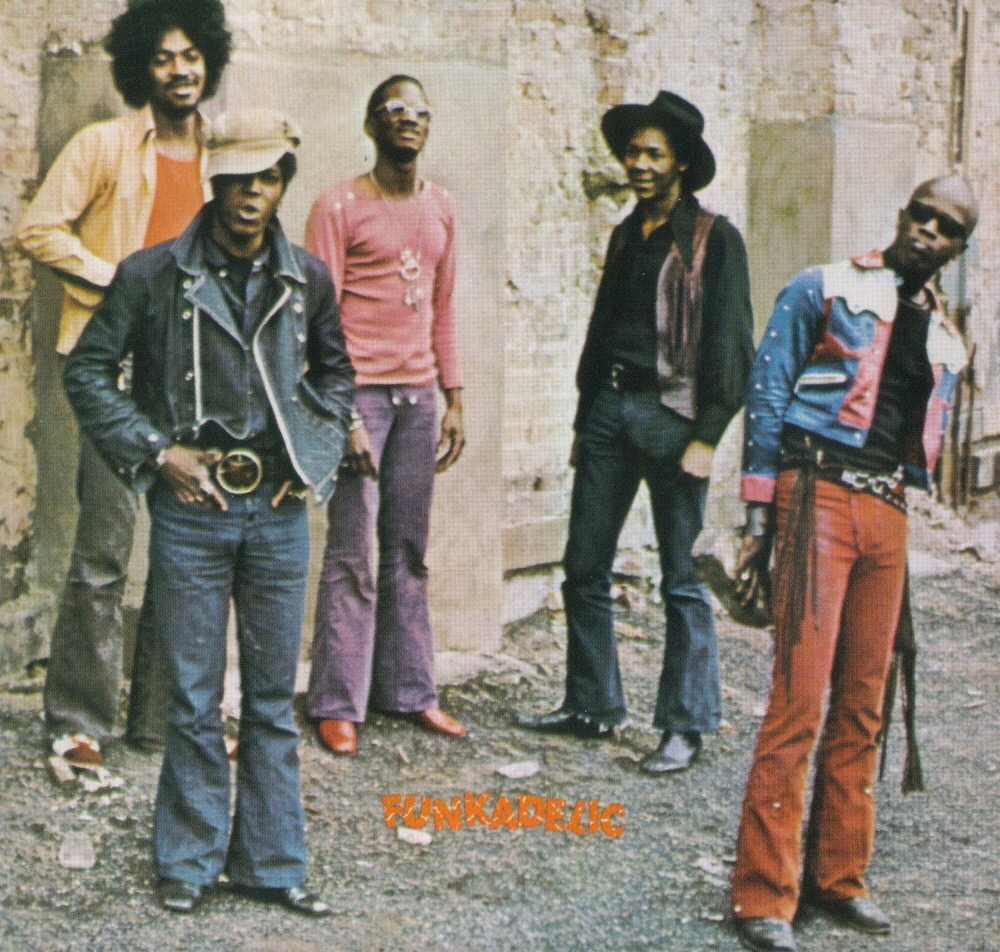
There is no sharp suited foursome instructed to smile into the camera for this album sleeve. Instead, we have a picture of a woman’s head emerging from the earth, which is either screaming in agony or laughing maniacally? Inside, there is an image of the band, standing on a bit of spare ground, looking menacingly hip, no doubt tripping on acid. They did a lot of that at the time. Those smiles may not be friendly ones…
There is a macabre myth associated with the inspiration for the album title: that George Clinton’s brother’s corpse had been lying for such a length of time that maggots were found to be found crawling through the eye sockets of his empty skull when his dead body was finally discovered. And death seemed very much on everyone’s minds during the recording sessions for the album. Consider for example, the title track, the album’s most celebrated moment. If this brain-scrambling finger-blistering slice of melancholia is a cathartic experience for the listener, just imagine how it may have felt for its protagonist Eddie Hazel. It is well documented that Clinton instructed him to ‘Play it as if your momma just died.’ Some claim that Hazel only discovered his mother hadn’t died after the recording finished. Whatever the truth, and the bulk of personnel involved in the recording have very little recollection of the event, the result was something extraordinary. An impassioned slow burning guitar that cries, weeps and wails its sorrowful eulogy, is only slowly and gradually released from its agony after a gruelling ten minutes. While Hazel sounds on his knees his guitar knocks asteroids off their courses. I imagine the walls of the recording studio sweating blood by the end, the guitar shrivelled up like a piece of dead fruit after it’s exertions. Stylistically, the track could be interpreted as an homage to Hendrix who had died shortly before recording sessions for the album began, but the moment belongs to Eddie Hazel. When Hazel died in 1992, fittingly the song provided the soundtrack at his funeral.
While Hazel was digging Hendrix, there were other influences that shaped the band’s sound, most obviously the rhythmic funk of James Brown and Sly Stone. Listen to ‘Can You Get To That’ or ‘Hit It And Quit It’ where the positive Family Stone influence is at its most bold and infectious, if made even more flamboyant by Bernie Worrell’s intensified keyboard work. On ‘Super Stupid’ Hazel amplifies the decibels with an even heavier sound – George referred to it as ‘a louder Temptations, The Temptations on acid’ – on a song that tells the story of a fatality caused by mistaking heroin for cocaine.
The ten minute finale, ‘Wars of Armageddon’ is the strangest of trips – percussive anarchy, frenzied axe-grinding, bubbling organ, screaming, freedom chants, airport announcements and ridiculously crude lyrics merge together in what sounds like one big Parliafunkadelicment orgy. One can divine its influence in the abstract Afro-funk of the title track to Miles Davis’ fabulous ‘On The Corner’, released the following year. It also anticipates the real party to come, aboard that Mothership…
Has there ever been a more fitting name for a band than Funkadelic? Says it all really. Perhaps if Roxy Music had been called Glam Art Trip or if Kraftwerk had simply been dubbed The Robots. In the evolutionary development of Parliament-Funkadelic, and indeed of the music of the period, the album serves as a missing link – both musically and chronologically – between Jimi’s ‘Electric Ladyland’ and Parliament’s aforementioned ‘The Mothership Connection’. There are lots of stopping-off points along the way of course, not just in the Parliament-Funkadelic canon, but this evolution was paralleled elsewhere: in jazz (the post ‘Bitches Brew’ fusion explosion) and in soul [Ernie Isley’s guitar work with The Isley Brothers for example]. Into that melting pot came Clinton and Funkadelic. They partied, preached and pounded, and alongside their monumental guitar solos, they funked it up like nobody else. (JJ)
“We want to put a bit of distance between what we do and the rock’n’roll tradition.”
The Raincoats interviewed by Greil Marcus
The Raincoats initially formed after Gina Birch, inspired by the chaotic energy of The Slits, teamed up with guitarist Ana Da Silva in 1977. An all-female line up was completed the following year with classically trained violinist Vicky Aspinall, and drummer Palmolive jumped ship from The Slits. It was this line up that recorded the ramshackle and scratchy debut album for Rough Trade. However, following its release, Palmolive left, forcing the band to write songs for the next album without a drummer. Just as losing a drummer allowed Spacemen 3 to make the minimalist masterpiece that is Play With Fire, this seems to have freed up their sound, and coupled with the purchase of a bunch of exotic instruments from a visit to New York, and the punk practice of swapping instruments helped to push their songwriting into uncharted territory.
In Simon Reynolds excellent Rip It Up And Start Again, Gina Birch is quoted saying “You couldn’t find a band that rehearsed more than we did, but we always fell apart. We always pushed ourselves a little bit beyond where we were capable of playing”. Listening to Odyshape now, 34 years after it was released and 18 years after I first heard it, just makes me wonder why more bands can’t or won’t push themselves that far, when reaching beyond their abilities resulted in a record that is sparse and spiritual, and almost completely uncategorisable. At the time the NME bemoaned the fact that there were no musical comparisons to be made, not even to their previous album. The Raincoats were now walking through a different musical terrain.
The influence of everything from folk, punk, reggae, krautrock (Can circa Ege Bamyasi) to all kinds of ethnic music can be heard throughout, but each sound is woven into the fabric of The Raincoats music so perfectly it never sounds like genre tourism that occasionally plagues music post eighties. Everything here sounds like Raincoats music, just not the Raincoats that had played on the first album. The use of such un-rock instruments as sruti box(?), claves, kalimba, timpani, balafon, ektare and finger symbols sets this record apart from many of its contemporaries and closer to the wyrd atmosphere of records like Dr Johns’s spook-fest Gris Gris or Tim Buckley’s free folk’n’jazz Lorca. Perhaps the appearance of Rough Trade label mate Robert Wyatt on a couple of tracks should give us a clue to the difference in sound from the first album. Maybe Gina Birchs involvement alongside Swell Maps Epic Soundtracks in the Red Crayola was an influence.
So is there any point in trying to describe an album that is as difficult to pigeon hole as this? I think there is.
Shouting Out Loud is a frantic Countess From Hong Kong, bass and drums circling like crows around intense passages of violin and guitar duels. The lack of drums on Family Treet allows the instruments to push and pull at the tempo as its tale of very english melancholy unfolds. Only Loved At Night builds verses around a killer scratchy guitar riff and chorus around kalimba. The epic Dancing In My Head (“Long, long way to go”) always made me think of Debra Keese’s Travelling without sounding much like it. The opening verse sounds like it’s heaving under a heavy weight while the chorus (“My spirit is dancing in my head and in my heart”) with great piano playing from Vicky Aspinall lifts you somewhere completely out of yourself. I would love to hear Joanna Newsom sing this.
The title track kicks off with a circular chiming guitar riffs around a lyric dealing with body image in magazines. The benefits of writing without a drummer seems most pronounced on And Then It’s Ok where the tempo refuses to settle in one place for too long, the guitar switching from a frantic Feelies strum to almost Dark Star Live Dead picking. Baby Song is Congoman put through Can’s Future Days filter, all shimmering rhythms and heat haze harmonies. There’s an almost Cajun flavour to the violin at the start of Red Shoes. Go Away closes the album in fine punky style even as the violin echoes Kashmir.
Odyshape is as classic as anything released during one of the most fertile periods for British music. Despite people like John Lydon, Sonic Youth and Kurt Cobain heaping praise on the band, it rarely gets mentioned alongside Metal Box or Unknown Pleasures, never mind making those Greatest Records Of All Time lists. Perhaps this is down to its un-rock leanings, or possibly it is down to its influence being harder to trace. I can hear reflections of Vicky Aspinalls violin in Hahn Rowe’s work in Hugo Largo, in P J Harvey at her most English. It doesn’t sound out of place amongst the post 2000 music dubbed New Weird America or freak folk. Whatever. Kim Gordon called their music “defiant in its spirituality without being corny” and that pretty much sums this record up. (TT)
There can’t have been a more unforgiving year in music than 1974. Hardly anything fitted in – its time had either been and gone or was still to come. Glam was over – Bowie and Roxy were still delivering but, post-Ziggy and post-Eno respectively, they seemed in transition and this was doubly so for T.Rex and Mott, as those desperate dirges Teenage Dream and Saturday Gigs testified.
Music had come so far in the previous decade that it could hardly see back to where it had come from and had little idea where it was going. Revival of early rock ‘n’ roll had become big business but these lingering gazes in the rearview mirror at irrevocably lost pre-Vietnam times – embodied by the admittedly wonderful American Graffiti – took eyes off the road ahead. Meanwhile, the idealism of seven or eight years earlier had long since curdled, calcified and ossified but many from these periods were still around yet cut adrift and much of what’s now considered classic from ’74 or thereabouts didn’t even gain enough of a profile to be ignored; what audience was there still left for the ex-singer of the Box Tops and his new band? For the guy who left the Byrds after two years? For the guy who sang The Wanderer and Runaround Sue?
Nor was there yet much of an audience for leather-jacketed bubblegum, played faster and louder than it had ever been before, for Who pasticheurs in suits, nor even for Runyon-by-way-of-Scorsese mock epics set in New Jersey. As for the Stones, the Who themselves and sundry solo Beatles, they had crested, peaked, plateaued and were settling in for Olympian sessions of water-treading. Zeppelin and Pink Floyd had the commercial momentum but, as the planet became barely big enough to accommodate them, the controls were already set for them to hit the wall. And then there were the Bay City Rollers… the truism that you have to know where to look, which has sustained many music fans through barren times, was seldom as true as in 1974.
It was in this blighted, benighted, blasted environment that Sparks made their impact and there was no one smarter, fresher or more zestful to be found anywhere. The calcium carbonate and Camembert Mael brothers, Ron and Russell, had started off in their native California as Halfnelson, named after a wrestling hold, and while the camp theatricality of American wrestling had some resonance with the music they produced, their fine debut for Todd Rundgren’s Bearsville label, and its follow-up , A Woofer In Tweeter’s Clothing – their first as Sparks – cut little ice in a market made for the Allmans and the Dead.
The land where Mick McManus plied his gravelly trade in the ring was in thrall to the aforementioned glam gargantuans and had just embraced Lou Reed – if not yet the Velvets – so a move for the Maels, avowed Anglophiles both, made palpable sense. Of course, everything took off swiftly after their no 2 hit, This Town Ain’t Big Enough For Both Of Us, a song which, despite the best efforts of some to wreck it through overplay, I simply never tire of hearing. Received wisdom – something I often find myself concurring with but always strive to avoid taking as gospel – has it that parent album Kimono My House was Sparks’ early high watermark but my acquaintance with it at this time was fleeting. Its follow-up Propaganda is often dismissed as a hastily-conceived sequel, arriving as it did just six months later, but it’s the one that found its way into our house, that I had the time to get to know, and which confirmed Sparks as the first band I properly got into.
I was in the early stages of primary school and it helped immensely that children are a recurring theme on Propaganda, stories told with directness and empathy from their point of view, and what could have been objectionably twee in other paws is an endlessly productive grin factory instead, albeit with a sober edge. The message Never Go With Strangers, printed on flyers alongside a ghostly silhouetted figure, was being drummed into us and was as horribly urgent as it’s ever been; on Thanks But No Thanks the Maels characterise the strangers as “The merry band of how-are-yous/In tweedy suits and pointy shoes.” in Russell’s incomparable falsetto, I heard nothing sinister and thought instead of Enid Blyton’s mischievous goblins and brownies, who I always favoured over the all–too-human Famous Five, and as a mesmerising extended fade geared up, I sympathised with Russell’s bewildered infant as he mused: “My parents say the world is cruel/ I think that they prefer it cruel.”
Even so, parenthood is made to sound as much unalloyed fun as childhood on Who Don’t Like Kids, though this is as much down to reassured egos as anything else – the kids are “proof that I’m not just a vegetable” and get to chant the title between a circular riff that would have caused more than a few copies to be checked for stuck grooves. Less gleeful is Aaron, the deserted father narrating BC who, for reasons not fully explained, loses both Betty and Charlie, paradoxically to the most upful, high-kicking melody on an album exploding with the things.
The other most prominent members of Propganda’s cast are flustered would-be suitors. The marauding, propulsive At Home, At Work, At Play recounts the familiar tale of the unattainable girl but this time she’s out of reach not because of mystery or aloofness but because of a relentlessly packed social and professional diary. The extended military metaphor of Reinforcements is characteristically clever, if not quite subtle, but enables the Maels and the piledriving but skilful band they recruited in London to spin another scintillating coda. And there’s real pathos on the album’s first single, Never Turn Your Back On Mother Earth, where brevity – it’s barely two and a half minutes – is no barrier to them executing their most beautiful moment to date, while relating an enigmatic story of emotional chaos and a strange interlude of “three days and two nights away from my friends” before remorse forces temporary abandonment of the wit and smart wordplay: “I’ll admit I was unfaithful/But from now I’ll be more faithful.”
The biggest riot is reserved for Achoo, a song I was warned got loud before I heard it for the first time. A patient bass riff from Ian Hampton and a strangely menacing keyboard fanfare from Ron usher in an epidemic of “La-las with a powrful sting/That’ll stop any opera or any Bing.” Russell once observed that, in true pantomime tradition, the song lent itself to audience participation; by the time the grandstand of mingled Californian and English sneezes is done, quarantine would be strongly recommended.
There can be little doubt that Billy MacKenzie and Martin Fry were listening as closely to Sparks as to their more established contemporaries. Ron’s primitive synths teeter on the edge of Yes-scale pomposity on the closing Bon Voyage, which could redefine every notion you have of bittersweetness, but it was 1974, after all, and Sparks were tossing around incalculably original ideas which helped to ensure pop, or rock if you must, survived its most fraught period to date (PG).

 The New Perfect Collection